

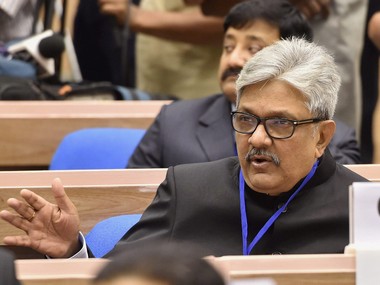
 "KM Joseph's elevation row: Constitution allows president to send back names, but SC collegium's recommendation is binding")
The appointment of Supreme Court judges has been a thorny issue between the Central government and the judiciary with the former seeking a veto power to reject recommendations made to the Supreme Court. The result of this standoff has been the Centre sitting on recommendations far too long, and often returning the recommendations of the collegium for reconsideration.
The latest example is the Centre’s refusal to accept the collegium’s recommendation to elevate KM Joseph, the Chief Justice of Uttarakhand High Court, to the apex court, on which the collegium is likely to have a meeting on Wednesday. In a letter to the Chief Justice of India Dipak Misra, Law and Justice minister Ravi Shankar Prasad gave several reasons including how Joseph is not the senior-most high court judge in India along with citing reasons like lack of representation of several high courts in the Supreme Court such as Uttarakhand, Jammu and Kashmir, Gujarat, Rajasthan, etc, as well as the fact that another justice from Kerala is already a judge in the Supreme Court.
The Centre’s reasons beg several questions, the most important of them being the method or process that has to be followed to elevate a judge to the Supreme Court. Let’s take a look:
The appointment of judges to the Supreme Court falls under Article 124 of the Constitution of India. It gives details about the eligibility criteria and the processes to be followed during the appointment of a judge to the Supreme Court of India.
Section 2 of the Article 124 lists out who and how will be Supreme Court judge be appointed, and when the CJI’s intervention becomes necessary, whereas, Section 3 lists out the eligibility criteria for the appointment of judges. Here’s what they have to say:
Who appoints a judge to the Supreme Court?
Section 2 of Article 124 states:
“Every Judge of the Supreme Court shall be appointed by the president by warrant under his hand and seal after consultation with such of the judges of the Supreme Court and of the high courts in the states as the president may deem necessary for the purpose and shall hold office until he attains the age of sixty-five years:
Provided that in the case of appointment of a Judge other than the Chief Justice, the Chief Justice of India shall always be consulted: (a) a judge may, by writing under his hand addressed to the president, resign his office; (b) a judge may be removed from his office in the manner provided in clause (4).”
The eligibility criteria for a judge is described in Section 3 of Article 124. It says: “A person shall not be qualified for appointment as a judge of the Supreme Court unless he is a citizen of India and: (a) has been for at least five years a judge of a high court or of two or more such courts in succession; or (b) has been for at least ten years an advocate of a high court or of two or more such courts in succession; or (c) is, in the opinion of the president, a distinguished jurist.
The problem
As section (2) and (3) of Article 124 shows, it is very clear that the president of India will appoint judges to the Supreme Court. However, the meaning of “consultation” and whether or not it’s mandatory for the president to accept the views of the judges of the Supreme Court and the high courts has always been an issue of debate.
The topic has been discussed in detail in the popular Three Judges case during which it first held that the Centre had a final say in appointments (1981), then overturned it while hearing the Second Judges Case (1993), thus leading to the formation of the setting up of the collegium system, which is the bone of contention at present.
In the collegium system, the Chief Justice of India and four other senior-most judges of the Supreme Court decide the appointments to the higher judiciary. In 1998, the apex court in the Third Judges Case stated that the Chief Justice of India has to take into account the views of a ‘plurality’ of judges before making decisions on appointments after then-president KR Narayan sought clarification as to if or not consultation with the CJI alone was sufficient. The apex court also expanded to now include four senior-most judges apart from the chief justice of India in appointments.
In 2008, a report of the Law Commission of India questioned the efficacy of the collegium system and sought the return of the original balance of power where the executive had final say in the appointment of judges.
In 2014, the government passed the National Judicial Appointments Commission (NJAC) Bill in both Houses of Parliament and even received the president’s assent on 1 January. The Act brought changes to Article 124 making the NJAC as the sole forum responsible for the appointment of judges in Indian courts. But Justice JS Khehar struck it down in 2015 calling it unconstitutional and void . The government then came up with a Memorandum of Procedure for the appointment of judges in the Supreme Court and the high courts, however, the judiciary sought some changes. The MoP has since then stuck in a limbo.
Collegium’s decision is binding: The method of appointment of judges at present requires that the collegium recommends a candidate, the president either accepts the candidate or sends it back for reconsideration. However, if the collegium still recommends the same candidate, the president has no option but to accept it. So, at present, the decision making power in terms of appointment of judges to the Supreme Court resides with the Collegium.
Despite the Centre’s refusal to elevate Justice Joseph to the Supreme Court, legal experts and former high court judges are of the opinion that the Collegium has a final say in the appointment of judges and its decision is binding on the government.
The Third Judges Case has a relevant para which reads, “However, if after due consideration of the reasons disclosed to the Chief Justice of India, that recommendation is reiterated by the Chief Justice of India with the unanimous agreement of the judges of the Supreme Court consulted in the matter, with reasons for not withdrawing the recommendation, then that appointment as a matter of healthy convention ought to be made.”
The question here is of time. Since the previous orders and the Article 124 doesn’t give a timeframe on the appointment of judges to the Supreme Court, even if Justice Joseph’s name is recommended again, the Centre is free to sit on it as long as it wants.
The Centre has been accused of knowingly delaying appointments by sitting on files for far too long. In fact, in August 2016, former CJI TS Thakur attacked the Centre asking if it wanted to bring the judiciary to a “grinding halt” by sitting on recommendations for so long.
With inputs from PTI





 "Why the Supreme Court has temporarily banned Patanjali ads")
 "President appoints former SC judge as new Lokpal chairperson")
 "What are new changes to India's surrogacy law? Whom will it benefit?")
 "Chandigarh mayor row: Why is the Supreme Court reviewing ballot papers?")
 "Why the Supreme Court has temporarily banned Patanjali ads")
 "President appoints former SC judge as new Lokpal chairperson")
 "What are new changes to India's surrogacy law? Whom will it benefit?")
 "Chandigarh mayor row: Why is the Supreme Court reviewing ballot papers?")