 "India’s condolence diplomacy signals support for democratic stability in Bangladesh")
A series of carefully calibrated diplomatic gestures by India following the death of former Bangladesh Prime Minister Khaleda Zia has triggered a compelling question in South Asian strategic circles: Is New Delhi moving to isolate Nobel laureate-turned-interim leader Muhammad Yunus and his perceived alignment with Islamist forces, while signalling support for democratic and moderate actors in Bangladesh?
The developments come at a time when Sheikh Hasina — Bangladesh’s longest-serving elected leader — remains in exile in New Delhi, following the dramatic political churn that brought Yunus-backed forces to power in Dhaka amid accusations of extra-constitutional manoeuvring and radical mobilisation.
Condolences with a message: India engages BNP leadership
Following Khaleda Zia’s death, India has gone well beyond formal protocol. Prime Minister Narendra Modi not only conveyed condolences, but also wrote directly to Tarique Rahman, who now leads the Bangladesh Nationalist Party (BNP). PM Modi’s message framed Zia as an important political figure whose role in Bangladesh’s democratic evolution could not be ignored.
External Affairs Minister S Jaishankar flew to Dhaka, handed over PM Modi’s letter, and held discussions with Rahman.
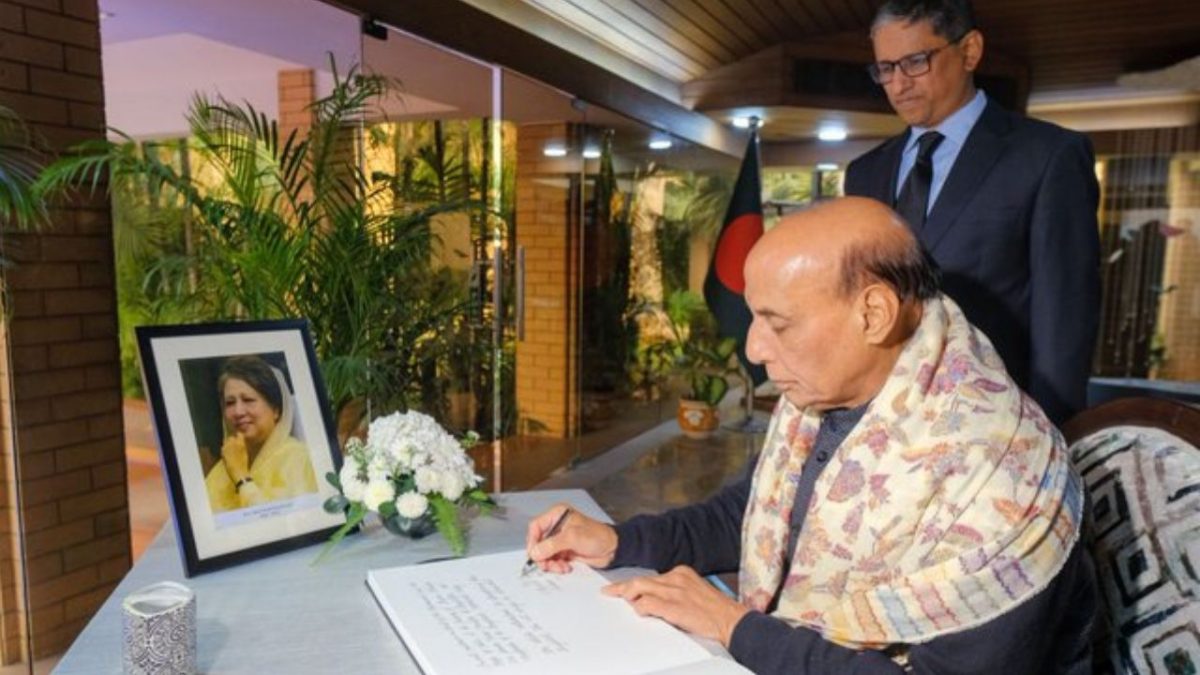
Back in New Delhi, Defence Minister Rajnath Singh visited the Bangladesh High Commission to sign the condolence book, writing on X, “Went to the High Commission of Bangladesh in New Delhi. Signed the Condolence Book expressing our profound sorrow at the passing of former Prime Minister and BNP Chairperson Begum Khaleda Zia. Our thoughts are with her family and the people of Bangladesh.”
Quick Reads
View AllThis marks one of the rare occasions in recent years when India has so explicitly engaged the BNP leadership at such senior levels. A rival of Hasina’s Awami League — the party that led Bangladesh’s fight for liberation from Pakistan with India going to war over the refugee crisis that Islamabad created in 1971 — the BNP positioned itself as a counter-India force in the country.
But after Yunus banned the Awami League from carrying out any political activities, meaning Hasina’s party was disqualified for the upcoming national election, the BNP became the lone pan-Bangladesh democratic party.
The Jamaat and the youth party NCP, which sprang out of the anti-Hasina protests, are not known for their democratic credentials. The Jamaat got the ban lifted on its political activities only after the youth protesters installed Yunus in power in Dhaka. Bangladesh has since then witnessed a surge in Islamist attacks in the country.
Behind the symbolism: Messaging to Dhaka power structure
India’s diplomatic choreography appears to deliver multiple layered signals. First, New Delhi is conveying that India stands with Bangladesh’s democratic actors, even if their politics have historically been complicated. At a time when Dhaka’s political authority is fragmented, India is demonstrating engagement beyond one political faction.
Second, this implicitly questions the political direction under Muhammad Yunus, whose perceived proximity to Jamaat-e-Islami and hardline Islamist mobilisation has raised concerns across strategic establishments in the region.
Indian policymakers and strategic thinkers have spoken with concerns that Yunus risks reopening ideological doors that Bangladesh shut in 1971, when it broke away from Pakistan’s Islamist identity to embrace linguistic nationalism and secular values.
Critics in New Delhi often frame it bluntly: Yunus risks turning Bangladesh into a “Bengali Pakistan” — where Bengali nationalism is subjugated to radical Islamic ideology that has guided Pakistan for decades, and which Bangladesh’s founding fathers rejected.
Bangladesh’s linguistic identity was so strong and its campaign was so pivotal for liberation from Pakistan was so overwhelming that Unesco recognised it in its declaration of February 21 as the International Mother Language Day. It was on February 21 in 1952 several protesters died in the firing by Pakistani police during agitation by students of Dhaka who defied laws seeking recognition of Bengali as an official language.
Third, India’s moves also counter what officials describe as radical ecosystem consolidation around Yunus. The BNP outreach serves as both reassurance and pressure — positioning India as a stakeholder in ensuring that Bangladesh does not drift into ideological destabilisation.
Security signalling and soft pressure
India’s engagement has not been purely political. Earlier, India’s Army Chief General Upendra Dwivedi spoke to his Bangladeshi counterpart Waker-uz-Zaman in what officials described as a “frank security conversation”. Following the interaction, voices in Dhaka — which had earlier taken a sharper rhetorical line — noticeably toned down statements relating to India.
These moves suggest that India is looking for quiet stabilisation efforts over loud geopolitical confrontation. The signal to Dhaka appears clear that New Delhi expects responsible governance, insulation from radical groups and preservation of Bangladesh’s secular, liberation-war-derived identity.
India’s broader worldview on Bangladesh
For India, Bangladesh is not just a neighbour. It is:
a frontline partner against terror networks
a crucial pillar in eastern regional stability
a land and maritime security buffer
a key actor in Bay of Bengal geopolitics
Politically, New Delhi’s red lines appear clear. India has long opposed:
the return of Jamaat-e-Islami into mainstream power structures
attempts to reshape Bangladesh’s identity into a religious-nationalist template
any rollback of 1971’s political ethos
India’s evolving engagements hint at New Delhi’s attempt to build a democratic coalition that can resist ideological hardening in Dhaka and prevent regional destabilisation.
Isolating Yunus without saying so?
India has not publicly taken a stance castigating Muhammad Yunus. Diplomatically, it is keeping its vocabulary measured. But strategic community voices in New Delhi argue that Yunus is playing into the hands of radicals and undoing the foundational separation between Bangladesh and Pakistan.
By reaching out to Tarique Rahman, engaging BNP respectfully, maintaining contact with security institutions, and publicly showing empathy at a moment of national mourning, India is doing something rare: crafting political messaging through mourning diplomacy.
Whether this ultimately isolates the Yunus–Jamaat alliance or simply resets political balance in Dhaka remains to be seen. But India has made it unmistakably clear — it is in any mood to stand by silently if Bangladesh’s secular democratic identity is threatened as this has the potential of triggering a crisis on India’s bordering and in bordering states similar to the early 1970s.
An accidental journalist, who loves the long format. A None-ist who believes that God is the greatest invention of mankind; things are either legal or illegal, else, they just happen (Inspired by The Mentalist). Addicted to stories. Convinced that stories built human civilisations. Numbers are magical. Information is the way forward to a brighter and happier life.