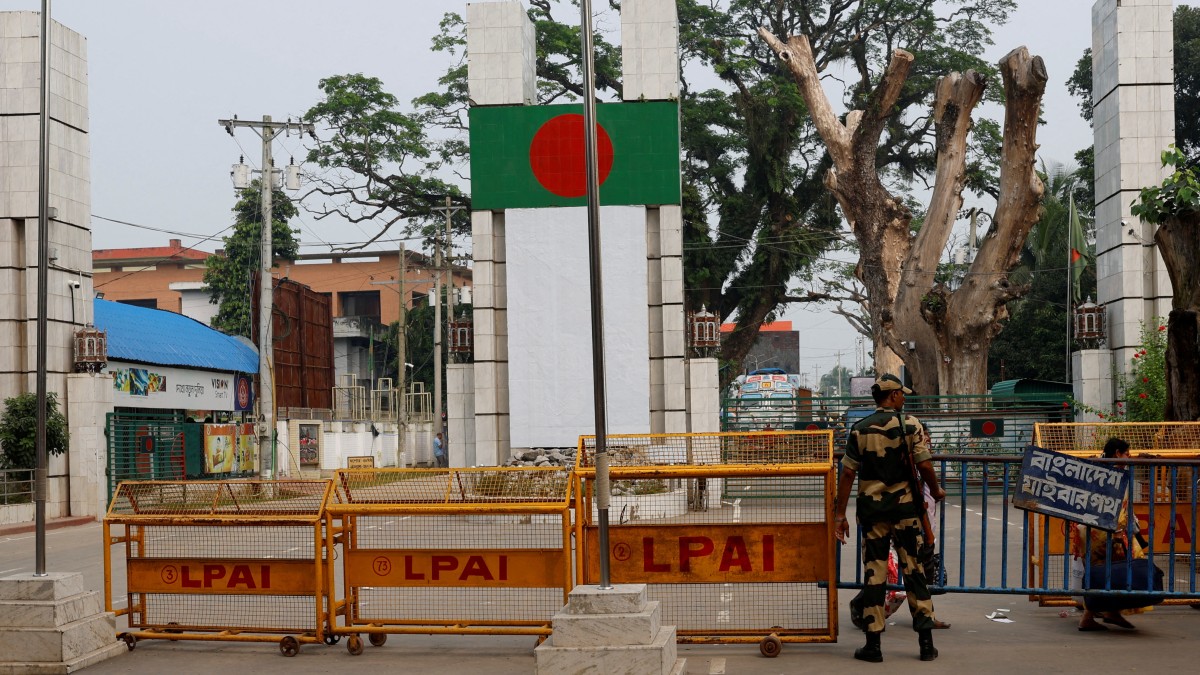
 "A Border Security Force (BSF) official stands in front of the gates of the India-Bangladesh international border in Petrapole, India. Reuters/Sahiba Chawdhary/File Photo")
The ancient Chinese philosopher Lao Tzu had said, “There is no greater danger than underestimating your opponent.” In a recent discussion about whether the evolving situation in Bangladesh poses dangers for India and whether India should attempt a strategic reset, one learnt expert stated rather contemptuously: “A third-rate power like Bangladesh poses a security threat of no consequence to us. A single hypersonic missile hitting Shahjalal International Airport in Dhaka and another hitting the main port terminal of Chittagong are all that will be needed to bring Bangladesh to its knees. It is Bangladesh that should seek a reset of relations, not us.”
Thus, it is not uncommon how many people—even the most learnt ones—forget Lao Tzu’s wise words. No doubt, India is much, much more powerful militarily than Bangladesh. However, military strength is not the only factor that shapes the state of play in relations between nations.
The fact that India faces a delicate and evolving chapter in its relationship with Bangladesh is a reality underscored in the recently presented report of the Parliamentary Standing Committee on External Affairs, led by Congress leader Shashi Tharoor. Titled “Future of India-Bangladesh Relationship”, the report says, quoting an expert who deposed before the committee on June 27, 2025: “India faces its greatest strategic challenge in Bangladesh since the Liberation War of 1971. The challenge in 1971 was existential, a humanitarian crisis, and the birth of a new nation. Today, the threat is subtler but probably graver, more serious: a generational discontinuity, a shift of political order, and a potential strategic realignment away from India.”
The report also says that “The collapse of the Awami League dominance, the surge of youth-led nationalism, the re-entry of Islamists, and intensifying Chinese and Pakistani influence collectively marked a turning point,” and adds, “If India fails to recalibrate at this moment, it risks losing strategic space in Dhaka not to war, but to irrelevance.” The report identifies key challenges in India-Bangladesh relations today: illegal immigration, radicalisation and extremism, regional security, and hostile rhetoric against India’s sovereignty and territorial integrity.
Quick Reads
View AllUndoubtedly, the situation in Bangladesh after the fall of Prime Minister Sheikh Hasina in August 2024 poses significant and complex challenges for India. The Awami League government had fostered strong pro-India relations and security cooperation, but the current interim government led by Muhammad Yunus as the chief adviser has provided fertile ground for the resurgence of radical Islamist groups like Jamaat-ul-Mujahideen Bangladesh and Ansar al-Islam, with alleged links to Pakistan’s Inter-Services Intelligence (ISI). There have been attacks on Indian diplomatic missions which have led to the temporary suspension of visa services. Thus, the relations between India and Bangladesh have reached their lowest point in decades.
The continued presence of former Prime Minister Sheikh Hasina in India is an important factor behind the current diplomatic friction. Strong anti-India sentiment in some sections in Bangladesh is currently driven by the perception that New Delhi is propping up Sheikh Hasina by providing her a safe haven in a guarded home in Delhi.
On November 17, 2025, a Bangladeshi tribunal sentenced Sheikh Hasina to death in absentia for “crimes against humanity” related to the 2024 student-led uprising. Bangladesh’s interim administration, led by Muhammad Yunus, has formally requested her extradition multiple times, including a fresh diplomatic note in November 2025. The interim administration has described India’s sheltering of Hasina as “unfriendly behaviour” and a “travesty of justice”. India maintains she arrived under “certain circumstances” for safety and has only “noted” the verdict without committing to extradition. India will not, and should not, extradite her to Bangladesh.
The relations between India and Bangladesh have reached their lowest point in decades. There have been attacks on Indian diplomatic missions which have led to the temporary suspension of visa services. There have also been numerous reports of violence and threats against Hindu and other minority communities in Bangladesh, which has become a major point of diplomatic friction and a source of internal pressure on the Indian government to ensure their safety.
India shares a long, porous 4,096 km border with Bangladesh. Sustained violence against Hindu minorities (over 2,200 reported cases by late 2025) risks a mass refugee influx of illegal migrants into neighbouring Indian states like West Bengal and Assam, straining resources and potentially causing communal polarisation within India.
Instability in Bangladesh also poses a direct threat to India’s strategic “Chicken’s Neck” (Siliguri Corridor), the narrow 22 km land link connecting mainland India to its northeastern states. There is potential for hostile elements in Bangladesh to use proxies to disrupt critical infrastructure like bridges, rail lines, or pipelines within the corridor. Any disruption or security threat in this region could cripple economic activity and compromise national security along the sensitive border with China. Naturally, China’s upgrading of the Lalmonirhat airfield, located near this strategic corridor, has intensified Indian security concerns.
Previously suppressed Indian insurgent groups in the Northeast (such as the ULFA) may find renewed sanctuary in Bangladesh. A less cooperative government in Dhaka may not take action against such Indian insurgent groups, allowing them to re-establish camps and plan attacks from Bangladeshi soil, as was the case in the past. There could be a revival of safe havens and the resurgence of insurgency and terrorism.
Instability in Bangladesh also has an impact on India’s “Act East” policy and will lead to the disruption of strategic connectivity. Bangladesh serves as a strategic gateway for India’s landlocked Northeast, and the current political flux (as of late 2025) has created several roadblocks. It threatens $8 billion worth of Indian-funded connectivity projects such as the Akhaura-Agartala line and the Khulna-Mongla Port rail line, which are vital for the economic development of the Northeast and India’s trade links with Southeast Asia.
There is also the danger of radicalisation spillover. The rise of Islamist groups like Jamaat-e-Islami, Hizb-ut-Tahrir, and Ansar al-Islam creates a direct threat of cross-border radicalisation, particularly affecting the social fabric of West Bengal. Intelligence reports suggest Pakistan’s ISI is leveraging the current situation to re-establish networks in Bangladesh to target India through arms smuggling and cross-border terrorism.
There are also important geopolitical and diplomatic risks. The growing influence of China in India’s neighbourhood is a significant concern. China is actively seeking to expand its footprint in Bangladesh through lucrative infrastructure and defence deals. Leveraging Bangladesh’s economic instability, China is expanding its influence through infrastructure and military cooperation, potentially including naval access at Chittagong or Mongla. As Bangladesh shifts away from its “India-first” stance, India’s strategic space in the Bay of Bengal will diminish, complicating its efforts to counter Chinese influence.
There are also signs of Pakistan-Bangladesh realignment. Pakistan’s Deputy Prime Minister and Foreign Minister visited Dhaka in August 2025, the first such visit in 13 years, resulting in the signing of six agreements. Visa restrictions have been eased and direct flights reinstated to foster goodwill and cultural exchanges. Direct trade between Pakistan and Bangladesh has resumed for the first time in over five decades. Reports indicate a significant growth in bilateral trade since the government change in August 2024, contrasting with a decline in trade with India during the same period.
Both nations are reportedly in discussions with China to form a potential new South Asian regional bloc to replace the dormant Saarc. Reports suggest the revival of Pakistan’s Inter-Services Intelligence (ISI) operational presence in Bangladesh, with intelligence officers operating under diplomatic cover, a development that has raised security concerns in India.
There has also been a surge in military delegation exchanges. Top military officials from Bangladesh, including Lieutenant General SM Kamrul Hassan, Principal Staff Officer of the Armed Forces Division, have met with Pakistan’s top military leadership to discuss enhancing defence cooperation.
Bangladesh’s Navy also participated in the Pakistan-hosted multinational naval exercise “Aman-2025” for the first time in decades. Discussions are reportedly underway for a potential bilateral defence agreement, military contracts and strategic coordination. Bangladesh is exploring the potential acquisition of Pakistan’s JF-17 Thunder fighter jets, which would integrate Dhaka into a broader Pakistan-China technological defence ecosystem.
Against this background, the upcoming national elections in Bangladesh, scheduled for February 12, 2026, present a critical opportunity for a “reset” in India-Bangladesh ties. The elections allow India to move away from its “one-party” reliance on the Awami League and build ties across the political spectrum. The Bangladesh Nationalist Party (BNP), currently the frontrunner, has expressed a desire to strengthen ties with New Delhi and presented itself as a pragmatic, secular alternative.
Senior BNP leaders, including Secretary General Mirza Fakhrul Islam Alamgir and Quazi Moniruzzaman, have publicly expressed a desire for a friendly and strong relationship with India, framing it in terms of mutual need and respect for sovereignty. The BNP is also attempting to shed its former image as a centre-right, Islamist-aligned party. It has officially split with its long-time ally, Jamaat-e-Islami, to position itself as a moderate, liberal, and secular-leaning force.
The BNP’s acting chairman, Tarique Rahman, recently returned to Bangladesh after 17 years in exile and is positioned as a leading candidate for the prime ministership. His return has introduced a potential, though complex, pathway for improving ties with India. Rahman has shifted away from a pro-Pakistan or anti-India stance, adopting a “Not Dilli, not Pindi (Rawalpindi), Bangladesh before everything” approach. This strategy of maintaining “equal distance” from both neighbours is viewed as an improvement over the perceived pro-Pakistan tilt of the current interim administration.
Summing up, India-Bangladesh relations are currently at a tense, critical juncture. India faces major strategic challenges in Bangladesh due to the rise of Islamist groups and increasing anti-India sentiment. The relationship is navigating a complex phase, moving from a strong strategic partnership under Hasina to one requiring careful management of new political realities.
India’s approach should focus on strategic restraint, diversified diplomatic engagement, and the consistent pursuit of mutually beneficial outcomes. The coming months are critical for India to recalibrate its Bangladesh policy, focusing on engagement with moderate elements and addressing security concerns to prevent a deeper strategic loss.
(The writer is a retired Indian diplomat and had previously served as Ambassador in Kuwait and Morocco and as Consul General in New York. Views expressed in the above piece are personal and solely those of the author. They do not necessarily reflect Firstpost’s views.)