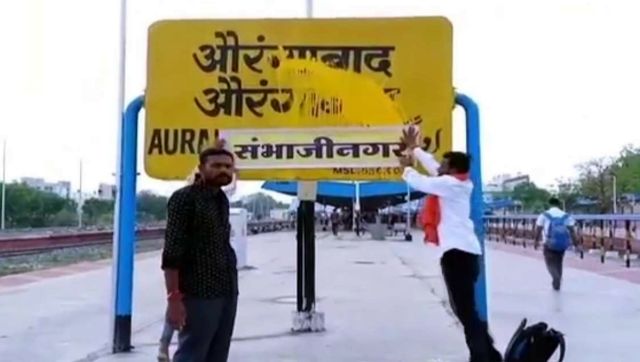
 "Aurangabad is now Sambhajinagar, Osmanabad is Dharashiv: How cities get new names")
The Maharashtra cabinet on Wednesday approved the renaming of Aurangabad city as Sambhajinagar, and that of Osmanabad city as Dharashiv.
Leaving aside the politics and the timing of such a move, let’s take a look at the procedure of renaming cities and states, the cost involved and the history of renaming.
Renaming a state
First, the state legislature needs to pass a resolution for the same. That resolution is then forwarded to the Centre as approval from the Centre’s Ministry of Home Affairs (MHA) is required under provisions laid down in its 1953 guidelines.
This means that a constitutional amendment becomes necessary to affect this change.
The ball is then in the court of the Union Cabinet which can either approve or reject the Constitution Amendment Bill after receiving No Objection Certificates (NOCs) from several agencies such as the Ministry of Railways, Intelligence Bureau, Department of Posts, Survey of India and Registrar General of India.
If the proposal is accepted, the resolution is introduced as a bill in the Parliament which both Houses need to pass by a special majority.
If this is done, the bill becomes a law and the name of the state is changed thereafter.
In July 2019, the West Bengal Assembly had unanimously passed a resolution to change the state’s name to Bangla. However, it went nowhere.
Renaming a city
The decision of renaming a city will again be taken by the state government.
As per Indiatimes, the process for changing the name of a place was outlined a 11 September, 1953, letter by Sardar Fateh Singh, the then deputy secretary in the Ministry of Home Affairs.
Quick Reads
View AllThe letter was addressed to all state governments, instructing them to submit suggestions for name changes based on the broad criteria outlined in the letter.
The letter stated that name changes should be avoided unless there are compelling reasons. The letter also mentioned that all such proposals must be submitted to the Ministry of Home Affairs before any changes are made. The letter asked state governments to keep five parameters in mind while proposing name changes:
It is not good to change the name of a place that people have become accustomed to unless there is a compelling cause.
Village names and other names of historical significance should be preserved as much as possible.
A change should not be made solely for the sake of local patriotism or linguistic reasons (with an exception for martyrs).
It is important to avoid places with the same name in the state or nearby that could cause confusion.
The state shall provide thorough explanations for the proposed name change as well as the new name selection.
Is this a recent phenomenon?
Hardly.
It’s been happening since Independence.
In 1956, the States Reorganisation Commission recommendation led to the creation of linguistic states, including renaming of existing ones through the Seventh Constitution Amendment Act.
Kerala was one of the new states so created after merging Travancore-Cochin and adjoining areas. Madras was renamed Tamil Nadu in 1969 and Mysore state was renamed Karnataka.
The 1980s and 1990s saw a fresh wave of renaming big cities.
Here are a few examples:
Bombay became Mumbai
Madras was renamed Chennai
Calcutta was changed to Kolkata
Baroda to Vadodara
Trivandrum back to Thiruvananthapuram
Calicut was renamed Kozhikode
Tuticorin was again Thoothukudi
Ootacamund or Ooty was changed to Udhagamandalam
What about the cost of renaming a city?
As per Indiatimes, the cost of renaming a city includes the cost of repainting street signs and making civic corporation names consistent with the city’s name.
The Corporation of Madras, for example, was renamed Chennai Municipal Corporation. Kolkata Municipal Corporation replaced Calcutta Municipal Corporation.
However, the renaming of a city does not necessitate the renaming of other public and private establishments. The High Courts in Kolkata, Mumbai, and Chennai are still known as the Calcutta High Court, the Bombay High Court, and the Madras High Court, respectively.
With inputs from agencies
Read all the Latest News , Trending News , Cricket News , Bollywood News , India News and Entertainment News here. Follow us on Facebook , Twitter and Instagram .