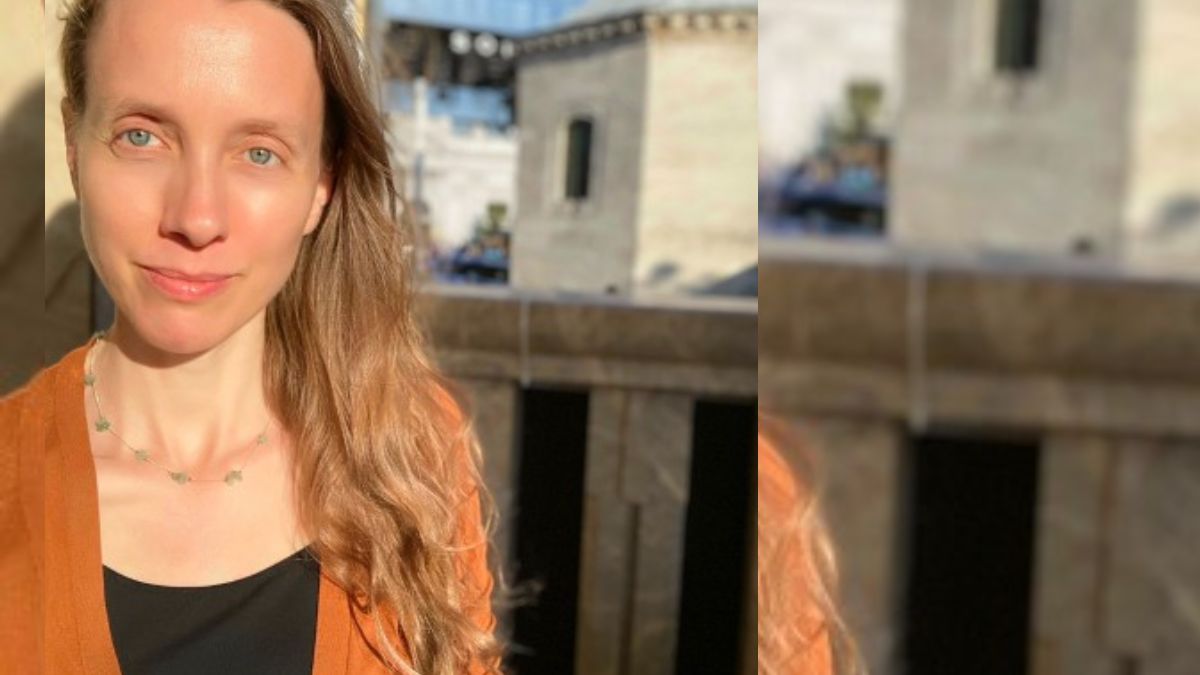
 "Kittleson is an independent journalist based in the Middle East. Her work has been contributed to multiple publications over the last decade. Image courtesy: LinkedIn/Shelly Kittleson")
Shelly Kittleson, an award-winning American journalist, was kidnapped in Baghdad, Iraq’s capital, on Tuesday evening (March 31). Iraq’s Interior Ministry has confirmed that the government security officials have started operations to trace her and track down the abductors.
One suspect has been arrested, and a vehicle has been seized, according to the Iraqi ministry. The suspect is reportedly a member of the Iran-allied Kataib Hezbollah.
Dylan Johnson, a senior US State Department official, asserted that the department is aware of the “reported kidnapping of an American Journalist in Baghdad, Iraq,” but he did not mention or identify Kittleson by name.
We take a look.
Who is Shelly Kittleson?
An independent journalist based in the Middle East. She has contributed to several publications over the last decade, including Al Majalla, Al-Monitor, ANSA, and RAI Radiotre, as well as other freelance work, according to Kittleson’s profile.
In her X bio, Kittleson calls herself an “award-winning journalist reporting from the Middle East and Afghanistan.” She also mentions additional work not listed on her LinkedIn account, including Foreign Policy, BBC World Service, New Lines Magazine, and Politico.
Kittleson’s New Lines Magazine biography notes that she reports on “issues related to security, conflict, and post-conflict in the Middle East and its environs.” AI-Monitor states that Kittleson is known for “her courageous reporting from war zones in Afghanistan, Iraq and Syria.”
The website also says that Kittleson kicked off reporting from Afghanistan and, over the years, has reported extensively from the ground in Syria and Iraq.
According to the Italian Institute for International Political Studies, in 2017, Kittleson won the coveted Italian journalism award, Premio Caravella, for her war-zone reporting, the USA Today reported.
How was Shelly Kittleson kidnapped?
The American Journalist was kidnapped on a busy street in central Baghdad. The New York Times (NYT) reported, citing two senior security officials, that abductors quickly drove away with her in a convoy of two cars.
Authorities, informed by witnesses about the kidnapping, traced the vehicles to a highway outside the city and attempted to chase them down, according to the officials.
The car carrying Kittleson overturned during the chase; however, abductors quickly removed her from the wrecked vehicle and put her in the other car, reportedly. Eventually, they managed to escape from the wrecked vehicle and put her in the second car.
The Associated Press (AP) reported that two cars were involved in the kidnapping of the US journalist. One of the cars crashed and was nabbed on the spot, while the second car fled with the journalist, making its way toward the south of Baghdad.
A video aired by Al Arabiya, whose authenticity could not be independently verified by Firstpost, shows the early moments of the alleged kidnapping. In the clip, armed men stop Kittleson’s car on a busy street, pull her out, and escape.
Barbara Kittleson identified herself as Kittleson’s mother. Barbara provided Kittleson’s age as 49 when asked by the Times on the phone on Tuesday (March 31). She said that she heard from her daughter the previous week.
What did Iraq’s Interior Ministry say?
“Security forces immediately launched an operation to apprehend the perpetrators, acting on precise intelligence and through intensive field operations, tracking the kidnappers’ movements,” said the interior ministry statement translated from Arabic.
“The pursuit resulted in the interception of a vehicle belonging to the kidnappers, which overturned as they attempted to escape,” it added.
The ministry did not immediately identify the suspect and called the kidnappers “unknown individuals”.
The statement furthered, “The Ministry affirms that efforts are ongoing to track down the remaining perpetrators and secure the release of the abducted woman, and to take due legal action against all those involved in this criminal act, in accordance with the law.”
An Iraqi official confirmed to the BBC’s US partner CBS that “top-level efforts” are underway to secure Kittleson’s release.
Was Shelly Kittleson on the hit list of abductors?
Kittleson’s emergency contact, Alex Plitsas, a CNN national security analyst and senior fellow at the Atlantic Council, said that Kittleson was already warned by the Federal Bureau of Investigation (FBI). According to Plitsas, US officials said that her name appeared on Kataib Hezbollah’s plans to “kidnap or kill” her.
Plitsas described himself as a friend and her point of contact with US authorities in the case of an emergency. He said that her name was on a list in Kataib Hezbollah’s possession. Despite warnings, Kittleson continued to report and remained in Baghdad.
Another source confirmed she had been informed of a potential risk, but thought it was false information.
What have been the reactions?
“The Trump Administration has no higher priority than the safety and security of Americans,” the State Department said, adding that “due to other considerations and privacy, we have nothing further to share at this time”.
Johnson wrote on X without mentioning Kittleson’s name that “the state department had earlier warned this individual of threats against them.” “It will continue to coordinate with the FBI to ensure their release as quickly as possible”.
“Iraq remains at a Level 4 Travel Advisory and Americans are advised not to travel to Iraq for any reason and to leave Iraq now,” Johnson furthered, blaming Iranian-backed Iraqi militia Kataib Hezbollah for Kittleson’s abduction.
Al-Monitor, a US-based news outlet focused on West Asia that Kittleson contributed to, asserted it was “deeply alarmed by the kidnapping and urged her safe and immediate release.”
“We stand by her vital reporting from the region and call for her swift return to continue her important work,” the publication said in a short statement.
It is yet not clear if the kidnapping was related to the ongoing war in West Asia. However, Iran-backed militias in Iraq have launched regular attacks on US facilities in the nation since the start of the US-Israeli war on Iran on February 28.
The US Embassy has warned of kidnapping threats and urged its citizens to leave the country since the start of the Iran war . Iraqi militias had kidnapped foreigners even before the war began.
Kataib Hezbollah, one of Iraq’s most powerful militias, was also reportedly responsible for holding Israeli Russian Elizabeth Tsurkov, a doctoral student at Princeton University, hostage for over two years.
With inputs from agencies