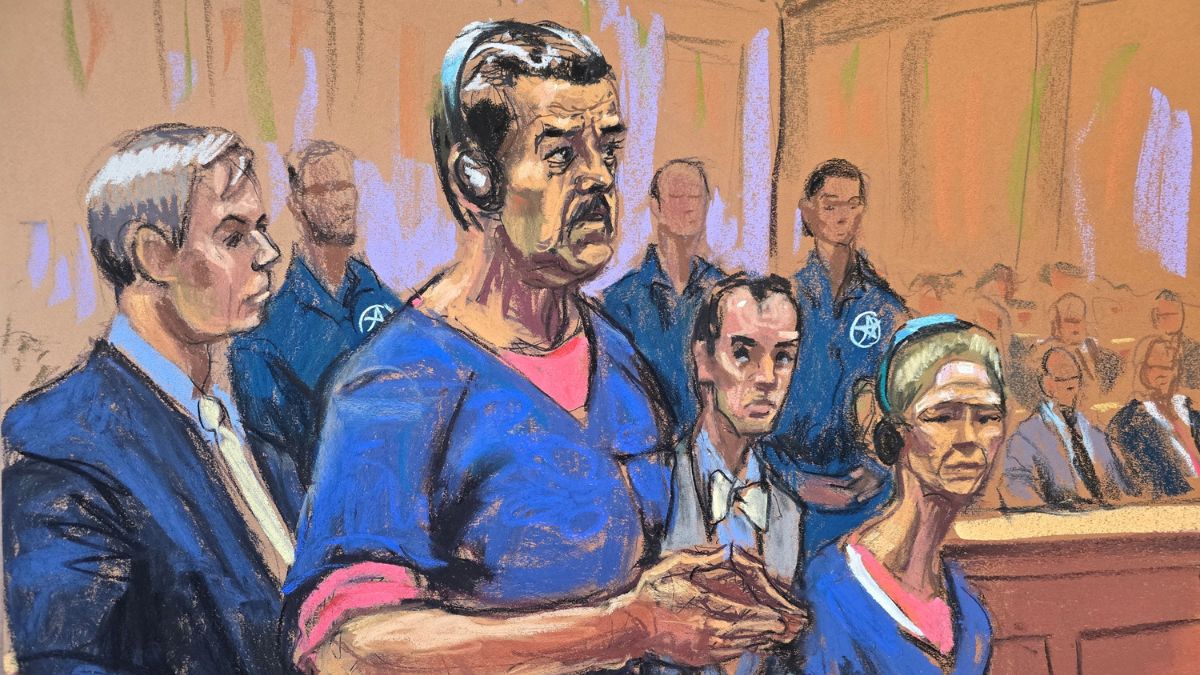
 "Venezuela's captured President Nicolas Maduro and his wife Cilia Flores attend their arraignment with defence lawyers Barry Pollack and Mark Donnelly to face US federal charges including narco-terrorism, conspiracy, drug trafficking, money laundering and others, at the Daniel Patrick Moynihan United States Courthouse in Manhattan, New York City, US, January 5, 2026 in this courtroom sketch. Reuters")
Barry J Pollack, an American defence attorney is representing Venezuelan leader Nicolas Maduro as the former president faces federal charges in Manhattan.
Maduro’s transfer to United States custody following a surprise military operation in Caracas has triggered diplomatic fallout across the globe.
Pollack, a seasoned criminal defence lawyer has a long track record of representing defendants in complex, high-stakes cases involving national security, classified information, and alleged abuses of state power.
How Maduro’s courtroom debut went
Maduro appeared in federal court in Manhattan on Monday (January 5, 2026), marking his first appearance before a US judge since being seized from his residence in Caracas two days earlier.
The former Venezuelan leader, aged 63, entered the courtroom under heavy security, having been transported from a Brooklyn detention facility by helicopter and then driven in an armoured vehicle to the courthouse.
He and his wife, Cilia Flores, were brought into the courtroom shortly before noon, both wearing jail-issued clothing and leg restraints, and both using headsets to follow the proceedings through a Spanish interpreter.
From the outset, Maduro used the hearing to contest the legitimacy of his arrest and detention.
Addressing the court through a translator, he declared, “I was captured,” before later stating his formal plea. “I am innocent. I am not guilty. I am a decent man, the constitutional president of my country.”
At another point, Maduro asserted, “I am here kidnapped since Jan 3, Saturday. I was captured at my home in Caracas.”
His comments were interrupted by US District Judge Alvin Hellerstein, who indicated that arguments related to the circumstances of Maduro’s arrest would be addressed at a later stage. “There will be a time and place to go into all of this,” the judge said.
Hellerstein, a 92-year-old jurist appointed to the federal bench in 1998 by former US President Bill Clinton, sought to establish the defendant’s identity before proceeding further.
“At this point in time, I only want to know one thing,” he told the court. “Are you Nicolás Maduro Moros?”
“I am Nicolás Maduro Moros,” Maduro replied.
Maduro’s wife, Flores, also entered a not-guilty plea. She identified herself in court as “first lady of the Republic of Venezuela” and appeared with visible bandages on her forehead and right temple.
Her lawyer, Mark Donnelly, told the court that she had sustained “significant injuries” during the operation in which she and her husband were taken into US custody.
The charges facing the couple are severe. A 25-page federal indictment accuses Maduro and others of collaborating with drug cartels to enable the movement of vast quantities of cocaine into the United States.
Prosecutors allege that the operation involved violence, including kidnappings, physical assaults, and killings aimed at enforcing debts and eliminating perceived threats.
One allegation cited in the indictment involves the killing of a local drug figure in Caracas. If convicted, Maduro and Flores could face life sentences.
As the hearing concluded, tensions inside the courtroom briefly spilled over. A man in the audience denounced Maduro as an illegitimate leader.
Moments later, Pedro Rojas, a 33-year-old who later said he had been imprisoned by the Venezuelan government, stood up and addressed Maduro directly in Spanish.
As US marshals escorted the former leader out, Maduro responded, “I am a kidnapped president. I am a prisoner of war.”
How Barry Pollack entered the Maduro case
Standing beside Maduro throughout the arraignment was Barry J Pollack, a partner at Harris St. Laurent & Weschler LLP, a boutique New York law firm known for high-profile criminal defence work.
Pollack formally entered his appearance in the case on the court docket later that morning, though it remains unclear when discussions about his representation of Maduro first began.
Pollack immediately signalled the direction of Maduro’s defence, stating that he expected to challenge the legality of what he described as a “military abduction.”
He also argued that Maduro should be entitled to protections associated with his former office. According to Pollack, Maduro is “head of a sovereign state and is entitled to the privileges and immunities that go with that office.”
That argument, however, faces significant legal hurdles. The United States does not recognise Maduro as Venezuela’s legitimate president, particularly following his contested re-election in 2024.
A similar claim of immunity failed more than three decades ago when Panamanian leader Manuel Noriega unsuccessfully attempted to block prosecution after being captured during a US military operation in 1990.
Despite these obstacles, Pollack’s involvement highlights the seriousness with which Maduro’s defence is being mounted.
Pollack is widely regarded as one of the most experienced criminal trial lawyers in the United States, with more than three decades of practice.
In a brief exchange with reporters after the arraignment, Pollack declined to elaborate on his strategy, saying only, “I think what President Maduro said in court speaks for itself.”
What we know about Pollack’s background
A graduate of Indiana University and Georgetown University Law Center, Pollack began his career as a public defender before moving into private practice.
Over time, he developed a reputation for handling cases involving complex factual records, sensitive government information, and intense public scrutiny.
He previously served as president of the National Association of Criminal Defense Lawyers, an influential organisation representing defence attorneys across the United States.
Andy Birrell, current president of the association and a former colleague of Pollack, said the Maduro case fits squarely within Pollack’s area of expertise. “There’s always challenges in high-profile cases, but Barry’s a veteran,” Birrell told NBC News.
“He’s done it before.”
Birrell also offered insight into Pollack’s courtroom style and professional reputation, describing him as both methodical and approachable.
“He’s a person that absolutely reeks credibility,” Birrell said. “I think that Barry’s a person who presents as someone who is trying to get at the truth and people like that, they respect that.”
C Melissa Owen, president-elect of the same organisation, echoed that assessment, emphasising Pollack’s communication skills.
“I would say he has Ivy League intellect with Midwestern sensibilities in terms of being able to communicate with the American public,” she told NBC News.
According to Chambers USA, a widely consulted guide to the legal profession, Pollack is known as a “thorough and deep-thinking lawyer” who “lives, breathes and sleeps trials.”
Pollack’s most recognised case
For more than a decade, Pollack shaped WikiLeaks founder Julian Assange’s legal strategy in the United States, navigating a case that touched on press freedom, state secrecy, and the limits of the Espionage Act.
In 2024, Pollack helped secure a plea agreement that resulted in Assange’s release from prison. Under that deal, Assange pleaded guilty to a single count of violating the Espionage Act related to the publication of classified military and diplomatic documents.
US authorities had accused him of conspiring to unlawfully obtain and disseminate top-secret national defence information, arguing that the disclosures endangered national security.
After Assange’s release, Pollack framed the case as a broader struggle over freedom of expression and the public’s right to know.
“He has suffered tremendously in his fight for free speech, for freedom of the press, and to ensure that the American public and the world community gets truthful and important newsworthy information,” Pollack said.
Legal experts believe that Pollack’s experience dealing with classified evidence and sensitive intelligence matters could prove relevant in Maduro’s defence.
The prosecution is expected to rely on extensive intelligence material related to drug trafficking networks, some of which may involve classified sources or methods.
Pollack has previously represented Jeffrey Sterling, a former CIA officer convicted of leaking classified information to a journalist. That case, like Assange’s, required navigating the intersection of criminal law and national security concerns.
Pollack’s acquittals and overturned convictions
Pollack has represented Michael W Krautz, a former Enron accountant charged with criminal fraud following the company’s collapse.
Krautz was acquitted by a jury, a rare outcome among the many prosecutions that followed one of the most infamous corporate scandals of the early 2000s.
Pollack also played a central role in overturning the convictions of Martin Tankleff, a Long Island man who spent 17 years in prison after being wrongfully convicted of murdering his parents as a teenager.
Pollack succeeded in having those convictions reversed and the charges dismissed entirely.
More recently, Pollack defended a senior executive at a poultry company accused of conspiring to fix chicken prices. In two separate trials, jurors declined to return guilty verdicts.
Reflecting on his work in an interview with the legal publication Lawdragon in April, Pollack spoke about the personal dimension of criminal defence. “Typically, when I meet with a client, they are facing what may be the worst crisis that they have ever faced,” he said.
“At the end of the day, it’s no longer a stranger who I’m seeing get through to the other side of this terrible piece of their life. It’s somebody that I’ve come to know and respect.”
What next
President Donald Trump has openly stated that the United States will temporarily oversee Venezuela following Maduro’s removal, declaring that Washington would “run” the country and “fix it.”
While Trump reiterated that “we’re in charge,” US Secretary of State Marco Rubio adopted a more restrained tone, saying the US would not manage Venezuela’s daily governance beyond enforcing an existing oil quarantine.
Trump has suggested that Maduro’s removal could lead to increased Venezuelan oil exports, but oil prices rose 1.7 per cent following the arrest, reflecting doubts about how quickly production could recover after years of neglect and mismanagement.
Venezuela’s interim leader, Delcy Rodríguez, initially demanded Maduro’s immediate return, describing the operation as an illegitimate act of aggression.
She was sworn in on January 5 by her brother, National Assembly leader Jorge Rodríguez, and addressed the nation with her right hand raised.
“I come with sorrow for the suffering inflicted upon the Venezuelan people following an illegitimate military aggression against our homeland,” she said. “I come with sorrow for the kidnapping of two heroes.”
Later, Rodríguez struck a more conciliatory tone on social media, signalling openness to cooperation with the Trump administration and calling for respectful relations with Washington.
Maduro’s son, Nicolás Maduro Guerra, warned that his father’s detention could have far-reaching implications.
“If we normalise the kidnapping of a head of state, no country is safe. Today it’s Venezuela. Tomorrow it could be any nation that refuses to submit. This is not a regional problem. It is a direct threat to global political stability,” he said.
The United Nations Security Council convened an emergency meeting to discuss the situation.
A senior UN official cautioned that the United States may have violated international law through its unilateral action, while also highlighting Venezuela’s ongoing humanitarian crisis after years of economic hardship.
With inputs from agencies