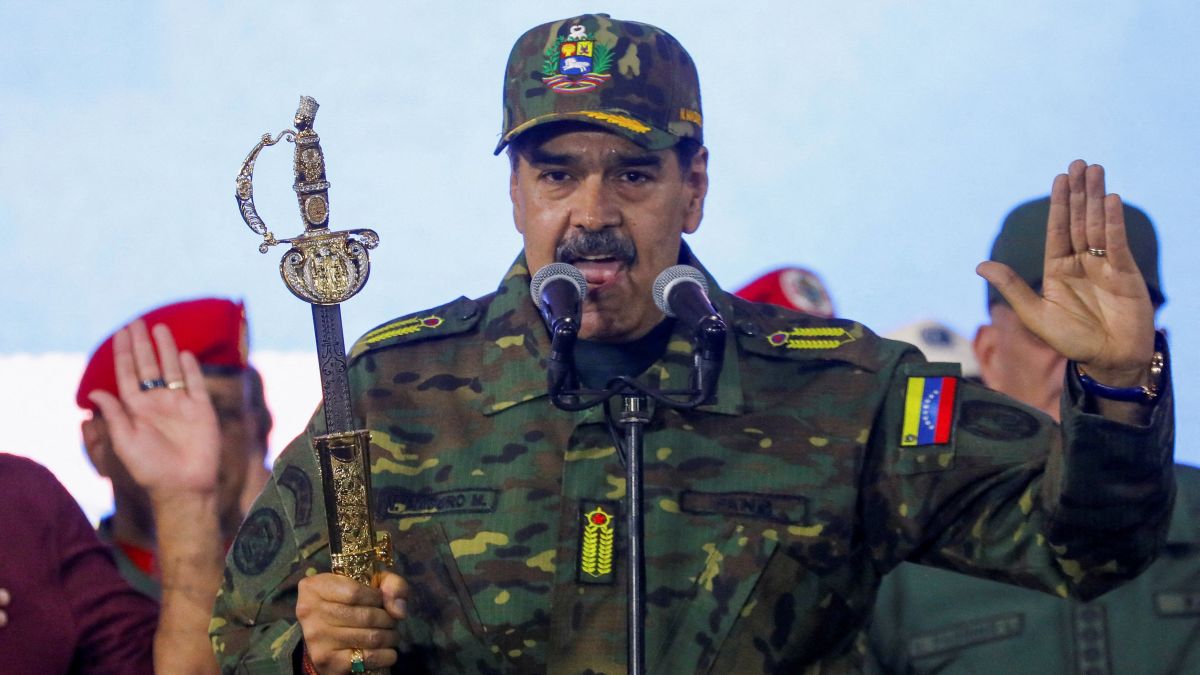
 "Venezuela's President Nicolas Maduro holds Simon Bolivar's sword as he addresses members of the armed forces, Bolivarian Militia, police, and civilians during a rally against a possible escalation of US actions toward the country, at Fort Tiuna military base in Caracas, Venezuela, on November 25, 2025. The US has captured Maduro, who has been indicted in New York on drugs and weapons charges. Reuters")
Nicolas Maduro has been deeply unpopular in Venezuela. But that has never undermined his power. He has been at the helm of the South American country since 2013. But now his reign has seen a dramatic end. The Venezuelan president and his wife, Cilia Flores, have been captured by the US .
On Saturday (January 3), the US conducted strikes in Venezuela . It began with a series of explosions in Caracas, with the Venezuelan government accusing the US of attacking civilian and military targets. Apart from the capital city, three other states – Miranda, La Guaira and Aragua – were targeted.
US President Donald Trump then made the big announcement on Truth Social: “The United States of America has successfully carried out a large scale strike against Venezuela and its leader, President Nicolas Maduro, who has been, along with his wife, captured and flown out of the Country.”
The whereabouts of Maduro and the Venezuelan first lady are not known. However, the Venezuelan leader will stand trial in the US, according to a Republican senator, Mike Lee, who says he spoke with US Secretary of State Marco Rubio. Maduro faces a 2020 indictment on drug trafficking charges.
We look at the rise and the fall of Nicolas Maduro
The bus driver who took the political path
Born in Caracas, Nicolas Maduro is a professed Marxist and Christian. As a teenager, he played guitar in a rock band called Enigma. He is a baseball fan and dances salsa, often in front of cameras.
He was the son of of political activist and joined the socialist league as a student. He began his career as a bus driver and then became a trade union leader. That opened the door to politics.
Quick Reads
View AllAs a union leader gaining prominence, Maduro met Cilia Flores. She was a young lawyer and one of Hugo Chavez’s legal defenders over the 1992 coup attempt. Flores and Maduro visited him in prison.
Maduro began following “chavismo”, the socialist-populist political ideology initiated by Chavez. The leader of the “Bolivarian Revolution” became his political father.
When Chavez became the president in 1999, Maduro entered the National Assembly. He soon rose in the ranks. He served as speaker of the legislature before taking over as foreign minister in 2006 and then vice president.
The succession battle began in Venezuela after Chavez was diagnosed with cancer. Maduro did not have many supporters then. But Chavez, who was battling illness, blessed him to lead the South American country.
“If some unforeseen circumstance should arise that prevents me from continuing as president of Venezuela, my firm opinion, as firm as the full moon, is that, in that scenario, which would require calling presidential elections, you should choose Nicolas Maduro,” said Chavez in December 2012, hours before he travelled to Cuba to continue his treatment, according to a CNN report. The then-president returned to Caracas but breathed his last in March 2013.
Maduro says he did not know why Chavez picked him. But his strong ties with Cuba could be one of the reasons. He built ties with Fidel and Raúl Castro and became a “key player” when Chavez fell ill and travelled to Cuba for treatment. This helped strengthen Maduro’s position to be the successor, the report says.
Maduro and his many controversies and crises
Every election that Maduro has contested since 2013 has been marred by controversy. Questions have been raised not only by the Venezuelan opposition but also by international organisations and allies.
The 2015 parliamentary election was won by the opposition. However, with chavismo and political tricks, the victory was downplayed. After every election came opposition challenges, protests, and even repression and death, documented by the United Nations, according to the CNN report.
But nothing seemed to deter Maduro.
Maduro weathered many threats, imagined and real, including a failed explosive-laden drone attack in 2018 that injured several soldiers. He successfully faced down sanctions after dozens of nations did not recognise his 2018 re-election, focusing on tightening control over the judiciary, legislature, military and state institutions.
He was often aided by close political and economic ties with China, Russia and other international actors that have helped the country stay barely afloat. To deflect blame for Venezuela’s woes, Maduro sustained Chavez’s anti-American conspiracy theories, accusing the United States of plotting to kill him and Western nations of ruining the once-thriving economy.
All the while, he shuttered channels for political dissent, locking up dissidents and challengers with little regard for due process, observers say. The US eased sanctions and other concessions in 2023 after he agreed to hold elections. However, he reneged on the conditions and sanctions were snapped back in April the next year.
To boost his omnipresent real-life persona, Maduro sought to endear himself to a long-suffering population through a popular TV and internet cartoon character in his image. Super-Bigote (Super Moustache) is a caped superhero “at war with imperialism”.
Through all this, Venezuelans remained miserable. There has been a rise in crimes against humanity, and the country’s economy is in a dire state, with its oil export revenue dipping.
Maduro’s popularity also plunged, but somehow he still “won” the 2024 presidential election. Opinion polls predicted a massive loss for Maduro, but he benefited from a wall-to-wall, state-sponsored propaganda drive. He subjected the opposition to a relentless persecution campaign, with dozens of arrests, political disqualification of rivals and non-stop harassment.
In his third term as leader, Maduro was accused of fraud, suppressing opposition and human rights abuses. But he carried on with an iron fist.
The fall of Maduro
The Venezuelan leader overcame many crises, but he could not take on Trump, who continued to undermine his authority.
The US has been ramping up pressure against Venezuela since last January. Trump has accused Maduro of drug trafficking and illegal immigration to the US. In July, the administration announced a $50 million bounty on the president’s head and accused him of being a narco-trafficker.
The US declared Venezuelan gangs such as Tren de Aragua as terrorist organisations and started attacking and targeting boats in the Caribbean Sea for alleged drug trafficking. The Trump administration seized Venezuelan tankers and started building its military presence in the waters near the South American country.
Trump did not mince his words when talking about regime change in Venezuela. In late November, Potus gave Maduro an offer of safe passage out of his country, which he turned down. Addressing crowds in Venezuela, he said he wasn’t going anywhere.
But the pressure from the US continued. The CIA carried out a drone strike on Venezuelan soil, as Trump warned of extending military operations to land.
Then, in the wee hours of Saturday (January 3), the US struck, captured Maduro and his wife.
The future is bleak for Maduro
The Trump administration had earlier designated Cartel de los Soles as a foreign terrorist organisation and has claimed that Maduro is the leader of that group.
The Venezuelan leader is likely to stand trial in the US. In 2020, during Trump’s first term, Maduro was charged in the Southern District of New York for “narco-terrorism,” conspiracy to import cocaine, and related charges.
Trump on Saturday hailed the capture by the US military of Maduro, as his attorney general vowed the Venezuelan leader would face the “full wrath” of American justice.
US Attorney General Pam Bondi said Maduro and his wife, Cilia Flores, had been indicted in the Southern District of New York on charges including “narco-terrorism Conspiracy,” conspiracy to import cocaine, and charges related to machine guns. “They will soon face the full wrath of American justice on American soil in American courts,” Bondi said on X.
With inputs from agencies