

 "What is Camite, the World War-I chemical weapon, Georgia used on protesters?")
Did Georgia use a World War One weapon on protesters last year?
That’s the new allegation a BBC report is making after an investigation into the matter.
An investigation has claimed to have uncovered evidence that the Georgian government used a chemical weapon on its own citizens during last year’s protests in the capital of Tbilisi.
But what happened? And what do we know about Camite?
Georgia halts ascension talks
Prime Minister Irakli Kobakhidze last year announced that the country will stop talks about joining the European Union. This came after the European Union’s Parliament refused to accept the election results in Georgia.
Georgia, part of the erstwhile Soviet Union, witnessed a highly controversial election in October 2024. Though the pro-Russian Georgian Dream party under its leader Kobakhidze was declared the winner of the vote with 54 per cent, many including the Opposition claimed that the election was rigged.
Election observers from a number of bodies including the European Parliament, NATO, Organization for Security and Co-operation in Europe (OSCE), and the European Commission also cast doubts on the election results.
Kobakhidze, the nationalist Prime Minister closely allied with Russia, accused the European Union of ‘blackmail’ and announced that Georgia would no longer seek to join the bloc. This was a widely unpopular decision as over 80 per cent of Georgians polled have approved of the notion. Georgia, which became eligible for EU membership in December 2023, had applied for it in March 2022. The country in 2017 changed its constitution to specifically spell out its goal of joining the EU.
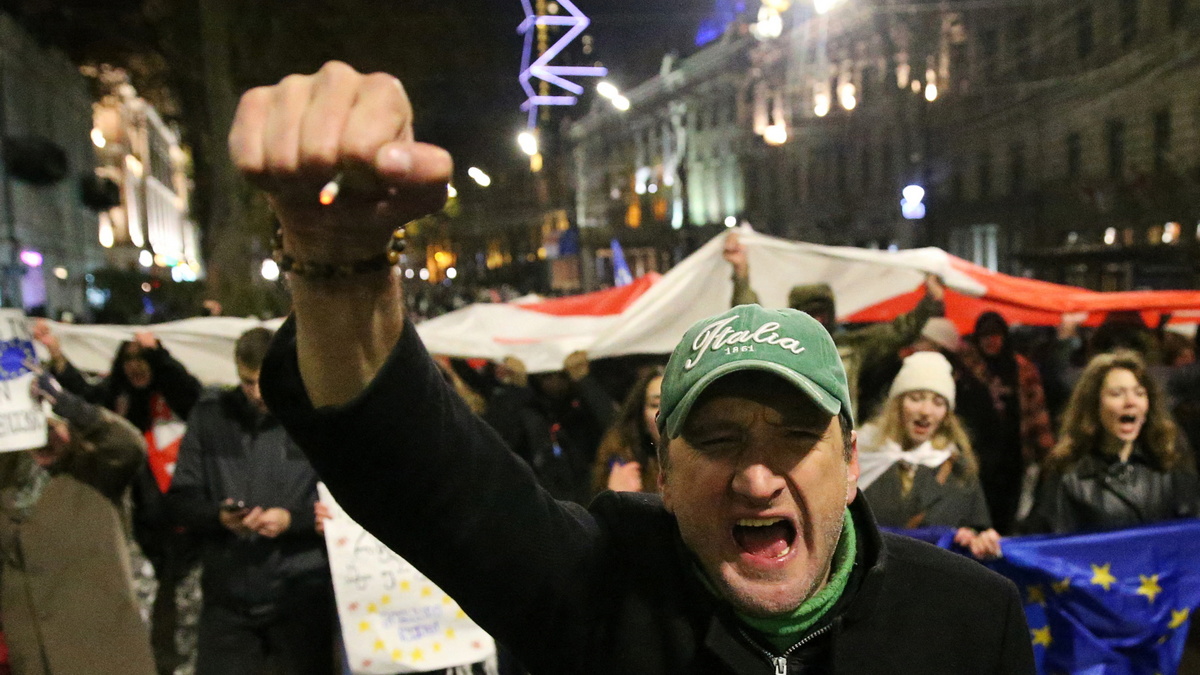
The decision resulted in thousands of people taking to the streets in Georgia, particularly in the capital of Tbilisi.
Camite, the World War-I era weapon
The investigation by the BBC has claimed that the Georgian government used water cannons laced with Camite, a chemical weapon from World War I, on its citizens via water cannons.
The outlet has obtained an internal riot-police inventory identifying two unlabelled chemicals as trichloroethylene and UN3439, a category that includes bromobenzyl cyanide, which is known as Camite.
The chemical agent, which was developed during World War I, was used by French forces at the end of the conflict to conduct riot control. However, its use was abandoned by the authorities after it was discovered to have long-lasting effects on protesters. Under international law, agents used for riot control must only have temporary effects.
Multiple high-level whistleblowers from Georgia’s Special Tasks Department, its riot police, claimed that the chemical was internally tested in 2009. Former department weapons chief Lasha Shergelashvili said it was “probably ten times stronger” than normal tear gas.
“We noticed the effect was not wearing off. Even after washing with water or baking soda, we still couldn’t breathe freely,” Shergelashvili added. He said that despite recommending that it never be used, water cannon vehicles continued to be loaded with the chemical till at least 2022.
‘Burned your skin’
Dr Konstantine Chakhunashvili, who conducted a medical study that interviewed nearly 350 people who participated in the protests, also shared his own results with the outlet.
Chakhunashvili, who incidentally was among those sprayed with water cannons by the police, said that nearly half the protesters suffered long damage (defined as over a month) such as cough, shortness of breath, and skin irritation. Some also witnessed changes to the lungs and heart. The study has reportedly been peer-reviewed and accepted for publication in Toxicology Reports.
A protester told the investigation that his facial skin was irritated for “at least a month” and even offered a picture of his skin peeling. The water “didn’t only get you wet, it also burned your skin”, the protester added.
Professor Christopher Holstege from the University of Virginia says the chemical could be Camite based on the symptoms of the protesters. Meanwhile, Dr Alice Jill Edwards, the UN Special Rapporteur on Torture, has said that this could be classified as an “experimental weapon” that violated human rights law.
However, the Georgian government has dismissed the accusations as ‘absurd’ and deeply ‘frivolous’. The ruling Georgian Dream party insisted that the police acted “within the bounds of the law and constitution” while responding to the “illegal actions of brutal criminals”.
Georgia, meanwhile, has continued to witness protests against its ruling party. Many claim the country is on the fast track to dictatorship after many of the Opposition leaders have been jailed, are in exile, or are facing criminal charges.
Georgian Dream, on the other hand, claims it is protecting the country from Opposition figures who are trying to seize power and foment a catastrophic war with Russia.
With inputs from agencies

 "Jaishankar warns misuse of biological weapons by non-state actors is no longer a 'distant possibility'")
 "In China, you can't even be angry over a fire that killed 151?")
 "Breaking News Live Updates: Lok Sabha adjourned for the day amid opposition's uproar over SIR")
 "Mumbai vs Delhi: Which city has the more toxic air?")
 "Jaishankar warns misuse of biological weapons by non-state actors is no longer a 'distant possibility'")
 "In China, you can't even be angry over a fire that killed 151?")
 "Breaking News Live Updates: Lok Sabha adjourned for the day amid opposition's uproar over SIR")
 "Mumbai vs Delhi: Which city has the more toxic air?")



