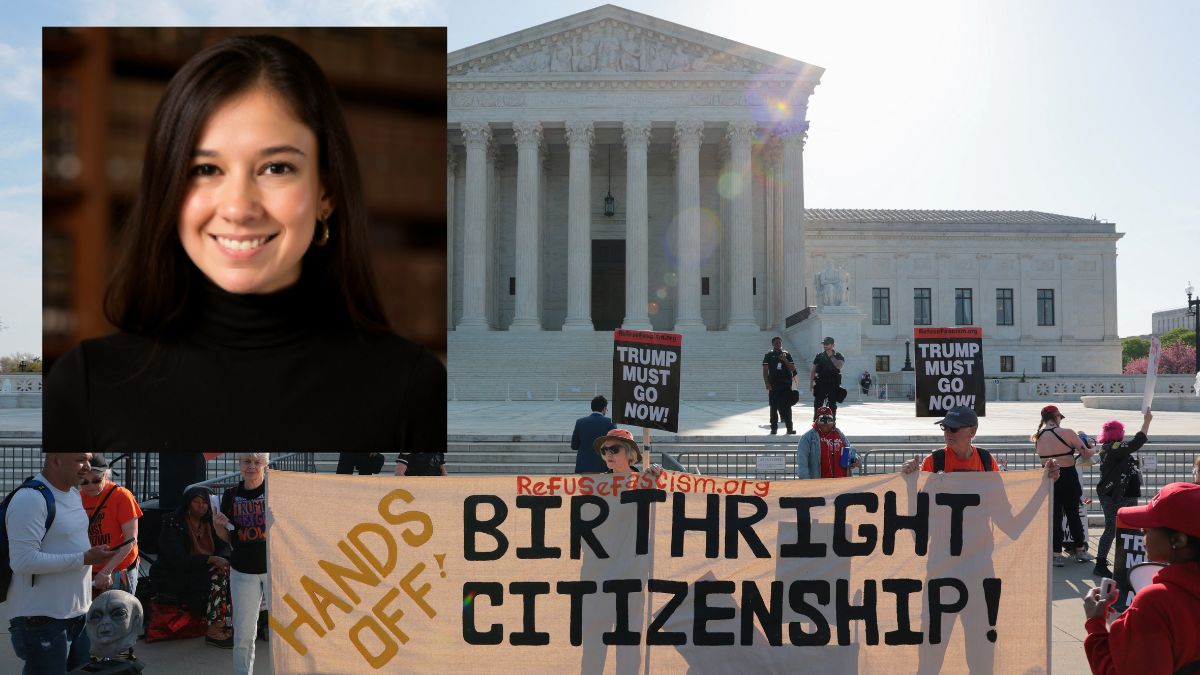
 "Who is Smita Ghosh, Indian-origin lawyer taking on Trump in birthright citizenship battle?")
United States President Donald Trump is attempting to reshape one of the most foundational principles of American citizenship. His push to curtail birthright citizenship has triggered a legal challenge that has reached the US Supreme Court.
As part of the legal resistance to Trump’s policy stands Smita Ghosh, an Indian-origin appellate lawyer whose work has become integral to defending the Citizenship Clause of the Constitution.
While she remains largely outside public spotlight, her legal scholarship and courtroom strategy have made her one of the most consequential figures in this case, officially titled Trump v. Barbara.
Who is Smita Ghosh
Despite the high-profile nature of the case, Smita Ghosh has maintained a relatively low public profile.
However, her academic and professional credentials reflect a deep engagement with constitutional law and legal history. According to her LinkedIn profile, Ghosh completed her undergraduate education in history at Swarthmore College, graduating with high honours.
She then pursued a Juris Doctor at the University of Pennsylvania Carey Law School, where she graduated cum laude.
In addition to her legal training, Ghosh earned a PhD in legal history from the University of Pennsylvania. During her academic career, she was recognised as an Annenberg History Fellow and later as a Benjamin Franklin Fellow, highlighting her scholarly achievements.
Ghosh’s professional trajectory includes a range of roles across academia, public service, and legal advocacy. She currently serves as Senior Appellate Counsel at the Constitutional Accountability Center, a position she assumed in January 2025 after previously working as Appellate Counsel at the same organisation.
Her work at the centre involves engaging in complex constitutional litigation, including the current case before the Supreme Court. The organisation has played a central role in challenging the administration’s policy, including filing an amicus brief supported by scholars from diverse ideological backgrounds.
Before joining the Constitutional Accountability Center, Ghosh worked as a law research fellow at the Georgetown University Law Center. In this role, she contributed to teaching and research on immigration policy, including courses examining how immigration law interacts with different branches of government.
Her research work has explored topics such as the “void for vagueness” doctrine and the history of immigration detention, reflecting a sustained focus on the legal frameworks governing immigration.
Ghosh also served as a Supreme Court Fellow at the United States Sentencing Commission, where she assisted with legal and policy research and contributed to work presented at the Judicial Conference of the United States.
Her responsibilities included drafting guidance related to Supreme Court decisions and sentencing frameworks.
Earlier in her career, she clerked for Judge Victor Bolden in the District of Connecticut, gaining experience in federal court proceedings, including drafting judicial opinions and preparing materials for trials.
Her professional background also includes roles in private practice and civil rights advocacy. She worked as a legal advisor at Berke-Weiss Law and contributed to pro bono and constitutional cases during her time at Paul, Weiss, Rifkind, Wharton & Garrison LLP.
Additionally, she served as a research associate at the NAACP Legal Defense and Educational Fund, where she worked on issues related to civil rights and equality.
A historic day at the US Supreme Court
On Wednesday (April 1), Trump made history by becoming the first sitting US president to personally attend oral arguments before the Supreme Court.
His presence highlighted the importance his administration attaches to the case, which challenges the legality of an executive directive he signed at the very beginning of his second term.
Arriving from the White House in a motorcade, Trump entered the courtroom dressed in formal attire, taking a front-row seat among senior administration officials. He was accompanied by White House Counsel David Warrington and sat alongside US Commerce Secretary Howard Lutnick and US Attorney General Pamela Bondi.
As proceedings began, the traditional courtroom announcement — “Oyez! Oyez! Oyez!” — marked the opening of a session that would carry significant constitutional implications.
Trump remained present through the opening phase of the arguments, listening as his administration’s legal team presented its case.
However, he departed shortly after the opposing counsel began making their arguments, leaving quietly under the protection of Secret Service personnel. In total, he spent just over ninety minutes at the courthouse.
The arguments themselves extended beyond two hours, with justices probing both sides on constitutional interpretation and precedent.
Early signals from the bench suggested hesitation toward the administration’s position, particularly regarding its attempt to reinterpret long-established principles of citizenship.
After returning to the White House, Trump reiterated his opposition to birthright citizenship through social media, writing, “We are the only Country in the World STUPID enough to allow ‘Birthright’ Citizenship,”.
The policy in question
Trump’s directive aims to deny automatic citizenship to children born in the United States if neither parent is a US citizen or a lawful permanent resident, commonly referred to as a “green card” holder.
This marks a significant departure from longstanding interpretation of American law, under which birth within US territory typically guarantees citizenship.
The executive order has already encountered judicial resistance. A lower court last year blocked its implementation, setting the stage for the Supreme Court to evaluate its constitutionality.
According to data from the Pew Research Center, the United States is one of 33 countries that provide unconditional birthright citizenship.
Interpreting the Fourteenth Amendment
The Fourteenth Amendment declares that all persons born or naturalised in the United States, and subject to its jurisdiction, are citizens. Legal scholars widely note that the wording contains no explicit qualifications tied to parental nationality or residency status.
The Trump administration’s argument seeks to introduce concepts such as “domicile” and “allegiance” into the interpretation of the clause. These concepts, however, are not explicitly mentioned in the constitutional text, raising concerns among several justices during oral arguments.
Even members of the court considered aligned with textualist interpretation expressed doubts about the administration’s reasoning.
The emphasis on textual clarity — an approach often favoured by conservative jurists — appears to complicate efforts to justify a reinterpretation that departs from the plain wording.
US Chief Justice John Roberts highlighted this point during the hearing, remarking that although circumstances may evolve, the Constitution itself remains unchanged.
Historical precedents
The courtroom discussions have also drawn heavily on historical legal precedents.
One such case is Lynch v. Clarke. In that case, a New York court ruled that a child born in the United States to Irish parents temporarily present in the country was entitled to citizenship.
The dispute arose from an inheritance claim, where opposing counsel argued that citizenship should depend on the parents’ legal status rather than the child’s place of birth.
The court rejected that argument, affirming that birth within US territory was sufficient to confer citizenship. This ruling has been cited as an early articulation of the principle that the Constitution later enshrined.
Another landmark case frequently referenced is United States v. Wong Kim Ark, in which the Supreme Court confirmed that a child born in the United States to Chinese immigrant parents was a citizen. This decision has long been regarded as a definitive interpretation of the Citizenship Clause.
Ghosh’s legal strategy
In her analysis, Ghosh has emphasised the historical continuity of birthright citizenship, drawing on early American case law to counter modern reinterpretations.
The core of the Trump administration’s argument rests on the idea that the Fourteenth Amendment’s phrase “subject to the jurisdiction thereof” implies a requirement of “allegiance” or “permanent domicile” by the parents.
They argue that citizenship should not be the result of a “mere accidental birth” but rather a reflection of the parents’ political condition.
Meanwhile, Ghosh’s strategy is rooted in the “plain language” of the Constitution and bolstered by historical precedents that predate the Civil War.
Writing for Slate last month, Ghosh pointed to the 1844 New York state court decision, Lynch v Clarke, to illustrate that birthright citizenship was recognised even for children of temporary visitors long before the Fourteenth Amendment was ratified.
In her analysis of the 1844 case, Ghosh explains, “In the 1844 case, Judge Lewis Sandford held that Julia Lynch, the child of Irish parents who was born during their ’temporary sojourn’ in New York, was a US citizen.”
The facts of that case mirror the current debate. Julia Lynch’s parents were visiting the US when she was born, and the court rejected arguments that her citizenship should depend on her parents’ residency status.
The court in 1844 ultimately ruled that she was a citizen by reason of her birth, effectively dismissing the very same arguments the Trump administration is advancing today.
Following the morning session, Ghosh issued a sharp critique of the government’s position via a CAC release.
“At the Court this morning, many justices appeared sceptical of the Trump Administration’s effort to withhold birthright citizenship from children of undocumented or temporarily present parents on the grounds that the Constitution, which grants citizenship to those ‘born in the United States and subject to the jurisdiction thereof,’ exempts those whose parents lack ‘domicile’ in or ‘allegiance’ to the United States.”
Regardless of the final outcome, Smita Ghosh has already secured her place in legal history.
As an Indian-origin attorney part of the charge against a sitting United States president on one of the most contentious issues of the 21st century, her work represents the very “American Dream” that birthright citizenship seeks to protect.
The eyes of America now await the Supreme Court’s ruling, which is reportedly expected by the end of June later this year.
With inputs from agencies

 "Iran Israel War News Live: Indian markets recover from early shock, with Sensex and Nifty returning to green")
 "What happens if Donald Trump pulls the US out of Nato")
 "Iran's Pezeshkian writes to Americans: 'We harbour no enmity towards you'")
 "‘If Pakistan attempts any misadventure, India’s response will be unprecedented and decisive’: Rajnath")
 "Iran Israel War News Live: Indian markets recover from early shock, with Sensex and Nifty returning to green")
 "What happens if Donald Trump pulls the US out of Nato")
 "Iran's Pezeshkian writes to Americans: 'We harbour no enmity towards you'")
 "‘If Pakistan attempts any misadventure, India’s response will be unprecedented and decisive’: Rajnath")