

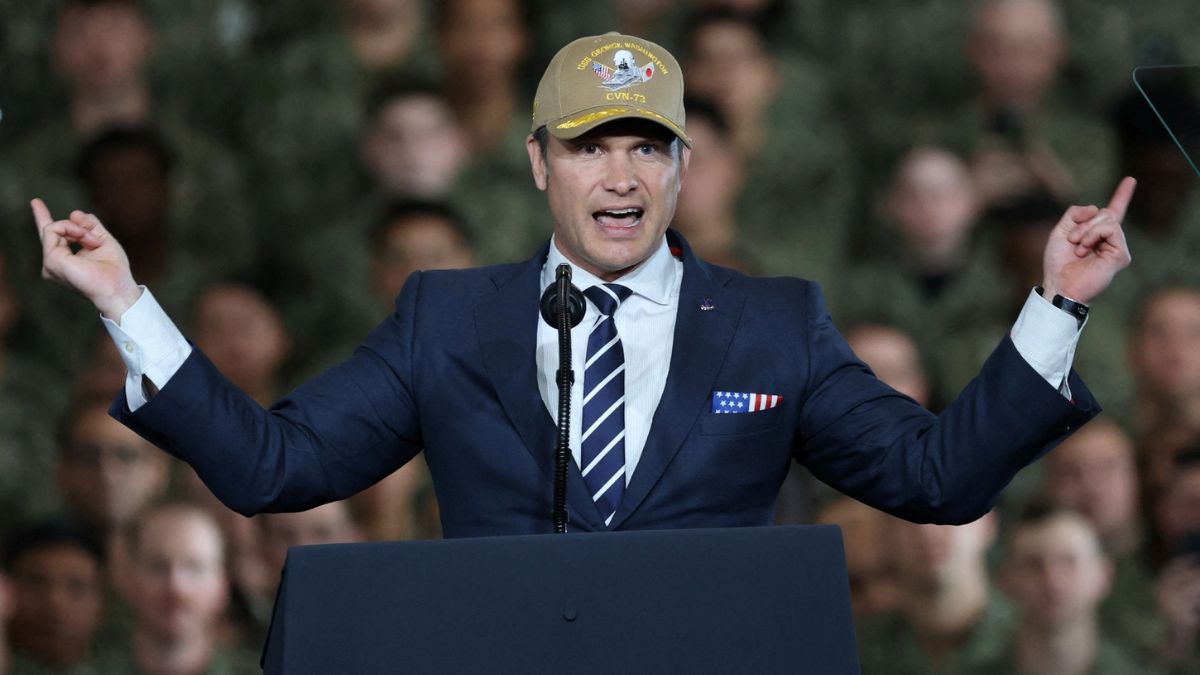
 "'Kill everybody': Did US Defence Secretary Hegseth's order to re-strike Venezuelan boat constitute a war crime?")
A United States military operation targeting a suspected Venezuelan drug-smuggling vessel was conducted in early September.
The mission, carried out by American naval forces, involved an initial precision strike that destroyed a boat believed to be ferrying narcotics, followed by a second strike that allegedly targeted survivors still in the water.
That follow-up attack is now resulting in inquiries from lawmakers of both major parties which are questioning the legality of lethal force at sea.
Although the Trump administration has defended the overall counter-narcotics campaign as necessary to protect US interests, experts have raised alarms about whether the actions undertaken — especially the alleged strike on men who survived the initial blast — may constitute violations of both peacetime and wartime law.
The issue has become even more charged when allegations were reported that US Defence Secretary Pete Hegseth gave a direct instruction to eliminate all individuals on the vessel, an assertion he denies.
How has the White House reacted?
The administration’s public defence of the chain of command began on Monday, when White House spokeswoman Karoline Leavitt addressed questions about the September 2 operation involving US Admiral Frank Bradley.
Responding to media reports alleging that Hegseth had pushed for a policy of leaving no survivors, she clarified that Bradley had explicit approval to execute the strike.
Leavitt stated, “Secretary Hegseth authorised Admiral Bradley to conduct these kinetic strikes. Admiral Bradley worked well within his authority and the law directing the engagement to ensure the boat was destroyed and the threat to the United States of America was eliminated.”
She also argued that the mission was aligned with both domestic and international law, noting that it occurred in open waters and that the administration categorises the targeted groups as foreign terrorist entities.
US President Donald Trump, however, distanced himself from one aspect of the operation. Speaking on Sunday, Trump said he would not have preferred a second attack on the vessel and explained that he had been told directly by Hegseth that he did not instruct anyone to kill the two survivors.
Despite that, a Washington Post report indicated that Bradley authorised a follow-up strike after two men were spotted clinging to remnants of the vessel destroyed in the first attack.
The newspaper also reported that this was done to comply with an alleged verbal directive from Hegseth to “kill everybody.”
The Trump administration has stated that the overall campaign is part of an effort to cut off narcotics shipments originating from or passing through Venezuelan waters.
Since September, at least 19 confirmed strikes have taken place in the Caribbean and off the Pacific coast of Latin America, with fatalities exceeding 70 people.
Other reports suggest the total number of such operations may have reached at least 21, with more than 80 people killed.
Could the strike on survivors be a war crime?
The most serious aspect of the September 2 incident, according to multiple legal specialists, is the alleged decision to attack men who were no longer able to defend themselves.
International humanitarian law has for more than a century made clear that individuals who are shipwrecked or otherwise incapacitated at sea must not be attacked, and are entitled to medical assistance unless they engage in hostile behaviour.
The US Department of Defense’s own manual reiterates this principle, explicitly stating that firing on the shipwrecked constitutes a clearly illegal act.
George Washington University law professor Laura Dickinson, argued that the situation does not meet the threshold for armed conflict — a classification necessary for lethal action to be broadly permissible.
She explained that the operations against suspected drug vessels fall under a different legal framework, telling Reuters, “It would be murder outside of armed conflict.”
She also warned that, even in wartime, killing survivors “would likely be a war crime.”
Michael Schmitt, a former US Air Force lawyer and retired Naval War College professor, expressed disbelief that such an act could ever be justified.
“I can’t imagine anyone, no matter what the circumstance, believing it is appropriate to kill people who are clinging to a boat in the water,” he told AP. “That is clearly unlawful.”
Experts on the law of armed conflict point out that for the United States to claim it is engaged in an armed conflict with drug cartels, the groups in question would need to be operating at levels of violence that pose an imminent and sustained threat to the country.
Schmitt noted that the mere trafficking of narcotics, even if those drugs later cause fatal overdoses, does not constitute the kind of violent behaviour needed to meet the threshold of war.
Brian Finucane, a former US State Department lawyer now with the International Crisis Group, reinforced the point by describing the legal consequences of acting outside wartime norms.
“The term for a premeditated killing outside of armed conflict is murder,” he told AP, adding that US personnel could face charges domestically.
He pointed out that “Murder on the high seas is a crime,” that conspiracy to commit murder overseas is prosecutable and that the Uniform Code of Military Justice includes murder under Article 118.
Matthew Waxman, a professor at Columbia University and former national security official, told AP that the US could face diplomatic fallout if allies perceive the strikes as unlawful.
Countries cooperating with the United States may be unwilling to share intelligence or participate in joint missions if those activities expose them to liability under their own laws or international legal frameworks.
The alleged directive to “kill everybody,” if substantiated, would constitute what is known as a declaration of “no quarter,” an action long prohibited in warfare.
The JAGs Working Group described the alleged instruction as “patently illegal,” and has argued that service members would have been obligated to refuse to carry it out.
The Pentagon’s law-of-war manual itself provides an example directly relevant to the September 2 incident: service members must refuse commands to fire on shipwrecked individuals.
How has US Congress reacted?
Members of both chambers of Congress have demanded thorough investigations into the September 2 incident.
The Senate Armed Services Committee’s chairman, Republican Roger Wicker, and its ranking Democrat, Jack Reed, issued a joint statement announcing that their committee would undertake “vigorous oversight” to establish the facts.
Their counterparts on the House side have also signalled their intent to probe the matter.
The controversy comes at a time when Democratic legislators with military and intelligence backgrounds have recently encouraged service members to resist unlawful commands.
Among these lawmakers is US Senator Mark Kelly, a former Navy aviator. His public comments have not only questioned the legal grounding of the counter-narcotics operations but also triggered a Pentagon investigation into whether he breached military law by participating in a video about resisting “illegal orders.”
Kelly has voiced deep concern about the September 2 reports, saying, “If what seems to have happened, actually happened, I’m really concerned about our service members.”
Not all Republicans have taken a defensive posture. North Carolina Senator Thom Tillis said he was troubled by the allegation of a deliberate second shot intended to kill survivors, noting, “Obviously, if there was a direction to take a second shot and kill people, that’s a violation of an ethical, moral or legal code. We need to get to the bottom of it.”
However, other senior Republicans, such as Senate Majority Leader John Thune have urged patience, stating that the strikes were designed to disrupt the drug trade and asserting that full reviews must conclude before any judgments are made.
For his part, Hegseth has firmly rejected the claim that he ordered the elimination of survivors. On social media, he denounced the reporting as “fake news,” arguing that all strikes were conducted according to the law and approved by qualified legal experts at multiple levels.
He also endorsed Bradley as “an American hero” and affirmed that he has his “100% support” for decisions made during the September 2 operation and others.
What next for US-Venezuela tensions?
In recent months, the United States has increased its pressure on Venezuela, citing what it alleges is the role of President Nicolás Maduro’s government in enabling the flow of illegal drugs to the United States.
Maduro strongly denies any involvement in narcotics trafficking, insisting that Washington’s accusations are politically motivated.
On Saturday, Trump declared that the airspace over and around Venezuela should be regarded as “closed in its entirety,” a statement that caused unease in Caracas and raised questions about potential military escalation.
A day later, he acknowledged speaking with Maduro but provided no insight into their exchange.
Behind the scenes, senior national security officials have discussed a range of strategies aimed at increasing pressure on Maduro’s government.
According to Reuters, options under consideration have included attempts to undermine or remove the Venezuelan leader from power, greater reliance on military assets already deployed in the Caribbean and the authorisation of covert CIA operations in the country.
The recent strikes represent a dramatic escalation for what White House officials continue to describe as a counter-drug mission.
Some experts have questioned whether the sheer level of firepower arrayed in the region aligns with the goals typically associated with narcotics interdiction.
Earlier this week, Trump met in the Oval Office with senior security advisers to discuss Venezuela policy and other foreign policy matters.
Although the administration has provided no public details of the meeting, officials familiar with the session said that the campaign to increase pressure on Caracas was among the topics.
With inputs from agencies

 "Steve Witkoff & Jared Kushner: Trump’s unconventional negotiators pushing for peace in Ukraine")
 "Zelenskyy says Ukraine territory is 'most difficult' issue in US peace deal ahead of his meeting with Witkoff")
 "IndiGo flight diverted to Mumbai after bomb threat prompts emergency landing")
 "Why Indian govt wants smartphone makers to pre-install an app on all devices")
 "Steve Witkoff & Jared Kushner: Trump’s unconventional negotiators pushing for peace in Ukraine")
 "Zelenskyy says Ukraine territory is 'most difficult' issue in US peace deal ahead of his meeting with Witkoff")
 "IndiGo flight diverted to Mumbai after bomb threat prompts emergency landing")
 "Why Indian govt wants smartphone makers to pre-install an app on all devices")



