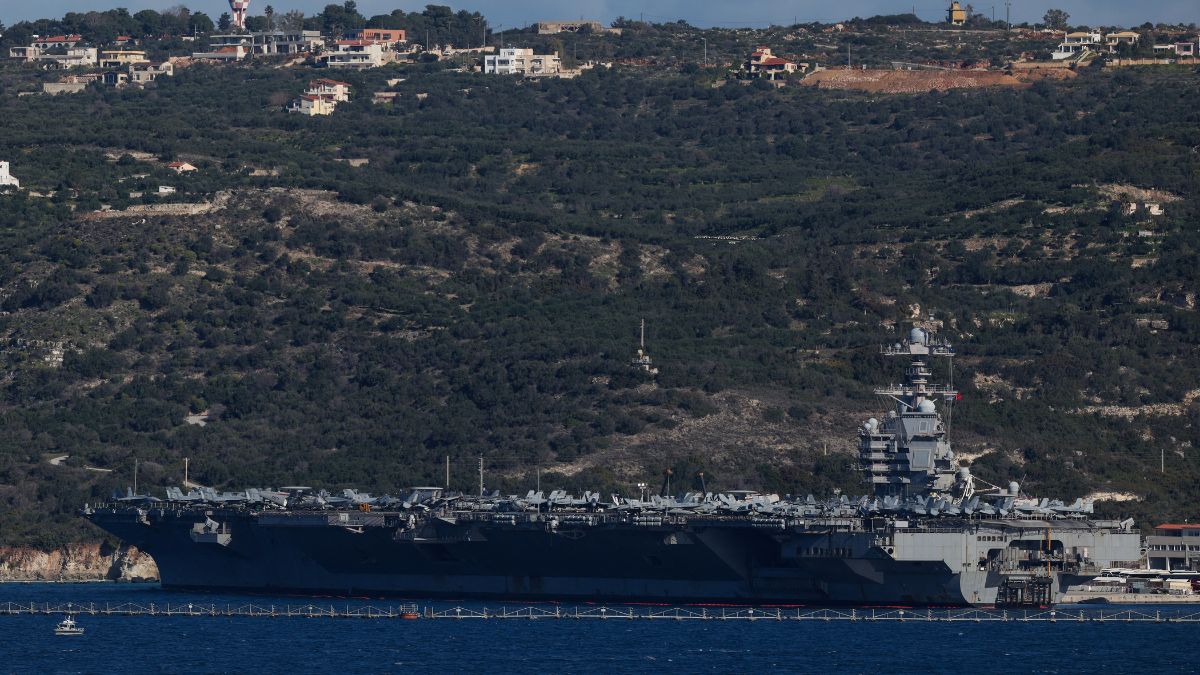
 "Nearly 5,000 sailors, malfunctioning toilets: What’s happening on US’ largest warship amid Iran tensions?")
The United States is preparing for a potential war with Iran, with the largest military build-up in West Asia in decades. The world’s largest warship has been deployed in the region to support any future American airstrikes on Iran.
The USS Gerald R Ford reportedly passed through the Strait of Gibraltar on Friday (February 20), heading east towards the Mediterranean. However, the enemy missile is not the biggest problem for the sailors on board the warship; it is the blocked toilets.
We take a look.
Toilet troubles on USS Ford
The USS Gerald R Ford’s toilet troubles were first reported by NPR in January.
Last June, after the aircraft carrier left its home port in Norfolk, several toilets went out of commission.
According to a 2025 internal engineering memo, dated 18 March, over 205 toilet breakdowns were recorded on the vessel in just four days last year.
The crisis on the US Navy’s $13 billion aircraft carrier reached a point where sailors were forced to wait for 45 minutes in queues to use the toilets.
Ford’s sewage system uses vacuum technology to transport waste from roughly 650 toilets on board, as per The Wall Street Journal (WSJ).
The problem stems from a design and engineering flaw in the vacuum system. Any issue with one head (toilet) can lead to all the toilets in that part of the ship losing suction, reported NPR.
From T-shirts to rope, the crew found different items clogging the toilet. The most common problem was the back of the toilet coming loose.
Any temporary fixes while the ship remains in enemy waters are not possible.
Quick Reads
View AllTemporary repairs, such as acid flushes to dispose of calcium build-ups, can be performed when the vessel is safely docked in US shipyards.
With the warship currently deployed in hostile waters, there is “no prospect” of a permanent fix, as per ThePrint.
The mechanical failure has triggered heated arguments between the crew and the sewage specialists, known as hull technicians.
An engineering head has reportedly complained that sailors are “mistreating and damaging” the system every day.
These hull technicians were working 19 hours a day to detect and fix leaks.
A Navy official told WSJ that the situation is improving and the problems have not obstructed the carrier’s ability to carry out its mission.
ALSO READ: How Iran is preparing for a US strike as nuclear talks continue
Why Gerald R Ford is facing toilet woes
The aircraft carrier USS Gerald R Ford has been at sea since last June. Once it left Norfolk, the problem appeared to have worsened.
In October, the Pentagon rerouted the warship to the Caribbean to support the US seizure of oil-carrying vessels near Venezuela.
Later, the ship was deployed for the US operation to capture Nicolás Maduro, then Venezuela’s president.
The Ford was reportedly slated for repairs at the US Navy’s public shipyard— Norfolk Naval Shipyard, Virginia — this year.
However, earlier this year, the crew was told that their deployment would be extended again, taking them back across the Atlantic Ocean to West Asia, reported WSJ.
During peacetime, carrier deployments are usually six months long, with planners considering a few months of potential overrun if needed, Mark Montgomery, a retired rear admiral, told the American newspaper.
The Ford sailors have been away from home for eight months already, leading to a possible deployment of 11 months, he said.
This would break the record for a continuous deployment by a US Navy ship.
How long deployment affects sailors
With 4,600 sailors on board and multiple toilets not functioning, compounded by a long deployment, the unfavourable conditions are bound to affect the crew.
Many sailors on the Ford are men and women in their early 20s. Some have missed the funeral of close ones, others the birth of their children.
A sailor on board the Ford told WSJ that many crew members are “angry and upset”, with some even considering leaving the Navy at the end of the deployment.
The sailor said she was also strongly thinking about quitting, adding that she misses her toddler daughter.
Weary crews can hurt the entire Navy’s fleet, beyond just the Ford. Last year, the aircraft carrier USS Harry S Truman lost several jet fighters while countering Houthi rebel attacks in the Red Sea. This happened in April and May 2025, near the end of an eight-month deployment. A Navy investigation blamed the increased operational tempo of the operation.
Long deployments can also impact the ships themselves. After eight months at sea, equipment starts to break, while long-planned maintenance and upgrades have to be deferred, disrupting schedules at the shipyards, Montgomery told WSJ. That has a ripple effect on the maintenance and training cycles of other ships.
With inputs from agencies


 "PM Modi Israel Visit Live Updates: PM Narendra Modi lands in Israel")
 "UK’s new travel rules explained: Will Indian travellers be affected?")
 "How a Rs 590-crore fraud unfolded at IDFC FIRST Bank")
 "Why Hormuz, not Fordow, is the real centre of gravity in the Iran crisis")
 "PM Modi Israel Visit Live Updates: PM Narendra Modi lands in Israel")
 "UK’s new travel rules explained: Will Indian travellers be affected?")
 "How a Rs 590-crore fraud unfolded at IDFC FIRST Bank")
 "Why Hormuz, not Fordow, is the real centre of gravity in the Iran crisis")