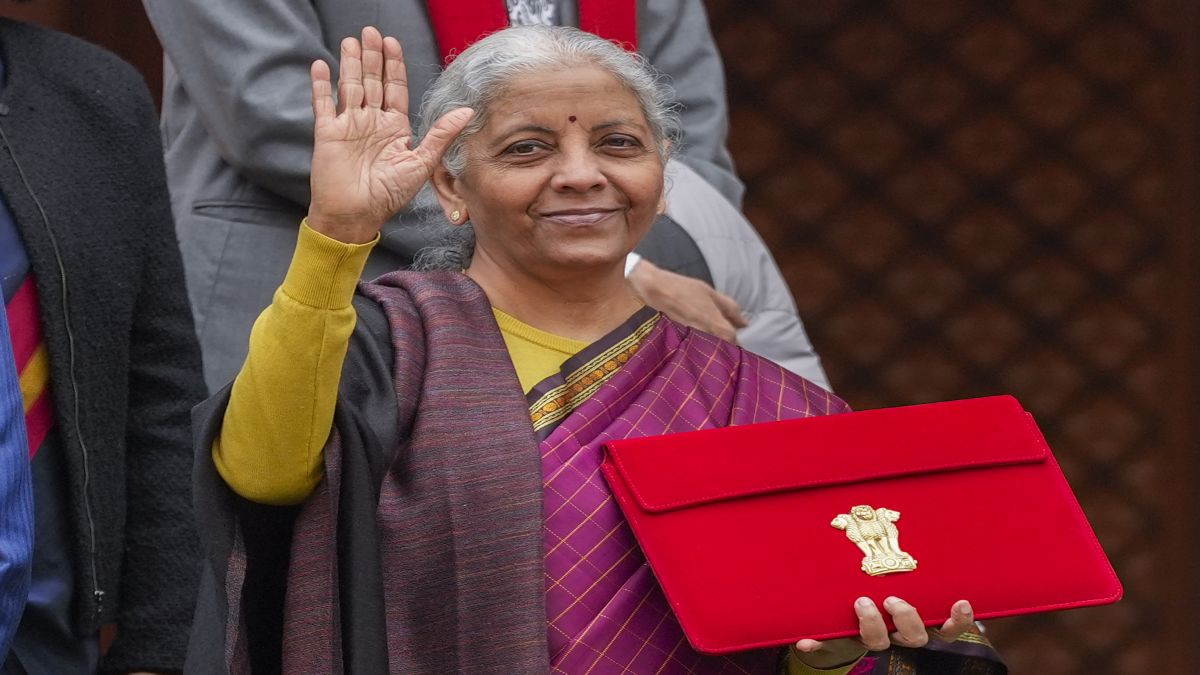
 "Finance Minister Nirmala Sitharaman waves before before presenting the Union Budget 2026-27, in New Delhi. PTI")
After a big bang Sunday — Finance Minister Nirmala Sitharaman delivered her record ninth consecutive Budget speech — the analysis continues.
Prime Minister Narendra Modi hailed the Union Budget 2026-27 as a “strong foundation” for India’s journey towards Viksit Bharat 2047, saying it would provide fresh energy and speed to the ‘reform express’ on which the country is riding.
Speaking to the nation after the Budget speech made in Parliament, PM Modi said, “This Budget is a strong foundation for the flight to the vision of Viksit Bharat 2047. This Budget will provide fresh energy and speed to the ‘reform express’ on which India is riding today. The path-breaking reforms provide an open sky to the courageous, talented youth of India. Our effort has been to continuously strengthen skill, scale, and sustainability.”
Many calls this is a Budget of clear trade-offs. While builders, manufacturers, startups, and small businesses emerge as beneficiaries, certain investor classes and corporates face a more demanding regulatory and tax environment.
Here’s a closer look at the winners and losers of Union Budget 2026.
Infrastructure — Winner
In Union Budget 2026, Finance Minister Nirmala Sitharaman announced that capital expenditure or capex has been raised to Rs 12.22 lakh crore, an increase of 11.5 per cent from Rs 10.96 lakh crore in the previous fiscal year.
This investment will be directed toward expanding and upgrading roads, railways, ports, logistics hubs, and urban infrastructure, sectors that generate employment while strengthening long-term productivity.
Furthermore, in her Budget speech, Finance Minister Nirmala Sitharaman also announced seven more high-speed rail corridors linking key financial hubs and emerging cities like Delhi, Mumbai, Pune, Hyderabad, Bengaluru, Chennai, Varanasi and Siliguri.
A dedicated freight corridor between Dangkuni in West Bengal and Surat in Gujarat has been announced. The government further plans to operationalise 20 new national waterways, reinforcing its push for cost-efficient cargo movement.
Traders — Loser
In the Budget speech, the finance minister announced major changes to the Securities Transaction Tax (STT), proposing a hike in STT for futures trade from 0.02 per cent to 0.05 per cent and raising the STT on options trade to 0.15 per cent.
This move by Sitharaman has been made to curb speculative trading.
Following this announcement, the markets tanked; the Sensex dropped 1,547 points whereas the Nifty plunged 495 points. In fact, the markets saw their biggest one-day fall in six years on Budget Day.
NRIs — Winner
This Union Budget brought a smile on the faces of many NRIs as significant changes were introduced. Firstly, a single Persons Resident Outside India (PROI) can now invest up to 10 per cent in the equity instruments of a listed Indian company, up from the earlier five per cent limit.
Following the Budget, the aggregate investment cap for all such overseas individual investors in a company has also been raised to 24 per cent from 10 per cent.
Earlier, resident buyers had to obtain a Tax Deduction and Collection Account Number (Tan) solely to deposit TDS when buying property from NRIs, even for one-time deals. However, it has now been announced that TDS on such transactions can be deducted and deposited using the buyer’s PAN-based challan, removing the need for Tan registration.
FM Sitharaman also proposed a six-month disclosure window for small taxpayers — including students, tech professionals and relocated NRIs — to voluntarily declare foreign assets and regularise tax compliance.
Bangladesh, Chabahar Port — Loser
The Budget also reflected India’s overseas aid to different countries. While this amount has increased to Rs 5,686 crore, a rise of about four per cent from the previous Budget, there have been some significant changes.
For instance, there’s zero funding for Iran’s Chabahar port project. This comes after allocations of Rs 400 crore in 2024–25 and Rs 400 crore in 2025–26. Also, aid to Bangladesh has also been cut in half from Rs 120 crore. This isn’t a surprise considering how ties between the two nations have deteriorated following the ouster of Sheikh Hasina.
Tech and manufacturing — Winner
India has announced a $4.3 billion outlay for electronic components manufacturing to propel the industry. The Budget also gave special focus to sectors such as semiconductors, rare earth minerals, and biological drugs (biopharma).
One of the biggest announcements from the Budget was the Semiconductor Mission 2.0, with an outlay of Rs 8,000 crore, as the government turns its focus to expand the country’s chip-making ecosystem.
Rare earth minerals also received special attention. The government has announced the development of rare earth corridors in Odisha, Kerala, Andhra Pradesh, and Tamil Nadu. The move comes as China, which dominates global rare earth production, imposes export controls amid its trade conflict with the US.
High net-worth individuals — Loser
High net-worth individuals and investors have been hit by the removal of interest deduction benefits on certain investments. This raises the effective tax liability on select financial products and reduces tax efficiency for affluent investors.
Tourism — Winner
Realising the large role that tourism plays in job creation and forex earnings, Nirmala Sitharaman has paid close attention to the tourism sector in Budget 2026.
The finance minister announced new ‘ecologically sustainable’ mountain trails will be developed as tourist destinations in Himachal Pradesh, Jammu and Kashmir, Uttarakhand, and even the Araku Valley in the Eastern Ghats. She also proposed developing 15 archaeological sites, including the Indus Valley Civilisation sites such as Lothal, Rakhigarhi, and Dholavira, as important ‘cultural tourism destinations’.
The Union Budget 2026 has also made international travel more affordable for Indians. The TCS on international tour programmes will drop from the current five per cent and 20 per cent rates to a flat two per cent, with no minimum amount condition.
Promoters — Loser
The Budget has proposed that the consideration received by a shareholder on buy-back will be chargeable to tax under “capital gains”, instead of being treated as dividend income.
Furthermore, it proposed to provide a differential rate for promoters. The government announced that to “disincentivise misuse of tax arbitrage”, promoters, which are domestic companies, will pay an additional buyback tax, making the effective tax of 22 per cent for corporate promoters. For non-corporate promoters, the effective tax will be increased to 30 per cent.
Textiles — Winner
The apparel sector that was hit by US President Donald Trump’s tariffs have received a boost from this Budget. A proposal to set up mega textile parks, was announced in this year’s Budget.
The Budget also proposed to launch the Mahatma Gandhi Gram Swaraj initiative to strengthen khadi, handloom, and handicrafts, which Sitharaman said would help in global market linkage and branding. “This will benefit our weavers, village industries, One District, One Product initiative, and rural youth,” said Finance Minister Nirmala Sitharaman.
She further laid out a comprehensive five-point plan for India’s textile sector development, which included the National Fibre Scheme, man-made and new-age fibres, a textile expansion and employment scheme, the National Handloom and Handicrafts Programme, and the TEX-ECO initiative, alongside Samarth 2.0 for modernised skilling.
Pharmaceuticals — Winner
One of the biggest gainers of this Budget has been the pharmaceutical sector with Finance Minister Nirmala Sitharaman announcing an outlay of Rs 10,000 crore over the next five years for developing biologics and biosimilars.
It was also announced that the government proposed a scheme to help states set up five regional medical hubs with aims of promoting India as a leading medical tourism destination.
The budget also proposed setting up a network of over 1,000 accredited Indian clinical trial sites.
In conclusion, while the Budget may have seemed not to have any big bang announcements, it seems to be focused on its long-term priorities, pushing the country faster towards a ‘Viksit Bharat’.
With inputs from agencies