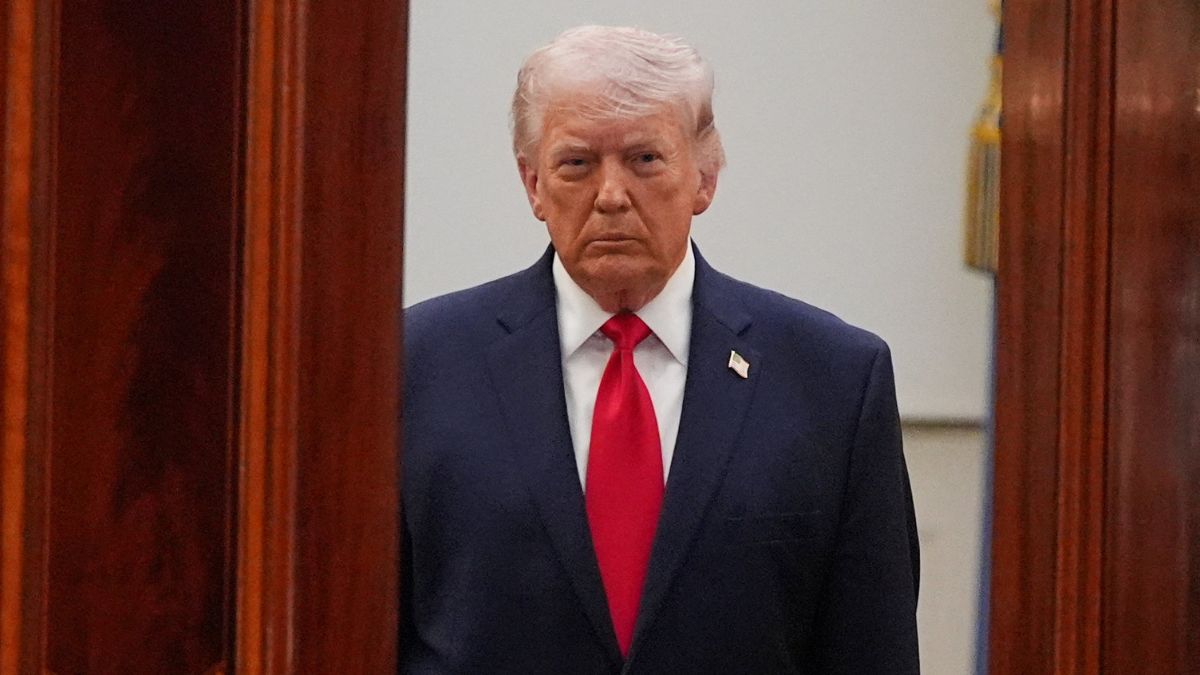
 "United States President Donald Trump arrives from the Blue Room to speak about the Iran war from the Cross Hall of the White House on April 1, 2026, in Washington, DC, US. Image/Pool via Reuters")
In a much-awaited televised broadcast on Wednesday night (April 1), United States President Donald Trump provided a status update on the ongoing military operations in Iran, asserting that the US is on the verge of achieving its primary tactical goals.
The 19-minute primetime speech, his first since the conflict began on February 28, came at a time of mounting domestic unease, volatile global markets, and increasing scrutiny from allies.
While Trump portrayed the US-led military campaign as nearing its conclusion, he stopped short of committing to a clear timeline for ending hostilities, all while facing a domestic public increasingly fatigued by the five-week-old conflict.
He instead signalled that the most intense phase of the aerial campaign may yet be on its way.
The ‘Stone Age’ ultimatum
At the core of Trump’s address was a firm assertion that the United States had made substantial progress in dismantling Iran’s military capabilities.
He stated that US forces had effectively neutralised key components of Iran’s conventional strength, including its naval and air assets, while also significantly damaging its ballistic missile and nuclear infrastructure.
“I can say tonight that we are on track to complete all of America’s military objectives shortly, very shortly,” Trump said. “We’re going to hit them extremely hard over the next two to three weeks. We’re going to bring them back to the stone ages where they belong.”
The US president pointed out that the coming weeks would be critical, signalling that military operations would intensify before any potential conclusion.
This projection of imminent success was framed as evidence of a highly effective campaign, with Trump describing the operation as both “powerful” and “brilliant.”
At the same time, he attempted to reassure Americans wary of prolonged military engagements by placing the current conflict in historical context.
“It’s very important that we keep this conflict in perspective,” he said, before listing the durations of major US wars, including World War I, World War II, the Korean War, the Vietnam War, and the Iraq War.
By comparison, he noted, the current operation had lasted just 32 days.
“We are in this military operation so powerful, so brilliant against one of the most powerful countries for 32 days, and the country has been eviscerated and essentially is really no longer a threat. … This is a true investment in your children and your grandchildren’s future,” he added.
Despite these claims, Trump refrained from outlining a precise endpoint for the conflict.
While he repeatedly suggested that objectives would be achieved “very shortly,” he did not specify when US forces would withdraw or under what conditions military operations would cease.
Threats of escalation
While acknowledging ongoing negotiations, Trump made clear that the US was prepared to escalate its military campaign if Iran failed to meet American demands.
“In the meantime, discussions are ongoing… The new group is less radical and much more reasonable. Yet if during this period of time, no deal is made, we have our eyes on key targets,” he said.
Trump warned that Iran’s critical infrastructure could be struck in the absence of a negotiated settlement. “If there is no deal, we are going to hit each and every one of their electric generating plants very hard and probably simultaneously,” he said.
He also pointed out that certain high-value targets, such as Iran’s oil infrastructure, had not yet been attacked. According to Trump, this restraint was deliberate.
He described oil facilities as “the easiest target of all,” noting that striking them would eliminate Iran’s ability to recover economically. However, the decision not to target them suggested a calibrated approach aimed at maintaining leverage in negotiations.
The Strait of Hormuz
One of the most consequential aspects of the conflict has been Iran’s effective closure of the Strait of Hormuz, a critical maritime passage that facilitates approximately 20 per cent of global oil and natural gas shipments.
The disruption has triggered what analysts describe as one of the most severe energy shocks in recent history, with oil prices surging sharply.
Despite the strategic importance of the waterway, Trump downplayed its relevance to the United States. He asserted that the country does not rely on energy supplies from the region and indicated that reopening the strait should not be a primary US responsibility.
“Go to the strait and just take it, protect it, use it for yourselves,” he said, urging other nations to act. “The hard part is done, so it should be easy.”
He reinforced this position by calling on countries dependent on Gulf oil to take ownership of the situation. “The countries of the world that do receive oil through the Hormuz Strait must take care of that passage,” he said. “They must cherish it.”
Trump also suggested that the strait would “just open up naturally” once the conflict concluded, even as Iran has repeatedly signalled its intent to maintain control over the waterway.
US military forces have not attempted to escort oil tankers through the strait, reflecting concerns about the risks posed by Iranian capabilities.
This approach has raised concerns among US allies, particularly those in the Gulf region, who may be left to manage the consequences of a weakened but still hostile Iran.
Trump also criticised the lack of military support from Nato members, describing their contributions as insufficient. He also indicated that he would consider withdrawing the United States from Nato, further straining relations with traditional allies.
This criticism comes at a time when many Western nations have been reluctant to join the conflict, particularly given that the war was initiated without broad consultation.
Iran’s nuclear programme
While Trump declared significant progress in degrading Iran’s nuclear infrastructure, key questions remain about whether the central objective of the war — preventing Iran from acquiring a nuclear weapon — has been fully achieved.
Iran is believed to retain a stockpile of highly enriched uranium, much of which has reportedly been moved or buried underground following US-Israeli strikes.
In a departure from earlier demands that Iran surrender this material, Trump indicated that he was no longer focused on its immediate removal. Instead, he suggested that the depth at which the material is stored, combined with US surveillance capabilities, reduces its threat.
At the same time, Iran has demonstrated that its remaining military assets — particularly missiles and drones — continue to pose a threat to regional targets, including Israel and US-aligned Gulf states.
Claims of regime impact
Trump also addressed the leadership dynamics within Iran, pointing to the deaths of several top officials as evidence of significant disruption. He characterised the emergence of new leadership as a potential opening for negotiations, describing them as “less radical and much more reasonable.”
He went further to suggest that regime change had effectively taken place due to the elimination of key figures. “All of their original leaders’ death,” he said, framing this as a major strategic achievement.
However, US intelligence assessments indicate that Iran’s governing structure remains largely intact, with successors — including figures from within the existing power hierarchy — assuming control.
In some cases, these new leaders are viewed as more hardline than their predecessors.
How markets & public reacted
Following Trump’s remarks, oil prices surged, with Brent crude rising above $105 per barrel and West Texas Intermediate climbing past $103 per barrel.
The escalation in prices reflects the ongoing disruption caused by the closure of the Strait of Hormuz, which has constrained global supply. In the United States, gasoline prices have exceeded $4 per gallon, adding to domestic economic pressures.
Financial markets reacted negatively to the speech, with stock futures declining and the US dollar strengthening.
Trump acknowledged public concern over rising fuel costs but attributed the increase to Iranian actions. “Many Americans have been concerned to see the recent rise in gasoline prices here at home,” he said.
“This short-term increase has been entirely the result of the Iranian regime launching deranged terror attacks against commercial oil tankers of neighboring countries that have nothing to do with the conflict."
Public opinion polls in the US indicate growing scepticism about the war, with a significant portion of Americans questioning the administration’s strategy.
According to a Reuters/Ipsos poll completed earlier in the week, Trump’s approval rating has fallen to 36 per cent, marking its lowest level since his return to the presidency.
Meanwhile, a separate survey found that 67 percent of Americans believe he lacks a clear plan for handling the situation in Iran.
The timing of the conflict also carries implications for US domestic politics, with congressional midterm elections approaching. The Republican Party faces the challenge of maintaining control of Congress amid shifting public sentiment.
Trump’s advisers have reportedly encouraged him to address economic concerns more directly, but his speech offered only limited reassurance.
With inputs from agencies
Inhaling global affairs on a daily basis, Anmol likes to cover stories that intrigue him, especially around history, climate change and polo. He has far too many disparate interests with a constant itch for travel. You can follow him on X (_anmol_singla), and please feel free to reach out to him at anmol.singla@nw18.com for tips, feedback or travel recommendations