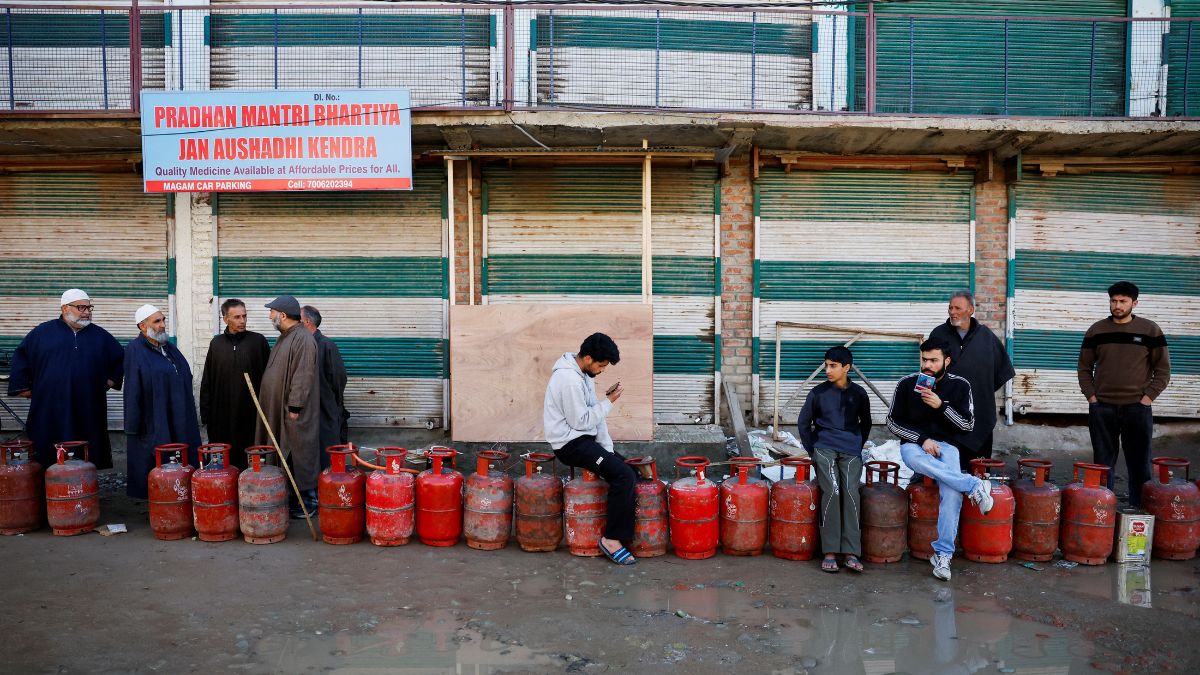
 "People wait in a queue with their empty LPG cylinders outside a gas agency amid supply disruptions following the US-Israeli conflict with Iran, in Magam town, Kashmir, March 13, 2026. Reuters")
The war in West Asia has sent global energy markets into shock. As the US-Israel war with Iran completes two weeks, global oil prices remain high.
India, which imports a significant part of its crude oil and gas from the region, has also been hit hard. Disruptions to the supply of Liquefied Petroleum Gas (LPG) imports from West Asia have spread anxiety.
In a first, a 31-year-old man from Uttar Pradesh, who has been in a vegetative state for over a decade, has been granted passive euthanasia by the Supreme Court. The historic case could set a precedent for similar cases in the future.
Here’s all this and more in our weekly wrap from India.
1. Amid war with Israel and the United States, Tehran has effectively shut the Strait of Hormuz, a vital waterway between Iran and Oman through which a fifth of global oil passes. The halt in shipments has pushed up oil prices globally.
More than 40 per cent of crude oil imported by India passes through the Strait of Hormuz. Over 80 per cent of its LPG imports travel through this narrow chokepoint that connects the Persian Gulf with the Gulf of Oman and the Arabian Sea. Amid a shortage in cooking gas supplies from West Asia, India has increased the prices of LPG cylinders and restricted commercial supply.
Due to this, commercial LPG cylinders used by hotels, restaurants and other sectors have been affected. Many eateries have shuttered down or trimmed their menus to avoid a total suspension of operations. They are also resorting to alternative methods of cooking, including using induction cooktops . Beyond restaurants and hotels, laundromats and autos that use LPG cylinders are also facing a crunch. We take a look here .
Quick Reads
View All2. India is the world’s third-largest consumer of crude oil, depending on imports to meet over 88 per cent of its needs. About half of its natural gas requirements are also met through imports.
India buys crude oil from more than 40 countries around the world, including Russia. However, recently, New Delhi has increased its reliance on West Asia for oil. It is heavily dependent on Qatar for its liquefied natural gas (LNG) needs. Read more about where India’s energy supplies come from.
3. Despite a surge in global oil prices, petrol and diesel rates in India are expected to remain stable, reports say. However, amid disruptions to cooking gas supplies, the government has hiked the prices of commercial and domestic LPG cylinders.
It has also invoked emergency powers, ordering refiners to maximise LPG production and prioritise domestic LPG consumers. Despite the government’s reassurance that households would not be affected by the cooking gas shortage, people have started panic buying. Long queues outside gas agencies have been seen in recent days across cities. People are also worried about a possible scarcity of Piped Natural Gas (PNG) .
This, compounded by restrictions on the commercial LPG supply, has led to black markets flourishing across the country, with cylinders being sold at exorbitant prices. We explain here .
4. In a historic verdict, the Supreme Court approved passive euthanasia for Harish Rana, a resident of Ghaziabad. The young man has been in a vegetative state for 13 years.
In August 2013, Harish, who was then a civil engineering student at Panjab University, fell from the fourth-floor balcony of his paying guest accommodation. Since then, he has been in a coma, with his parents seeing him stay alive with the help of life support. After the hopes of Harish’s recovery dimmed, his parents approached the courts to end his years of suffering. Here’s his heartbreaking story .
5. Is it already May? Many regions in India, especially the north and west, have been left wondering this question. While it is just March, temperatures have already soared above 40 degrees Celsius in some places, including Mumbai.
The weather in the north has jumped from the cool days of February to intense heat in March. With temperatures over eight degrees above normal, these regions are reeling from heatwave conditions. But why are heatwaves already sweltering parts of India ? We explain.
6. There is increased hostility in the US against H-1B visa holders, whom President Donald Trump’s Maga base accuses of taking away American jobs. Indians are the largest beneficiaries of these work visas, which are facing intense scrutiny from the Trump administration.
Now, a Democratic Congresswoman has introduced a bill in the US House of Representatives to undo some restrictions on H-1B visa holders. Named the Wisa Act (Welcoming International Success Act), the legislation aims to facilitate the hiring of highly skilled foreign workers by US companies, universities, and research institutions by rolling back some of the tougher requirements imposed on H-1B visa holders last year. Here’s what the bill entails.
This is all we have for you this week. If you like our analyses of top news, you can bookmark this page .