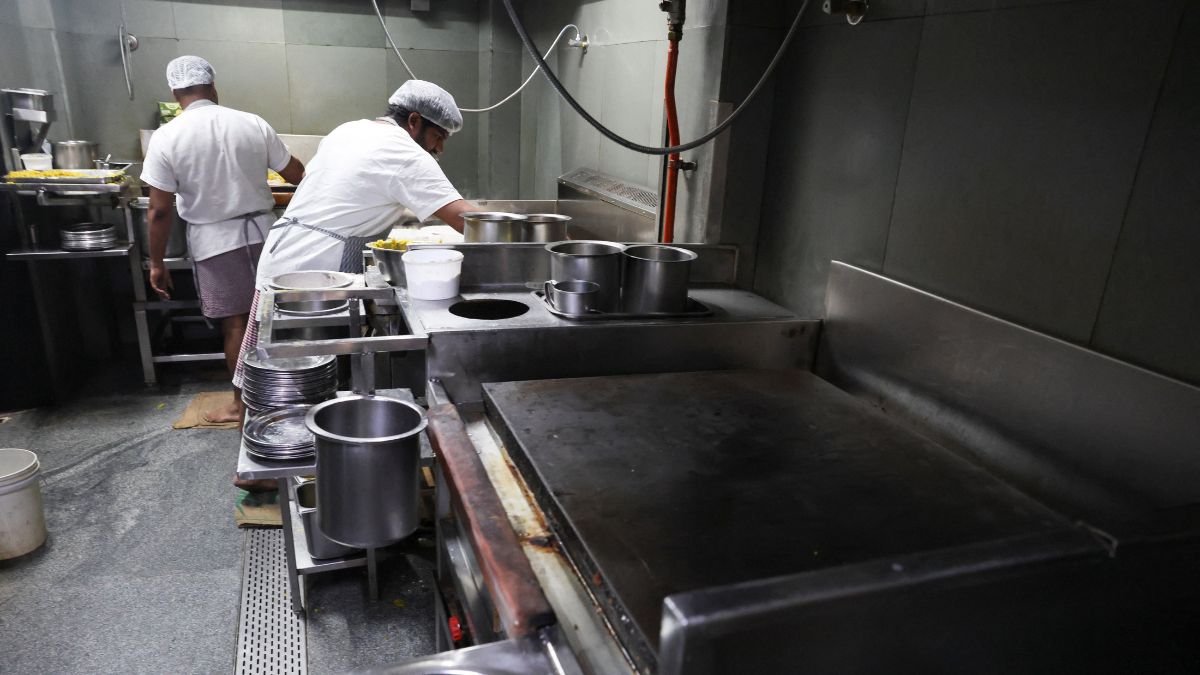
 "From kitchens to laundromats, how LPG shortage is upending daily lives of Indians")
The war in West Asia has started to sting India. Iran’s reported shutdown of the crucial Strait of Hormuz, a key chokepoint for global oil and gas flows, has halted the movement of ships, putting pressure on global energy markets.
More than 40 per cent of crude oil imported by India passes through the Strait of Hormuz. Over 80 per cent of India’s liquefied petroleum gas (LPG) imports travel through this narrow waterway between Iran and Oman.
While some reports say there will be no hike in petrol or diesel prices, the Indian government has already increased domestic cooking gas prices by Rs 60 per cylinder and commercial LPG prices by Rs 114.5.
India has also invoked emergency powers, ordering refiners to maximise LPG production and prioritise domestic consumers of the cooking gas. This has led to disruptions in the supply of commercial LPG cylinders used by hotels, restaurants and other sectors.
Let’s take a closer look.
Restaurants, hotels face brunt
Restaurants and hotels in Mumbai, Chennai and Bengaluru have sounded the alarm about a severe LPG crisis. They have warned that they could be forced to shut down if not provided with LPG refills in the next 72 hours.
Many eateries have started trimming their menus to avoid a total disruption to their operations.
The National Restaurant Association of India (NRAI), the apex body reportedly representing over 5,00,000 restaurants, said last week that restrictions on commercial LPG cylinders are “severely impacting the restaurant industry and, in turn, supply of food as an essential service for citizens”.
Quick Reads
View AllOn Monday (March 9), Bruhat Bengaluru Hotel Owners Association President PC Rao said restaurants were not getting commercial cylinders and urged the government to intervene to ensure supply.
As per Rao, about 25-30 hotels in Karnataka’s capital were impacted as suppliers stopped providing commercial cooking gas on Monday morning.
Restaurants are now opting for crisis menus that include faster-cooking items. They have also switched to alternative methods for cooking, such as tandoors, electric cookers and induction.
Speaking to Hindustan Times (HT), Rahul Rohra of Veranda in Mumbai’s Bandra and Khar, said high-flame cooking, particularly for Pan-Asian and Oriental dishes, has come to a near halt as induction cannot replicate that intensity. “We should be allowed to use charcoal to cook for the time being,” he added.
Shiladiya Chaudhury, the owner of popular restaurant chains Oudh 1590 and Chowman, told the newspaper that they were giving preference to tandoor food cooked in coal-based ovens. “Efforts are being made to use electric ovens as an alternative for other items but they are not very efficient,” Chaudhury said.
Bangalore Thindi on Infantry Road, a famous eatery with high footfall for lunch and afternoon meals, declared it would serve only beverages for now, reported Indian Express.
Hotels and restaurants in Tamil Nadu are also facing disruptions in commercial LPG supplies.
In Coimbatore, Annapoorna, a popular restaurant, has limited menu choices to conserve fuel, as per India Today.
As eateries curtail their menus, there are growing fears that lakhs of gig workers delivering food and other commodities could lose out on their incomes over the next two days, reported Frontline magazine.
“It is like a second Covid-19 lockdown for us,” the chairman of a popular restaurant chain, on the condition of anonymity, told Indian Express. “We have reduced the number of food items. If there is no supply of commercial LPG cylinders, we have no other go than to close down operations,” he said.
The hotel association in Odisha has also said that operations of several establishments were affected due to the LNG shortage. “Hotels and restaurants are highly dependent on the uninterrupted supply of commercial LPG cylinders for their daily kitchen operations. The sudden disruption in supply has severely affected food preparation and service in many establishments. If the situation continues, it may lead to the closure of hotel operations, cancellation of bookings, and severe inconvenience to tourists and visitors,” Hotel and Restaurant Association of Odisha chairman JK Mohanty reportedly wrote to Union Petroleum and Natural Gas Minister Hardeep Singh Puri.
The Punjab Hotel and Restaurant Owners Association is holding an emergency meeting of hospitality industry stakeholders in Ludhiana today to review the situation and discuss possible solutions.
Amid the acute shortage, eating at restaurants is expected to get costlier from next month.
As per reports, several restaurants are preparing to raise menu prices by 20-30 per cent as early as April, skipping the usual price revision cycle that usually happens around June–July.
Meanwhile, industry executives have warned that if the shortage continues, it could result in a black market for LPG cylinders.
ALSO READ: Loading... Could a Strait of Hormuz closure slow India’s internet?
Autos, laundromats & more
Autorickshaw drivers in Kolkata and Bengaluru have expressed concerns about a possible shortage of LNG supplies.
Most autos in the suburbs of Kolkata run on LNG. The restrictions on commercial LNG supply have started to disrupt auto services across the city.
The number of autos on several routes has plunged by nearly 30 per cent, operators told Times of India (TOI). Kolkata is witnessing long queues at fuel pumps, driven by panic buying and restricted supply.
“Many autos in the city still rely on ‘kaata gas’ (siphoned domestic LPG), which is diverted illegally from household cylinders and used as vehicle fuel. With domestic LPG supplies tightening and prices rising, the availability of such fuel also shrank. “Kaata gas price has doubled in the last two days,” said an auto operator.
Most autorickshaws in Bengaluru also use LPG, increasing anxiety among drivers about any fluctuation in supply and price. Drivers’ unions pointed out that LPG prices have already surged and different fuel stations are charging different rates. They believe this signals an uncertainty in supply in the coming days.
“Most autorickshaws in Bengaluru depend on LPG as their primary fuel. While a small number operate on CNG and a few have shifted to electric vehicles, the overwhelming majority still rely on LPG. If the supply chain is affected due to the ongoing conflict in West Asia, it will directly impact auto services across the city. Drivers are already paying nearly Rs 79 per litre at several fuel bunks, and prices vary from one outlet to another. If availability becomes uncertain, hundreds of drivers will struggle to operate, which will also inconvenience passengers who depend on autos for daily commuting,” TM Rudramurthy, general secretary of the Auto Rickshaw Drivers Union (ARDU), was quoted as saying by Indian Express.
Besides worries over commercial LNG, there is also no clarity for upmarket apartments that use piped gas. In cities like Mumbai and Delhi, whether supplies will continue normally or not remains uncertain.
Gas crematoriums in Pune have reportedly been closed amid concerns of fuel shortages.
In Mumbai, the LNG crisis has also affected the city’s laundry services, including the over a century-old Mahalaxmi Dhobi Ghat. LPG cylinders fuel the drying machines that dhobis (washermen) use. But the crunch in gas supplies has slowed operations, forcing many to seek cylinders in the black market at inflated rates, reported Indian Express.
State govts, associations reach out to Centre
Karnataka Chief Minister Siddaramaiah on Tuesday shot a letter to Union minister Hardeep Singh Puri to take action to ensure commercial establishments can continue their operations. Bengaluru South MP Tejasvi Surya also wrote to Puri in this regard.
Tamil Nadu CM MK Stalin held a review meeting on Tuesday to discuss steps that could be taken by the state. He also wrote to the Prime Minister’s Office, calling on the Centre to ensure the situation does not impact “the public, commercial establishments, or MSME industries in Tamil Nadu”.
“I have further urged that all necessary alternative arrangements be made for restaurants affected by commercial gas cylinder shortage and that the additional power required be secured,” he said after the meeting.
The National Restaurant Association of India also urged the government to ensure an adequate supply of commercial LPG cylinders to restaurants.
Similarly, the Federation of Hotel & Restaurant Associations of India (FHRAI) asked the government to exempt the hospitality sector from LPG supply restrictions.
On March 10, the Centre invoked the Essential Commodities Act to “ensure equitable distribution”. Under this, public-sector and private-sector refiners have to ascertain that the propane and butane streams produced by them are directed entirely towards the manufacture of liquefied petroleum gas.
FAQs
1. Why is there an LNG crisis in India?
India is reeling from a shortage of LNG supplies due to the closure of the Strait of Hormuz amid the Iran war.
2. What sectors have been affected?
From eateries to laundromats, services that require commercial LNG are facing disruptions to their normal operations.
3. What is the government doing?
The government has invoked the Essential Commodities Act to guarantee an uninterrupted supply of cooking gas.
With inputs from agencies


 "US-Israel Iran War Live Updates: Blasts heard across Doha as Iran’s Gulf strikes enter 12th day; Qatar intercepts new missile attack")
 "Where is Mojtaba Khamenei? Is Iran’s new supreme leader injured or in hiding?")
 "Iran War: Oil to remain above $95 for next two months, says Trump administration")
 "Qatar rejects mediation role until attacks stop, says 'regional neigbours are not Iran's enemies'")
 "US-Israel Iran War Live Updates: Blasts heard across Doha as Iran’s Gulf strikes enter 12th day; Qatar intercepts new missile attack")
 "Where is Mojtaba Khamenei? Is Iran’s new supreme leader injured or in hiding?")
 "Iran War: Oil to remain above $95 for next two months, says Trump administration")
 "Qatar rejects mediation role until attacks stop, says 'regional neigbours are not Iran's enemies'")