

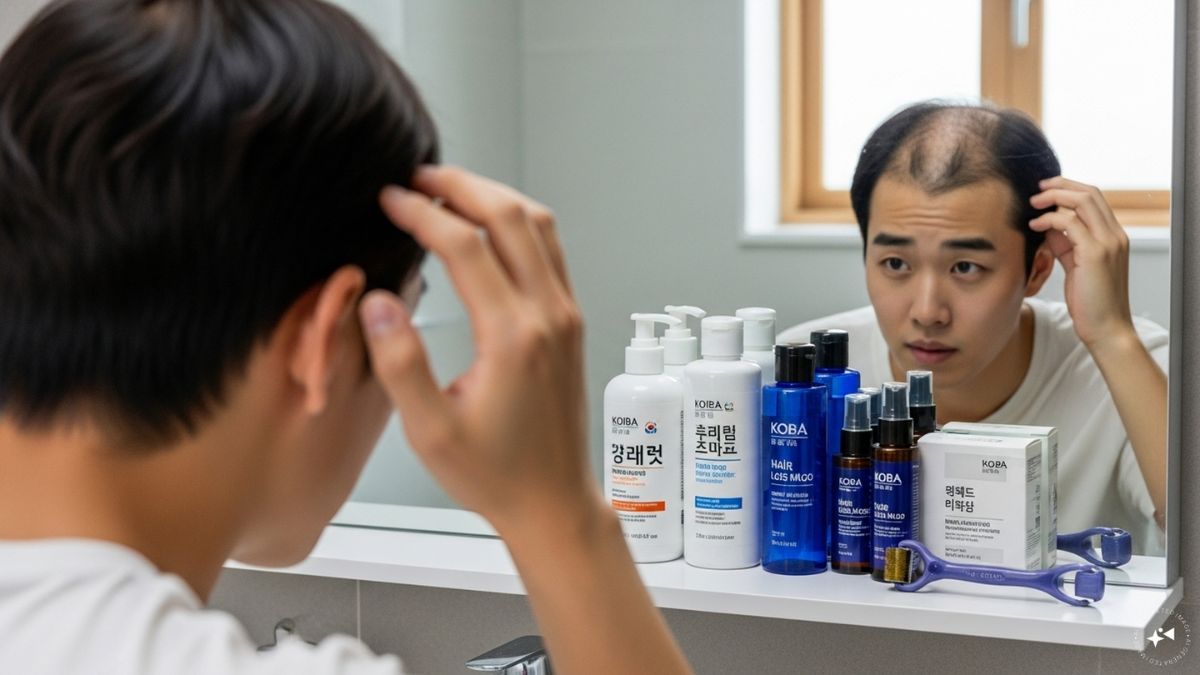
 "‘A survival matter’: Why South Korea’s president wants to help fund hair loss treatment")
South Korea’s leader wants to help its balding residents. President Lee Jae Myung has directed his government to consider expanding the country’s public health insurance coverage for hair loss treatment.
His suggestion has received mixed responses, with critics questioning the feasibility of such a move. The president’s remark that hair loss has become “a matter of survival” has also faced backlash.
We take a look.
‘A survival matter’
South Korean President Lee Jae Myung has suggested covering hair loss treatment under the national health insurance scheme.
As per The Chosun Daily, during a policy briefing on Tuesday (December 16), Lee asked, “Isn’t hair loss part of a disease? I hear young people use a lot of hair loss medication—has there been a review?”
To this, Minister of Health and Welfare Jeong Eun-kyeong replied that the national health insurance currently covers treatments for hair loss caused by medical conditions such as alopecia areata. Most treatments for common male pattern baldness are not included in the insurance scheme.
Jeong said that “genetic hair loss is not covered by health insurance due to its weak association with medical treatment.”
She explained that hereditary hair loss is not covered under the public insurance scheme because it is not life-threatening.
“Is it just a matter of whether to define hereditary disease as a disease?” Lee asked in response.
He further commented, “Hair loss medication seems widely used—wouldn’t designating it under medical insurance lower drug prices?”
Jeong reiterated that hair loss is considered a cosmetic concern.
Quick Reads
View All“Hair loss was once seen as a cosmetic issue, but now it’s perceived as a survival matter,” Lee rebutted. He suggested, “If costs are too burdensome, consider reviewing limits on frequency or total amounts.”
The South Korean president also mentioned obesity, asking, “The same applies to obesity —are we reviewing drug treatments?”
South Korea’s national health insurance partially covers gastric resection for severe obesity, but not drug therapies.
“There may be young people who think it’s unfair that they only pay insurance premiums and can’t receive benefits,” Lee said, pointing out that a “sense of alienation” among them had become severe.
South Korea has a universal insurance scheme funded by premiums calculated on the basis of income.
The Ministry of Health and Welfare has started reviewing support for the plan following the president’s directive, reported The Chosun Daily.
This is not the first time that Lee has made such a proposal. He promised to insure hair loss treatment during his unsuccessful 2022 presidential campaign. The plan was criticised as a populist measure.
Lee, however, dropped the proposal during his 2025 presidential election campaign.
Koreans divided over Lee’s plan
South Korea is infamous for its high beauty standards. Lee’s proposal highlights the country’s conservative culture that puts intense focus on physical appearance. This is a lot more demanding for women, who are expected to strictly maintain their makeup, skincare and body shape.
According to a 2024 survey of young adults in South Korea, 98 per cent of respondents said they believed attractive people get social benefits.
In such a society, baldness, especially for young people, comes with its own stigma. Men often grow out their fringes to hide their hair loss or opt for expensive treatments, as per The Guardian.
South Korea’s hair-loss treatment market was estimated to be worth around 188 billion won (Rs 1,141.18 crore) in 2024.
Industry groups claim that of the East Asian country’s total population of more than 51 million (5.1 crore), around 10 million (one crore) experience hair loss.
Of the 240,000 people who went to hospitals for hair loss last year, 40 per cent were in their 20s or 30s, BBC reported, citing South Korean authorities.
Despite this, Lee’s proposal of expanding national insurance coverage to include hair loss treatment has divided opinions in South Korea.
He has been praised by some social media users, one of whom described him as the “best president in history”.
But not all, including medical professionals and conservative figures, are on board with his plan.
The Korean Medical Association said that “rather than investing health insurance finances in hair loss treatment coverage, prioritising coverage for cancer and other serious diseases would better align with health insurance principles.”
The Conservative newspaper Chosun Ilbo also criticised Lee’s proposal. It argued in its editorial that “this is not something the president should suddenly instruct without collecting opinions from citizens who pay insurance premiums.”
Even the potential beneficiaries of subsidised hair loss treatment are not impressed.
The move feels “a bit like a vote-grabbing policy”, Song Ji-hoon, a 32-year-old Seoul resident who takes hair loss medication, told BBC.
“Saving money sounds nice, but honestly it costs less than 300,000 won (Rs 18,210) a year, so… is it even necessary?”
Opposition parties also denounced the South Korean president’s proposal.
“The national health insurance system is meant to safeguard treatment for diseases that directly threaten life and for therapies whose effectiveness has been medically proven,” People Power Party spokesperson Choi Bo-yun was quoted as saying by The Korea Herald.
Former lawmaker Yoon Hee-sook also criticised the plan.
“Families of cancer patients are already struggling with anxiety over expensive new medications that remain uncovered by public insurance,” she said, revealing that a close relative of hers is currently undergoing cancer treatment.
Some believe that the South Korean president is eyeing the support of male voters in the upcoming elections.
“There is no reason he needs to be bound by the promise this time,” Don S Lee, an associate professor of political science at Korea University, told BBC, adding that the president may be trying to “expand his base of supporters” for the local elections in mid-2026.
Fiscal impact of funding Korea’s hair loss treatment
The timing of Lee’s move has come into question as South Korea’s national health insurance scheme is already facing a crunch.
Last year, the deficit was 11.4 trillion Korean won. The system is reportedly projected to face deficits as large as 4.1 trillion won in 2026.
In a radio interview on December 17, Minister Jeong admitted that covering all types of hair loss would have a major impact on insurance finances.
“Because hereditary hair loss accounts for the majority of cases, extending benefits broadly would significantly affect the health insurance fund,” she said, as per The Korea Herald.
To address the financial burden, President Lee suggested that authorities could impose coverage limits for hair loss treatment.
With inputs from agencies

 "Ex-Pak PM Imran Khan, wife Bushra Bibi, sentenced to 17 years in prison in Toshakhana case")
 "Ajit Agarkar breaks down key decisions behind India’s T20 World Cup 2026 squad: 'It’s about combinations'")
 "Why air pollution is no longer just a lung issue but a brain health crisis")
 "Why Bangladesh unrest is a big worry for India")
 "Ex-Pak PM Imran Khan, wife Bushra Bibi, sentenced to 17 years in prison in Toshakhana case")
 "Ajit Agarkar breaks down key decisions behind India’s T20 World Cup 2026 squad: 'It’s about combinations'")
 "Why air pollution is no longer just a lung issue but a brain health crisis")
 "Why Bangladesh unrest is a big worry for India")



