

 "Why Bangladesh unrest is a big worry for India")
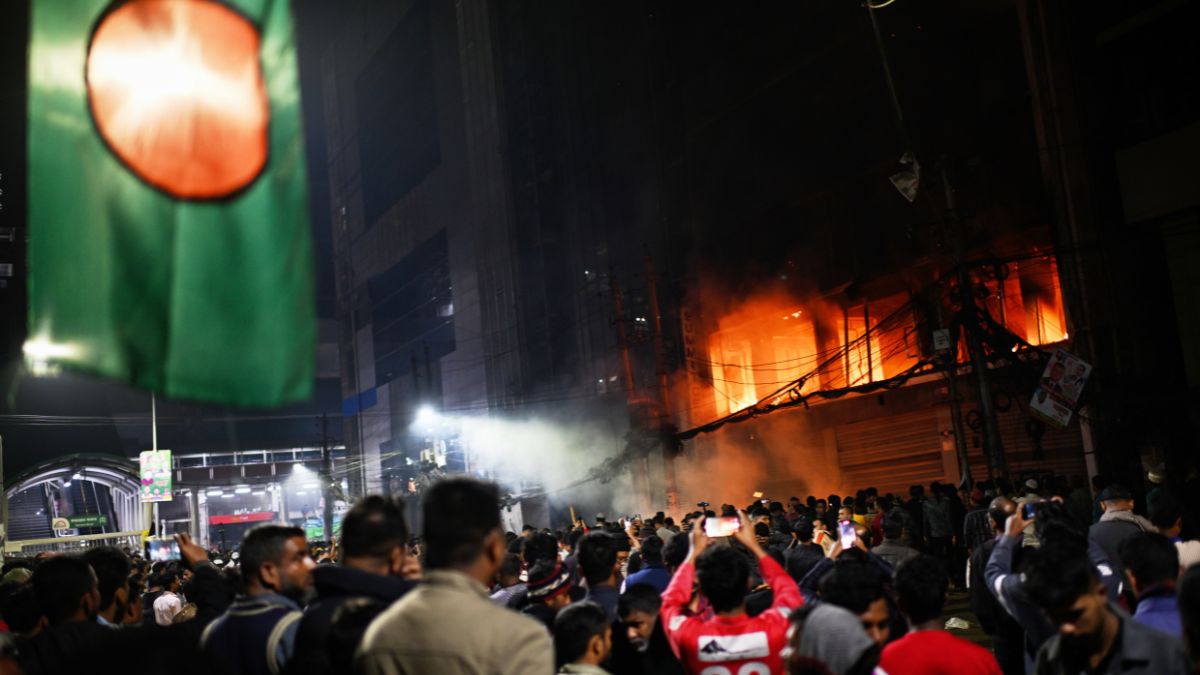
Bangladesh is on the edge again as violent protests have rocked the country following the killing of youth leader Sharif Osman Hadi. A vocal critic of India, the 32-year-old died on Thursday (December 18) night in a Singapore hospital, days after being shot by masked assailants in Dhaka.
As tensions flared after the news of his death, two leading newspapers, accused of favouring India, were targeted by the mob on Friday (December 19). Anti-India sentiment has grown in the South Asian country since the ouster of former Bangladesh Prime Minister Sheikh Hasina last August.
How will the latest violence impact India? We take a look.
Bangladesh protests target India
The latest unrest in Bangladesh broke out on Thursday night after the news of Hadi’s demise spread. Thousands of protesters took to the streets in Dhaka, with some resorting to violence and vandalism.
As violence gripped the country, the Indian High Commission in Dhaka and its Assistant High Commissions across Bangladesh also faced threats.
India has Assistant High Commissions in Chittagong, Rajshahi, Khulna and Sylhet.
The anti-India protests erupted after the Bangladesh Police said they had identified the two masked men who shot Hadi, adding that they believed the attackers had fled by crossing the border to India, as per Indian Express.
Hadi was a youth leader who took part in the student-led movement in 2024 that led to Hasina’s ouster. He was set to contest the February parliamentary elections as an independent.
A day before his death, protesters marched toward the Indian High Commission in Dhaka, demanding that Hasina be brought back to Bangladesh. This prompted the Indian mission to close its visa application centre for Bangladesh nationals for a day.
Hasina has been living in Delhi since fleeing from Dhaka last August. India’s ties with Bangladesh have frayed since Hasina escaped to Delhi and Dhaka has repeatedly asked New Delhi for her extradition.
In Chattogram, reports of stone-pelting and attacks at the Indian Deputy High Commission’s residence and office emerged.
The claim that Hadi’s attackers have fled to India has stoked anger among his supporters. Officials told Indian Express that this has enabled them to target Indian missions in Bangladesh.
Angry protesters have also targeted Bangladesh’s two leading newspapers, accusing them of favouring India and calling them “Sheikh Hasina’s enabler”.
Demonstrators ransacked and set ablaze the offices of Prothom Alo, Bangladesh’s largest daily, and The Daily Star on Thursday night.
According to The Daily Star, protesters accused it and Prothom Alo of “setting the ground” for Hadi’s killing.
During the attack on the newspaper’s office, the protesters shouted “Delhi or Dhaka; Dhaka, Dhaka”, “Sycophancy or movement; movement, movement”, “We have shed blood; we will shed more,” while demanding punishment for Hadi’s killers.
Both newspapers have dismissed the claims of siding with India or Hasina. In fact, they had supported the anti-Hasina protests last year, calling it a “new dawn”.
ALSO READ: How Bangladesh leader’s threat to cut off India’s ‘Seven Sisters’ has sparked a diplomatic row
Why India is closely watching
The violence in Bangladesh comes just months ahead of the national elections scheduled on February 12.
There are concerns that the unrest could be used as a pretext to defer these polls. Sources told News18 that the deteriorating law and order in Bangladesh could be used as a “narrative that elections are unsafe” and thus delay them. This would give time to radical elements to build support on the ground.
Bangladesh Nationalist Party (BNP) secretary general Mirza Fakhrul Islam Alamgir has called the recent violence a “conspiracy” to destabilise the nation before the general elections next year.
New Delhi’s worry about elections being postponed stems from the long time taken by the interim government led by Nobel laureate Muhammad Yunus to announce the polls since the toppling of Hasina’s government.
Bangladesh has banned Hasina’s Awami League. India and the rest of the international community will keenly watch the elections for their credibility if the former PM’s party is not allowed to contest, as per Indian Express.
The Ministry of External Affairs (MEA) has backed “free, fair, inclusive and credible” elections in Bangladesh in a “peaceful atmosphere”.
“We expect that the interim Government of Bangladesh will take all necessary measures for ensuring internal law and order, including for the purpose of holding peaceful elections,” the MEA said on December 14.
According to News18 sources, the current situation in Bangladesh is of “managed instability", where isolated incidents and deaths are being quickly exploited by radical and opposition groups to mobilise mass protests.
The law and order situation under Yunus has come under the scanner. Indian politicians have raised voices against the recent mob lynching of a Hindu youth, identified as Dipu Chandra Das, over blasphemy allegations.
Given its security concerns, India would be unhappy with the instability in its neighbourhood and the rise of the right-wing Islamist party, Jamaat-e-Islami, in the student body elections in major universities in Bangladesh
New Delhi is also monitoring the unrest in Bangladesh with bated breath due to elections in its own territory next year. West Bengal is likely to go to the polls in April-May next year. “We don’t want the spillover of the violence and the situation to impact our own domestic politics,” a senior Indian official told Indian Express.
India has longstanding, friendly relations with Bangladesh. New Delhi would hope that a new government in Dhaka would bring the ties back on track soon.
With inputs from agencies


 "‘Bangladesh’s Yunus govt failed to control ‘mobocracy’’: BNP leader on attack on Indian mission")
 "Tarique Rahman to return to Bangladesh after 17 years: Can Khaleda Zia’s son influence February elections?")
 "US Congressmen raise alarm over anti-Hindu violence in Bangladesh")
 "‘Time to Kash out’: Why Kash Patel’s choice of new wheels has sparked a row")
 "‘Bangladesh’s Yunus govt failed to control ‘mobocracy’’: BNP leader on attack on Indian mission")
 "Tarique Rahman to return to Bangladesh after 17 years: Can Khaleda Zia’s son influence February elections?")
 "US Congressmen raise alarm over anti-Hindu violence in Bangladesh")
 "‘Time to Kash out’: Why Kash Patel’s choice of new wheels has sparked a row")



