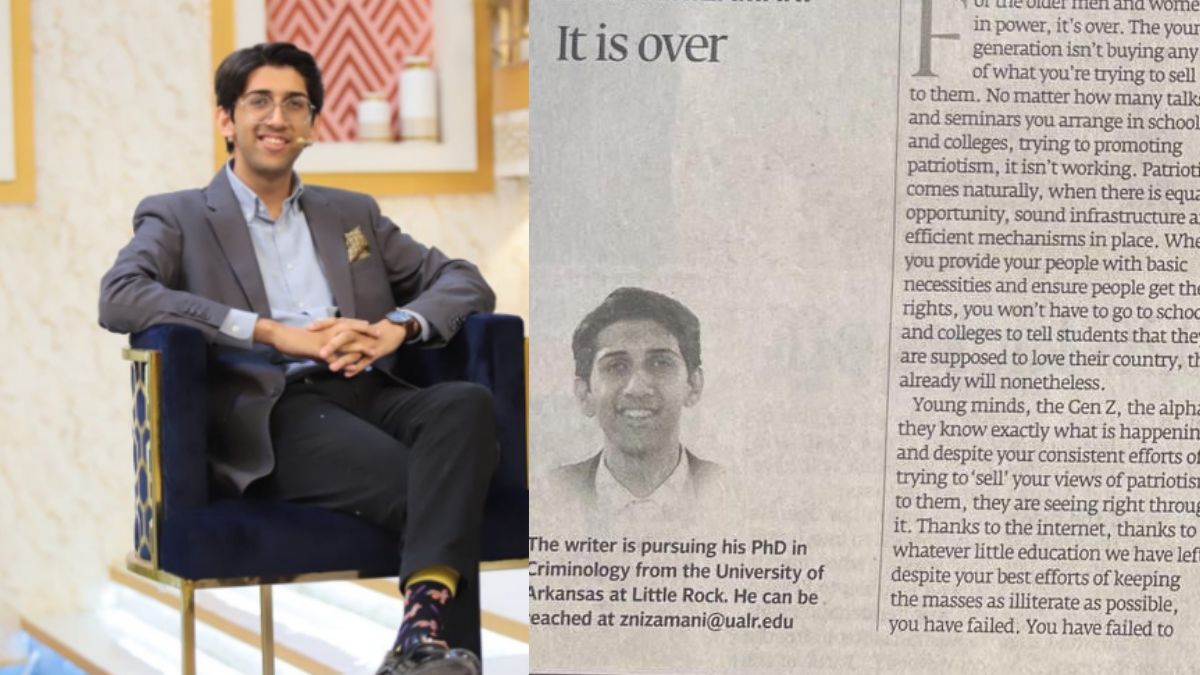
 "Why a deleted article on Gen Z has stirred a storm in Pakistan")
A now-deleted article on Generation Z has stirred a storm in Pakistan. The removal of the op-ed published in an English daily, The Express Tribune, on January 1 has sparked a row in the South Asian country.
The author has been dubbed a ‘national hero’, with even political parties commenting on the issue. As the world sees a rise in Gen Z protests, what has an article on the young generation got Pakistanis vexed?
We explain.
What’s in the article?
The opinion piece, titled It is Over, was published by The Express Tribune last week in the newspaper and uploaded on its website.
The article was authored by Zorain Nizamani, a PhD scholar in the United States and the son of popular TV actors Fazila Qazi and Qaiser Khan Nizamani.
He argued in the piece that despite their efforts, the era of the old men was over and Pakistan’s Gen Z was not falling for their narratives.
“For the older men and women in power, it’s over. The young generation isn’t buying any of what you’re trying to sell to them. No matter how many talks and seminars you arrange in schools and colleges, trying to promote patriotism, it isn’t working,” the author wrote.
While he did not mention Pakistan’s Army, Nizamani argued: “Patriotism comes naturally, when there is equal opportunity, sound infrastructure and efficient mechanisms in place. When you provide your people with basic necessities and ensure people get their rights, you won’t have to go to schools and colleges to tell students that they are supposed to love their country, they already will nonetheless.”
Quick Reads
View AllIn a sharp attack on his country’s civil-military rule, he said the younger generation is not buying the narratives of the state.
“Young minds, the Gen Z, the alphas, they know exactly what is happening and despite your consistent efforts of trying to ‘sell’ your views of patriotism to them, they are seeing right through it. Thanks to the internet, thanks to whatever little education we have left, despite your best efforts of keeping the masses as illiterate as possible, you have failed. You have failed to tell people what to think, they are thinking for themselves. They might be a little too scared to speak their minds because they prefer breathing,” Nizamani wrote.
He underlined that while fear may prevent Gen Z from open dissent, the youth were taking a “silent, quiet exit” out of the country.
“The younger lot has had enough, and because they have learned that they cannot challenge the powers, they’re leaving the country… They’d rather take a silent, quiet exit and not look back because their friends, who spoke up, were silenced,” Nizamani, who is also a lawyer, said.
Warning that it is “over” for boomers, he said there is no “future” for them. Nizamani also flagged the “massive disconnect” between the Gen Z and the current Pakistani regime.
“The Gen Z wants faster internet, the ones in power want a stronger firewall. The Gen Z wants cheaper smartphones, the boomers want smartphones to be taxed. The Gen Z wants eased restrictions on freelancing, the boomers want to increase regulations on freelancing,” he wrote.
Why was the article removed?
The article was pulled down a few hours after it was published online. There are reports that pressure from the Army led to the removal of the op-ed that has now become popular.
The Pakistan Army’s media wing, ISPR, posted articles countering the now-deleted piece, ThePrint reported, citing Drop Site news, a US-based investigative journalism platform.
The article that was published in the newspaper remains.
Row over take down of Gen Z article
Nizamani’s article has divided Pakistanis, with many praising him for expressing the Gen Z’s take, while critics call it an “overrated perception”.
“This is such a great article. Written from the heart of every young person to every old man failing at their job in Pakistan,” Pakistani lawyer Abdul Moiz Jafferi wrote on X.
This is such a great article. Written from the heart of every young person to every old man failing at their job in Pakistan. pic.twitter.com/XwAdkaToUA
— Abdul Moiz Jaferii (@Jaferii) January 1, 2026
Several journalists and human rights activists condemned the removal of Nizamani’s article.
Pakistani rights activist Mehlaqa Samdani, the founder and director of Community Alliance for Peace, said the article “bluntly tells Pakistan’s ruling elite that Gen Z is no longer falling for their attempts to manipulate and control narratives.”
“Not surprisingly, this article is no longer accessible through the Express Tribune’s digital edition—exactly the kind of censorship Zorain talks about. He is right. It really is over for those who think they can continue to get away with these crude tactics,” she posted on X.
Imran Khan’s Pakistan Tehreek-e-Insaf’s (PTI) Canada account labelled it a “must-read article”, saying it only confirms the truth.
A portal, Siasat Pakistan wrote, “Nobody knew Zorain Nizamani until yesterday morning, but today the entire Pakistan knows him. Whoever stands in front of your oppression, your intoxication with power, and your desire to become a dictator—even if anonymous—becomes a hero and a nationwide figure within 24 hours. Your hand is truly magical; whoever you lay your hand on becomes a rising sun.”
“Reality check for the generation shaping policy. The disconnect grows clearer by the day. Excellent analysis by Zorain Nizamani,” former Pakistani minister Moonis Elahi wrote on X.
As his article blew up and Nizamani was thrown to the centre of attention in his home country, he made a video to say that the piece “speaks for itself” and urged people to always think “critically.”
𝗧𝗵𝗲 𝗩𝗿𝗶𝗮𝗹 𝗭𝗼𝗿𝗮𝗶𝗻 𝗡𝗶𝘇𝗮𝗺𝗮𝗻𝗶:
— Dr Ahmad Rehan Khan (@AhmadRehanKhan) January 3, 2026
The viral Pakistani PhD scholar from the University of Arkansas, also the son of a well known celebrity couple, has now joined X to explain his Express Tribune article.#zorainNizamani I #Pakistan pic.twitter.com/zLakseDlhG
He also took to LinkedIn to address the hullabaloo around his op-ed. While apologising if his article “violated certain guidelines of the newspaper”, Nizamani said it was taken down for “reasons unknown” to him.
He said his work was “quoted by certain politicians on social media and mass media, making it suit particular narratives, narratives I did not endorse.”
“Let me reiterate that I do not hold any political affiliations because my views don’t go down well with anyone. My article ‘It is over’ was based on my personal observations, my views and my take on things. I do not carry disdain against anyone, there is enough hatred in the world, truth is always controversial,” the author said.

 "US-Venezuela Tensions Live Updates: Calls for release of political prisoners grow after Maduro’s ouster")
 "'Greenland belongs to its people': European leaders issue joint statement backing Denmark amid US interest")
 "Was Maduro 'kidnapped' or 'captured' by the US? Depends, and it matters")
 "Paris draft promises ‘binding commitment’ to Ukraine’s security; eyes on Witkoff, Kushner")
 "US-Venezuela Tensions Live Updates: Calls for release of political prisoners grow after Maduro’s ouster")
 "'Greenland belongs to its people': European leaders issue joint statement backing Denmark amid US interest")
 "Was Maduro 'kidnapped' or 'captured' by the US? Depends, and it matters")
 "Paris draft promises ‘binding commitment’ to Ukraine’s security; eyes on Witkoff, Kushner")