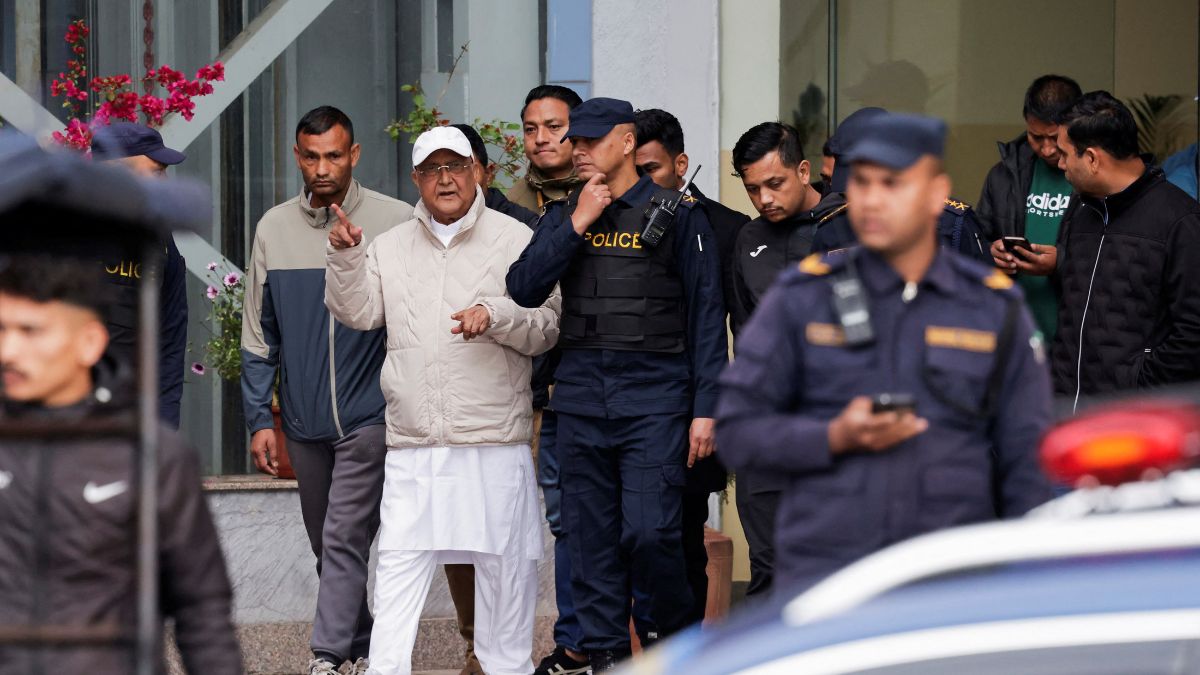
 "Former Nepal Prime Minister and Chairman of the Communist Party of Nepal, KP Sharma Oli gestures while being taken to a hospital from the District Police Range after his detention by police, who are investigating whether he was negligent in preventing dozens of deaths during the Gen Z protests, in Kathmandu, Nepal, March 28, 2026. Reuters")
Nepal’s former prime minister, Khadga Prasad (KP) Sharma Oli, as well as ex-home minister Ramesh Lekhak, have been arrested over their alleged involvement in last year’s deadly crackdown on Gen Z protesters. The leaders were taken into custody on Saturday (March 28), a day after rapper-turned-politician Balendra Shah was sworn in as Nepal’s prime minister.
The arrests come after a Nepali panel investigating violence during September’s anti-corruption protests recommended prosecuting Oli for negligence for failing to prevent the deaths of more than 70 people during the protests. The youth-led uprising had resulted in the collapse of the Oli government and the formation of an interim government headed by Nepal’s first female chief justice, Sushila Karki.
But who is Oli and why has he been arrested? We explain.
Who is KP Sharma Oli?
KP Sharma Oli , 74, is Nepal’s communist politician whose political career has been marked by contrasting stances towards neighbouring India.
Known as Dhruba as a child, Oli was brought up by his grandmother in eastern Nepal’s Jhapa following the death of his mother from smallpox when he was just four.
According to his childhood friends, Oli was a “smart” kid who enjoyed chess and even encouraged others to play, as it promoted brain development, reported The Kathmandu Post.
Oli’s foray into politics began at the young age of 12. Inspired by Karl Marx and Lenin, he entered Communist politics in 1966.
As a teenager, he participated in the ‘Jhapa revolt’ or the peasant uprising against landowners in 1967.
Three years later, Oli went underground after joining the Nepal Communist Party. He has been behind bars multiple times. At the age of 18, he was jailed for the first time in 1970 by the Panchayat government.
Quick Reads
View AllOli was then imprisoned in his early 20s for the murder of Dharma Prasad Dhakal, a farmer in eastern Nepal, reported Indian Express.
He was arrested again for his involvement in Nepal’s democracy movement and spent 14 years in prison from 1973 to 1987.
While Oli hardly speaks about his over a decade in jail, his associates say his experience behind bars shaped him.
“He has learnt to count on himself more than anyone else, even if that makes him a loner,” a journalist who has known Oli for decades told The Hindu.
Oli shot to fame for his role in the democratic movement in the 1990s that brought down the Panchayat regime.
He was first elected to the House of Representatives from Jhapa district in 1991. Over the years, Oli emerged as a key player in Nepal’s politics. The Communist leader served as deputy PM in the interim government led by Girija Prasad Koirala in 2006.
In 2008, Nepal abolished its 239-year-old monarchy and became a Republic. Oli became prime minister for the first time in 2015 after securing 338 out of 597 votes.
However, he was forced to resign in July 2016 after his ally, the Communist Party of Nepal (Maoist-Centre), withdrew support, leading to Oli losing a no-confidence motion in Parliament.
His second tenure as Nepal’s PM came in 2018 when his Communist Party of Nepal-Unified Marxist Leninist (CPN-UML) and its ally the Communist Party of Nepal (Maoist-Centre), led by Pushpa Kamal Dahal ‘Prachanda’, secured a two-thirds majority in the elections.
The two parties eventually merged into the Nepal Communist Party, with Oli and Dahal agreeing to co-chair the party organisation. The two leaders also decided to share the prime ministerial term. Oli was briefly reappointed as the premier in 2021.
He returned as Nepal’s PM for a fourth time in July 2024 after ‘Prachanda’ lost the vote of confidence in Parliament.
However, Oli was ousted from power just over a year later, following the September 2025 Gen Z anti-corruption protests in the Himalayan republic.
Oli’s ‘role’ in crackdown on Nepal’s Gen Z protests
The youth protests in Nepal last year were triggered by the Oli government’s brief ban on social media. However, the demonstrations were driven by widespread anger over corruption, nepotism and a lack of economic opportunities.
Oli stepped down as the prime minister as mobs set fire to his house, parliament and government offices. At least 77 people were killed, many of which were protesters shot by police, during the unrest.
In his resignation letter, the veteran leader said he hoped his exit would help “move towards a political solution and the resolution of the problems”.
Oli’s CPN-UML suffered a decisive defeat in the parliamentary elections held earlier this month. Balen Shah’s Rastriya Swatantra Party (RSP) won a landslide, the first time in decades that a single party gained a majority in Nepal.
Earlier this week, the Nepali panel probing the violence during last year’s Gen Z protests recommended prosecuting Oli for negligence.
The panel found Oli responsible for not taking any action to halt hours of firing that killed at least 19 Gen Z protesters on the first day of the protests that toppled his government.
As per the commission’s report, as many as 76 people were killed and 2,522 wounded during the two days of unrest in September last year.
The report said that it was “not established that there was an order to shoot”, but said that “no effort was made to stop or control the firing”.
“As the executive head … Oli should be held responsible for anything, good or bad,” it added.
The report also held Oli’s home minister, Ramesh Lekhak, and the then police chief, Chandra Kuber Khapung, responsible, calling for their prosecution.
In January, Oli, in a statement to the commission set up by the Karki-led interim government, denied ordering the police to open fire on protesters.
“I did not give any orders to shoot,” he reportedly said. Instead, Oli blamed “infiltrators” or “anarchic forces” for igniting violence, without elaborating.
“The children were led to such a point where the law itself orders shooting,” he added.
Oli rejected the commission’s findings this week as unacceptable.
“The report is extremely negligent, character assassination and hate politics. It is … regrettable,” the Annapurna Post daily quoted Oli as saying.
Oli arrested
Oli was arrested on early Saturday morning at his residence in Gundu, Bhaktapur. His ex-home minister Lekhak was arrested from his residence in Suryabinayak, Bhaktapur, around 5 am, The Kathmandu Post reported, citing his personal secretary Janak Bhatta said. They have not been charged.
The arrests come after a formal complaint by the Nepal Home Ministry, which led to an investigation and issuance of arrest warrants.
The development comes a day after 35-year-old Balen Shah and his Cabinet were sworn in.
Oli has reportedly said he has been arrested “vindictively”. “I will fight the legal battle,” he told the media.
“They were arrested this morning and the process will move forward according to the law,” Kathmandu Valley police spokesman Om Adhikari told newswire Agence France-Presse (AFP).
Oli’s lawyer told Reuters his detention was unwarranted. “It is illegal and improper because there is no risk of him fleeing or avoiding questioning,” he said.
On Instagram, new Home Minister Sudan Gurung welcomed the arrests. “No one is above the law… This is not revenge against anyone, just the beginning of justice,” he wrote.
Police spokesman Adhikari said both Oli and Lekhak were being kept in custody at the Kathmandu Police Office and would be produced before the court on Sunday. “We have arrested them as per the recommendations made by the investigation commission,” he said.
If prosecuted and found guilty by the court, Oli and Lekhak could be sentenced to up to 10 years in jail. However, as per legal experts, the government must carry out criminal investigations before formally charging them in court.
“It is not a charge sheet and they cannot be jailed on the basis of this report,” Dinesh Tripathi, a senior independent lawyer, told Reuters.
“There has to be a criminal investigation by police … The government can file the case in the court only after that,” he said, adding that the process could take at least a couple of months.
With inputs from agencies