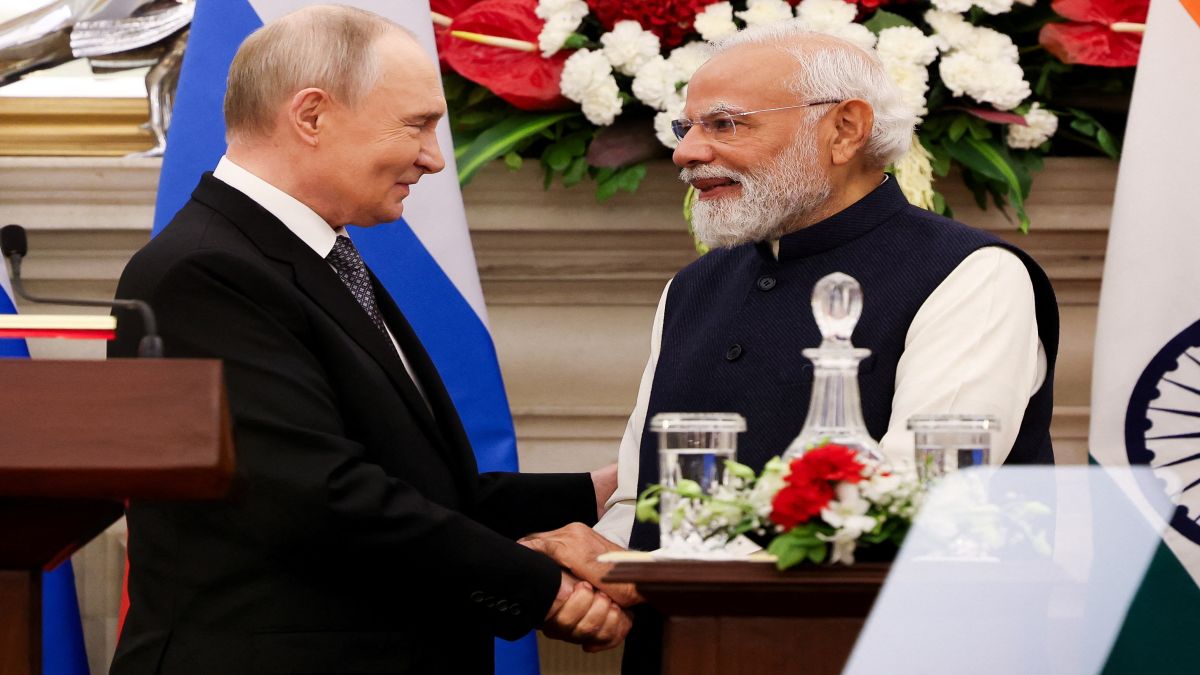
 "Russian President Vladimir Putin and India's Prime Minister Narendra Modi shake hands as they attend a presentation of a joint statement after their delegation level talks at Hyderabad House in New Delhi, India. Reuters")
Russian President Vladimir Putin’s trip to India is thus far proving an unqualified success.
Putin, who is on a two-day visit for the 23rd India–Russia summit, praised Prime Minister Narendra Modi for India’s independent and sovereign policy and noted how it is one of the fastest-growing economies in the world.
He also said the countries had vowed to expand bilateral trade to $100 billion (Rs 9 lakh crore) by 2030. The two countries have signed a slew of agreements including in the areas of security, economy, trade and culture.
Let’s take a closer look at how the trip will bring the countries closer together.
On jobs, migration
As noted in another piece, the signed labour agreement will have myriad benefits for both nations. On the one hand, Russia is in dire need of workers, particularly its Ural region, which is the industrial powerhouse. Moscow needs to fill around 3 million positions by the end of this decade.
Find the complete coverage of Vladimir Putin’s India visit hereOn the other, India, which has a demographic dividend, has around 10–12 million youth coming into the workforce every year. Many of these youths can find jobs in Russia and send money back home. While most Indians prefer Gulf countries, opportunities in Russia could change things.
The two countries have also signed an agreement to cooperate on combating irregular migration. This will assist in cracking down on illegal activities.
On education and medicine
India and Russia have agreed to a tie-up between the University of Mumbai and Lomonosov Moscow State University. Additionally, a collaboration has been announced between Pune’s Defence Institute of Advanced Technology and Russia’s National Tomsk State University. This will undoubtedly benefit both teachers and students alike and lead to a freer exchange of ideas and raise academic standards.
India’s Ministry of Health and Family Welfare has also agreed to a tie-up when it comes to healthcare, medical education, and scientific research.
Training
The two countries have signed an MoU between India’s Ministry of Ports, Shipping and Waterways and Russia’s Ministry of Transport. This will result in training specialists to be able to operate ships in polar waters. India and Russia have been working together in the Arctic region, which has become a geopolitical chessboard.
On healthcare and food safety
India and Russia have also signed MoUs when it comes to healthcare, science and food safety. India’s Ministry of Health and Family Welfare will collaborate in these fields with Russia’s Ministry of Health.
India’s Food Safety and Standards Authority and Russia’s Federal Service for Surveillance on Consumer Rights Protection and Human Well-being will also work together to increase food safety. This will result in a healthier and happier populace.
On communication
The collaboration between India’s and Russia’s media will grow after the two countries have signed several MoUs between Prasar Bharati and several Russian media groups.
This includes Gazprom, National Media Group, and BIG ASIA Media Group as well as ANO “TV-Novosti.” This will increase the ties between the outlets and result in the two nations deepening their cultural bonds and understanding.
On farms and fertiliser
India and Russia have signed an MoI between Russia’s Ural Chemicals and India’s Rashtriya Chemicals and Fertilizers Limited, National Fertilizers Limited and Indian Potash Limited. India is seeking a steady, long-term supply of fertilisers from Moscow.
Leaders outline Russia–India expanding ties
After the talks, Putin and Modi emphasised strong energy ties. Bilateral trade between the two countries stood at $68.7 billion (Rs. 6.19 lakh crore) in the last fiscal year ended March. The trade is heavily skewed in favour of Russia with deep deficits for India, which it is looking to bridge by pushing exports.
“To achieve this significant goal, a programme for the development of Russian–Indian economic cooperation until 2030 has been agreed upon,” Putin said. He said work is underway on an agreement for India to establish a free trade zone with the Eurasian Economic Union, a Moscow-dominated economic grouping of several ex-Soviet nations, adding that it could help increase trade.
“Russia is a reliable supplier of energy resources and everything necessary for the development of India’s energy sector,” Putin said. “We are ready to continue ensuring the uninterrupted supply of fuel for the rapidly growing Indian economy.”
Before the summit talks, the Russian leader said the two countries “have a very trusting relationship when it comes to military-technical cooperation.” Modi said after the talks that the two countries will work towards early conclusion of a free trade agreement with the Eurasian Economic Union. He also announced that India will soon start issuing free electronic visas for Russian tourists and groups visiting the country.
Modi said energy security has long anchored India–Russia ties, with civil nuclear cooperation spanning decades. He added that such cooperation will continue, alongside collaboration in clean energy, shipbuilding, fertilisers and labour mobility.
With inputs from agencies