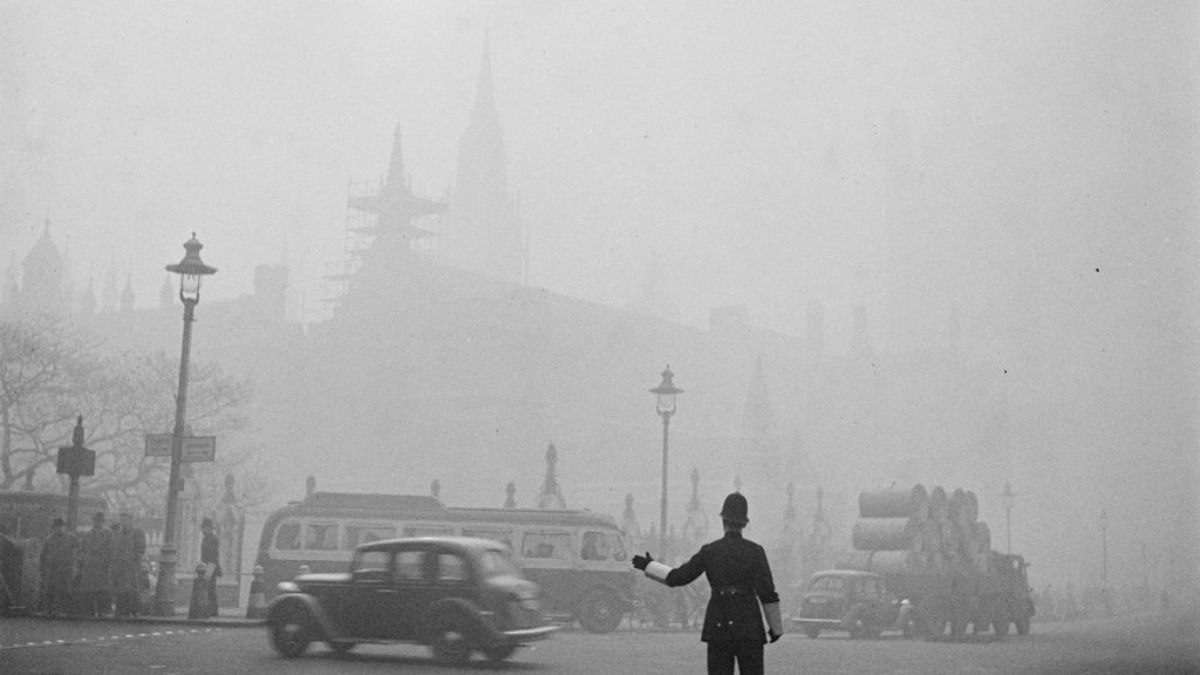
 "A traffic policeman works in London during the Great Smog of London, 1952. Wikimedia Commons")
One of the deadliest episodes of environmental disasters in the history of England took place on December 5, 1952, when the Great Smog enveloped the skies of London for a period of five days.
If you are a history geek who loves to learn about important events from the past, Firstpost Explainers’ ongoing series, History Today will be your one-stop destination to explore key events.
On this day in 2013, one of the influential leaders of the 20th century, Nelson Mandela, passed away at the age of 95.
Here is all that took place on this day across the world.
Smog killed thousands in England
The Great Smog of London was one of the most severe air pollution events in the history of England. The yellow-black smog full of industrial toxins engulfed London from December 5, 1952. Thousands of people lost were killed by the toxic air.
The disaster occurred when a rare combination of weather conditions trapped pollutants close to the ground. A high-pressure system settled over London, creating a temperature inversion: a layer of warm air rested above cold air near the surface, preventing smoke and pollutants from rising. At the same time, Londoners were burning large amounts of low-quality coal to heat their homes during an unusually cold winter. Factories, power stations, and vehicles added even more soot, sulphur dioxide, and other toxins to the air.
By the morning of December 5, the smog had become so dense that visibility dropped to near zero. Buses and trains halted, ambulances stopped operating, and people were forced to walk blindly through the streets. Indoors, the smog seeped into homes, theatres, hospitals, and shops, turning the air thick and suffocating. Many Londoners initially underestimated the danger, believing it was just another fog. But within days, hospitals began to fill with patients suffering from severe respiratory distress.
The smog lasted until December 9, when a shift in the weather finally dispersed it. By then, the death toll was already staggering. Although early estimates listed around 4,000 deaths, later research suggests that the true number was closer to 12,000, with tens of thousands more falling ill. The tragedy became a turning point in environmental policy. Public outrage pushed the British government to pass the Clean Air Act of 1956 , marking the beginning of modern air-quality regulation.
Nelson Mandela passed away
One of the most influential leaders of the 20th century and the global symbol of the fight against apartheid in South Africa, Nelson Mandela , passed away on December 5, 2013.
The 95-year-old leader had been battling a recurring lung infection for several months and had been in and out of the hospital throughout 2013. On the evening of December 5, South African President Jacob Zuma announced to the world that Mandela had “passed on peacefully” at his home in Johannesburg, surrounded by his family. The news immediately sparked an outpouring of grief and remembrance across South Africa and around the globe. Flags were lowered, candlelight vigils were held, and millions of people expressed their admiration for the man who had become a universal symbol of freedom.
He was born in 1918 in Mvezo, South Africa and dedicated his life to challenging the oppressive apartheid system. His activism led to his arrest in 1962 and eventual imprisonment for 27 years. Instead of breaking him, this strengthened his resolve. When he was released in 1990, Mandela emerged not with bitterness but with a message of unity and peace.
In 1994, he became South Africa’s first Black president, guiding the country through its historic transition from apartheid to democracy. His leadership emphasised forgiveness, nation-building, and human dignity, earning him the Nobel Peace Prize in 1993.
This Day, That Year
Utah became the 36th US state to ratify the Twenty-first Amendment, repealing Prohibition in 1933.
Phillis Wheatley, the first African American woman poet of note in the United States, died in Boston on this day in 1784.
Martin Van Buren, one of the founders of the Democratic Party, was born on this day in 1782.