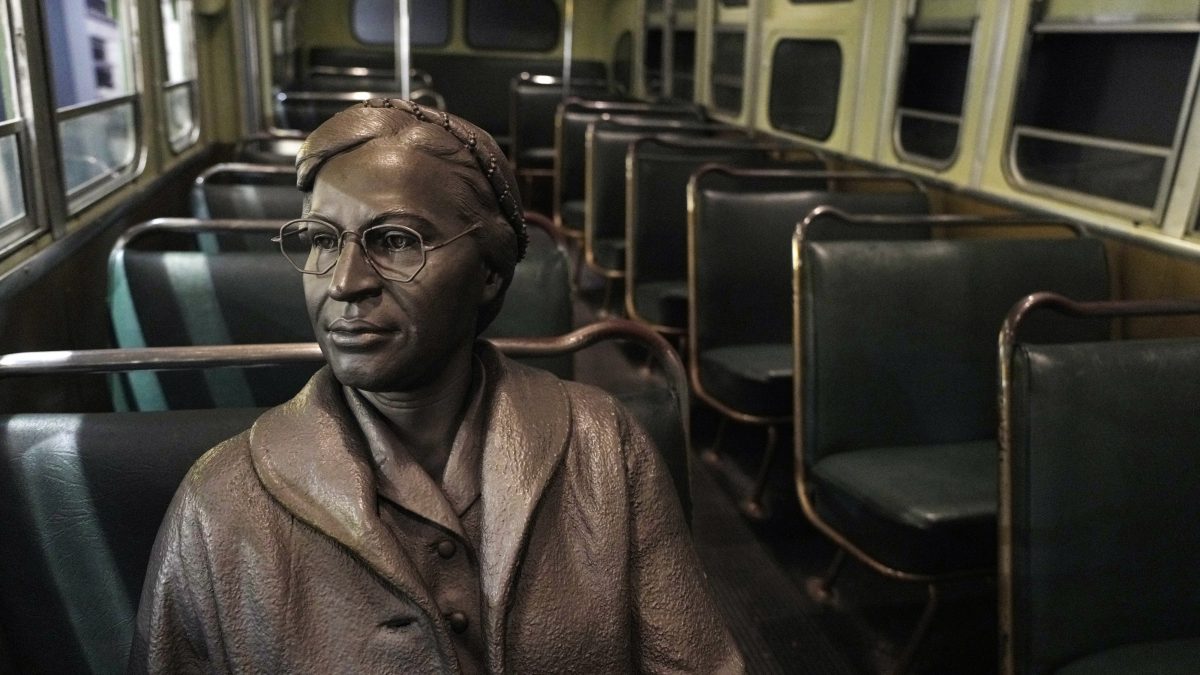
 "A statue of civil rights icon Rosa Parks sits in a bus as part of an exhibit inside the National Civil Rights Museum in Memphis, Tennessee, US. Reuters")
One woman and her courage were all it took to begin one of the most famous civil rights movements in the world. The American civil rights movement began when Rosa Parks refused to give up her seat to a white passenger on a segregated city bus in Montgomery, Alabama, on December 1, 1955.
If you are a history geek who loves to learn about important events from the past, Firstpost Explainers’ ongoing series, History Today will be your one-stop destination to explore key events.
On this day in 1913, the Ford Motor Company revolutionised industrial manufacturing when it introduced the moving assembly line at its Highland Park plant in Detroit, Michigan.
Here is all that took place on this day across the world.
Rosa Parks’s refusal to relinquish her bus seat
Rosa Parks sparked a pivotal moment in the American civil rights movement when she refused to give up her seat to a white passenger on a segregated city bus on December 1, 1955.
At the time, Montgomery’s laws enforced strict racial segregation on public transportation - Black riders were required to sit in the “colored section” and could be asked to surrender their seats if the white section filled. Parks, a 42-year-old seamstress and long-time National Association for the Advancement of Coloured People (NAACP) activist, had endured these indignities for years.
That evening, Parks boarded the Cleveland Avenue bus after work and sat in the first row of the coloured section. When the bus became crowded, the driver ordered her and three other Black passengers to vacate their seats. The others complied, but Parks quietly refused. Her defiance was not due to physical fatigue; rather, she later explained she was tired of giving in to a system that demeaned her dignity. The driver called the police, and Parks was arrested and charged with violating segregation laws.
News of her arrest galvanised Montgomery’s Black community. Activists swiftly organised a citywide bus boycott, which later came to be known as the Montgomery Bus Boycott, to begin on the day of Parks’s trial i.e. December 5. That morning, thousands of Black riders refused to board city buses, choosing instead to walk, carpool, or arrange alternative transportation. The protest led to the rise of a young pastor, Dr Martin Luther King Jr, who emerged as a central figure in the movement.
The Montgomery Bus Boycott lasted 381 days and ultimately led to a US Supreme Court ruling declaring bus segregation unconstitutional. Rosa Parks’s quiet act of defiance became an enduring symbol of resistance and moral courage, demonstrating how one determined individual could ignite a transformative national movement for justice and equality.
Ford’s assembly line started rolling
The Ford Motor Company revolutionised industrial manufacturing when it introduced the moving assembly line at its Highland Park plant in Michigan’s Detroit on this day in 1913. This innovation dramatically transformed not only the automotive industry but also global manufacturing practices.
Before the assembly line, cars were built by skilled workers who assembled an entire vehicle from start to finish. This process was slow, labour-intensive and expensive. Inspired by methods used in meat-packing plants and other industries, Henry Ford and his team sought to create a more efficient system. By breaking down vehicle production into 84 distinct steps and assigning each worker a single, repetitive task, they laid the foundation for a new manufacturing model.
The key breakthrough came with the introduction of a moving conveyor belt, which brought parts directly to workers instead of forcing them to move around the factory floor. When the assembly line officially began operating, the production time for a Model T chassis dropped from over 12 hours to just 93 minutes. This extraordinary increase in efficiency enabled Ford to produce cars on an unprecedented scale.
With reduced production costs, Ford slashed the price of the Model T from $850 in 1908 to about $300 by the 1920s, making automobiles affordable for a much wider segment of the public. Meanwhile, to keep up with the demands of repetitive labour, Ford introduced the famous $5-a-day wage in 1914, more than doubling average factory pay and setting new standards for industrial labour.
This Day, That Year
The first World Aids Day was held in 1988.
The Antarctic Treaty was signed by 12 countries in 1959.
Russian Emperor Alexander I died unexpectedly in southern Russia in 1825.
With inputs from agencies