

 "From Kolkata to Delhi, how Hindu man’s lynching in Bangladesh has fired up Indians")
The lynching of a Hindu man in Bangladesh has left India roiled.
On Thursday, as news of the death of Sharif Osman Hadi spread, Dipu Chandra Das, a Hindu youth, was lynched by a mob. The incident, which occurred in Bhaluka’s Mymensingh, saw Das accused of blasphemy. The garment factory worker was beaten to death, his body hung from a tree and then set ablaze.
Since then, a dozen people have been arrested by authorities in Bangladesh. The Bangladesh government on Friday had missed its first comment on the lynching, saying that “the perpetrators of this heinous crime will not be spared”.
The Ministry of External Affairs (MEA) has called Das’ killing “horrendous” and demanded the protection of all minorities in Bangladesh. “India continues to keep a close watch on the evolving situation in Bangladesh. Our officials remain in touch with Bangladesh authorities and have conveyed to them our strong concerns at the attacks on minorities. We have also urged that the perpetrators of the barbaric killing of Das be brought to justice,” MEA spokesperson Randhir Jaiswal has said.
But what has been the wider reaction in India?
Let’s take a closer look.
Street protests
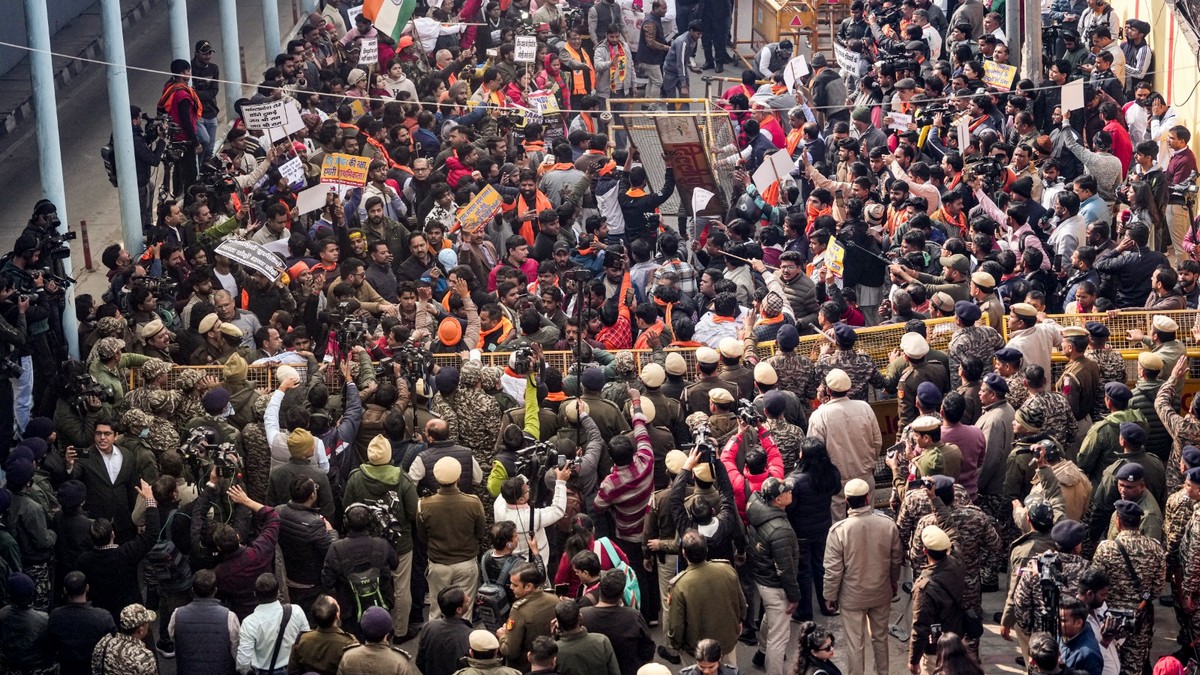
In Delhi, several Hindu groups, including the Vishwa Hindu Parishad (VHP), congregated near the Durgabai Deshmukh South Campus Metro Station to protest against the killing of Das and atrocities against Hindus in Bangladesh.
The protest, led by members of the Vishwa Hindu Parishad (VHP) and other Hindu organisations, was called to condemn what they described as atrocities against Hindus in Bangladesh and the recent mob lynching of Dipu Chandra Das in Mymensingh.
Protesters raised slogans such as “Yunus sarkar, hosh mein aao” and also chanted religious verses, including the Hanuman Chalisa. Protesters were seen holding up banners condemning the attacks on Hindus in Bangladesh. VHP members tried to march on the Bangladesh High Commission but were stopped by authorities. Protesters were told they would not be allowed to proceed towards the Bangladesh High Commission or enter the Diplomatic Enclave under any circumstances.
The VHP on Monday said that India should not remain a silent spectator to the events occurring in Bangladesh.
“Bharat has a long and proud tradition of standing with oppressed and persecuted communities across the world. We strongly urge the government to take all possible diplomatic, political, and humanitarian measures,” VHP president Alok Kumar was quoted as saying.
He also demanded that Yunus’ Nobel Prize be withdrawn.
“Any leadership which fails to protect minorities and maintain law and order has no moral right to enjoy international recognition or legitimacy,” he said.
In Kolkata, several Opposition politicians, including BJP leader Suvendu Adhikari, staged a protest outside the Bangladesh Deputy High Commission. Adhikari was accompanied by several Congress members. Adhikari had attempted a march on the High Commission in Beck Bagan. Several Hindu monks also joined in; however, the march was halted by the police after security concerns. The demonstration also saw effigies of Yunus being burned.
On Saturday, there were reports that the protesters were removed from outside the Bangladesh High Commission around 9 pm. According to reports, the men had reached the spot in three to four vehicles. Police and paramilitary units were positioned outside the embassy.
The Ministry of External Affairs (MEA) said around two dozen youths had gathered in front of the Bangladesh High Commission in New Delhi on Saturday to protest Das’ killing. The MEA also noted “misleading propaganda” in sections of the Bangladesh media over the incident. Bangladesh media claimed that “Hindu extremists” had protested outside the High Commission in New Delhi. Bangladesh’s Ministry of Foreign Affairs called the incident “unjustifiable” and “highly regrettable”.
In the statement, Bangladesh’s foreign ministry said, “The miscreants were allowed to carry out their activities right outside the perimeters of the High Commission, creating panic among the personnel inside the complex. The High Commission was not given advance information about this organised event.”
Foreign affairs adviser Md Touhid Hossain claimed that the situation left the Bangladesh High Commissioner and his family feeling under threat.
“The fact is that about 20–25 youths gathered in front of the Bangladesh High Commission in New Delhi on December 20 and raised slogans in protest against the horrendous killing of Dipu Chandra Das in Mymensingh, while also calling for the protection of all minorities in Bangladesh,” Jaiswal responded.
On Sunday, security was stepped up outside the Bangladesh High Commission in Chanakyapuri.
Politicians, NGOs condemn incident
A number of politicians have condemned the incident.
Congress leader Shashi Tharoor on Saturday wrote on X, “An unbearably tragic incident amid the mob rule that is raging across Bangladesh.”
“While mourning the loss of this poor Hindu man at the hands of unspeakable criminals, I appreciate the condemnation issued by the Government of Bangladesh but must ask them what they are doing to punish the murderers and what steps they are taking to ensure that such incidents do not recur?” Tharoor enquired.
Andhra Pradesh Deputy Chief Minister Pawan Kalyan slammed Bangladesh over the incident.
Congress leader Priyanka Gandhi Vadra last week called the lynching “extremely disturbing” and called on the Indian government to take up the issue of the safety of minorities with the Bangladesh regime.
“The news of the brutal murder of Hindu youth Dipu Chandra Das by a mob in Bangladesh is extremely disturbing. In any civilised society, discrimination, violence, and murder based on religion, caste, or identity are crimes against humanity,” Priyanka Gandhi said in a post in Hindi on X.
“The Indian government should take note of the increasing violence against Hindu, Christian, and Buddhist minorities in the neighbouring country and raise the issue of their safety and security forcefully with the Bangladeshi government,” she said.
The Idea of India (IOI) Foundation think tank, which is based in Mumbai, also condemned the “brutal murder and mob lynching” of Das. Foundation chief Mohammed Umar Siddiqui, in the statement, said that the barbaric incident represented a direct attack on human rights. The foundation said it will send Yunus a formal appeal alongside a memorandum of demands.
Muslim groups add voices to condemnation
Jamiat Ulama-e-Hind president Maulana Mahmood Madani called Das’ killing “very shameful” and asserted that it was against the teachings of Islam.
“When Muslims do such things, we hang our heads in shame, and this cannot be condemned enough. Firstly, no one in a civilised society should have the right to kill another human being. No matter how wrong someone has acted, there is a process for punishment, and that process should be followed. Furthermore, if the perpetrators are Muslims and the victim is a non-Muslim, then the crime becomes even more heinous. We strongly condemn this.”
“Killing someone, or even humiliating someone, is something that Islam does not permit. Islam does not permit it at any cost. No amount of condemnation is enough. Yes, it is unfortunate that extremism is increasing throughout this entire subcontinent, and it must be curbed. It must be countered in this region and worldwide. The world is also facing a similar situation, which must be countered,” he further added.
Meanwhile, Maulana Mehdi Hasan Aini Qasmi, president of the Deoband Alumni Federation, called the incident heinous, cowardly and inhuman. Qasmi also called for inter-faith dialogue and peace.
“Our world today needs bridges, not walls; understanding, not hostility. Standing firmly against religious hatred and violence is a shared moral responsibility of all people of conscience,” the statement read.
With inputs from agencies


 "‘Bangladesh’s Yunus govt failed to control ‘mobocracy’’: BNP leader on attack on Indian mission")
 "Tarique Rahman to return to Bangladesh after 17 years: Can Khaleda Zia’s son influence February elections?")
 "US Congressmen raise alarm over anti-Hindu violence in Bangladesh")
 "‘Time to Kash out’: Why Kash Patel’s choice of new wheels has sparked a row")
 "‘Bangladesh’s Yunus govt failed to control ‘mobocracy’’: BNP leader on attack on Indian mission")
 "Tarique Rahman to return to Bangladesh after 17 years: Can Khaleda Zia’s son influence February elections?")
 "US Congressmen raise alarm over anti-Hindu violence in Bangladesh")
 "‘Time to Kash out’: Why Kash Patel’s choice of new wheels has sparked a row")



