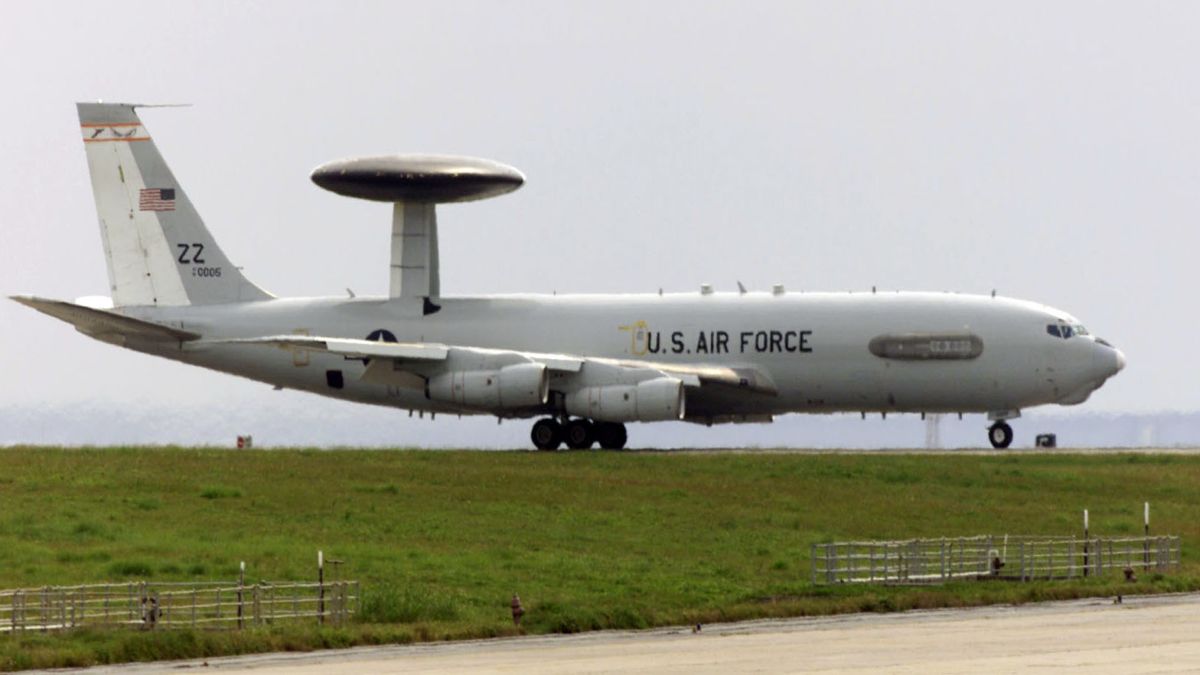
 "The E-3 Sentry airborne warning and control system aircraft (AWACS) is considered among the most precious assets in America’s conventional arsenal. File image/Reuters")
Since the Iran war began, there are reports that the US has been spending billions of dollars per day.
This includes the assets lost, which some have pegged between $1.4 and $2.9 billion (Rs 13,241 crore to Rs 27,428 crore) in the first three weeks of the conflict.
Little wonder the Pentagon has sent a request for $200 billion (Rs 18,91,600 crore) in funds for the war to the White House.
Now, Iran has taken out yet another US asset – the E-3 Sentry airborne warning and control system (AWACS) aircraft. But which assets has the US lost in Iran? What do we know about them?
Let’s take a closer look
AWACS
The AWACS is essentially “a modified Boeing 707/320 commercial airframe and has a rotating radar dome”. It was introduced in the US Air Force in 1977.
With a radar of over 375 kilometres, it is used to track drones, missiles and aircraft that are far away. This allows it to provide “situational awareness of friendly, neutral and hostile activity, command and control of an area of responsibility”. The AWACS also provides “all-altitude and all-weather surveillance of the battle space, and early warning of enemy actions during joint, allied and coalition operations”.
The AWACS can fly for eight straight hours without refuelling. It can also be refuelled while in the air, which increases its range and time. The US has 16 E-3 Sentry aircraft in service. The US Air Force has sent six of these to Europe and West Asia since the beginning of the Iran war.
Experts say the importance of the AWACS cannot be downplayed.
Retired US Air Force Colonel John Venable told the Wall Street Journal the development “hurts the US ability to see what’s happening in the Gulf and maintain situational awareness”.
“It’s a significant loss for the war in the short term,” Kelly Grieco, a defence policy expert and senior fellow at the Stimson Center think tank, told Air & Space Forces Magazine. “That has a consequence. There are going to be coverage gaps.”
Heather Penney, a former F-16 pilot and director of studies and research at the Mitchell Institute for Aerospace Studies think tank, added, “The loss of this E-3 is incredibly problematic, given how crucial these battle managers are to everything from airspace deconfliction, aircraft deconfliction, targeting and providing other lethal effects that the entire force needs for the battle space”.
KC135 tankers
The Islamic Resistance of Iraq has claimed to have downed a KC135 Stratotanker in western Iraq during Operation Epic Fury earlier this month.
Six US service members were killed in the incident. However, CENTCOM claimed that this was “not due to hostile fire or friendly fire”.
According to CNN, the KC135 is essentially a flying gas station. The craft has provided refuelling to Air Force, Navy, Marine Corps and allied nation aircraft for over six decades. It can also transport litter and ambulatory patients.
The KC135 is powered by four turbofans mounted under 35-degree swept wings. It can carry up to 322,500 pounds and hold up to 83,000 pounds of cargo.
The KC135 pumps fuel via the flying boom. Here, a crew member, known as the boom operator, stands at the back of the plane and controls the boom during mid-air refuelling.
The US has around 396 Stratotankers, of which the Air Force Reserve and Air National Guard have 243 aircraft. The KC135 is no longer being manufactured.
Jets
F-15E Strike Eagle
The US lost three F-15 Strike Eagle fighter jets in Kuwait on March 3 , in what was reportedly an incident of friendly fire.
F-15E Strike Eagle is an upgraded, two-seat, all-weather version of the fighter. It is capable of deep interdiction/attack, tactical nuclear delivery and air-to-air combat. The F-15E Strike Eagle is descended from the McDonnell Douglas F-15A. That craft, a large single-seat twin-engine fighter, was developed in the 1970s. It was introduced as a counterpart to the MiG-25.
Powered by two Pratt & Whitney F100-PW-220s, the craft is capable of hitting 9Gs. It first saw combat in 1991 during Operation Desert Storm. The F-15 has a history of utter dominance during conflicts. Not a single F-15 has been lost while it has 104 air-to-air kills to its credit. The F-15E Strike Eagle was formulated with the US Air Force in mind. Boeing has recently developed the F-15EX Eagle II as a replacement for ageing F-15C Eagles and to complement its F-22 and F-35s.
F-35A Lightning II
Iran reportedly hit the F-35A Lightning II over its airspace on November 19 . US CENTCOM, while confirming that the plane was hit and that the pilot was safe, declined to mention what went wrong with the F-35A.
This would be the first time in history that a country has managed to hit the F-35A Lightning II, which is considered the world’s most advanced multirole fighter jet. Only 1,300 F-35s have been delivered thus far. Each state-of-the-art aircraft over its life cycle costs a whopping $2 trillion (Rs 18,91,60,000 crore).
Lockheed Martin states on its website, “The F-35 brings a decisive advantage to the battlespace, providing an asymmetric advantage across the multi-domain spectrum. The F-35’s transformational capabilities enable pilots to operate in any environment, against any threat”.
The single-seat aircraft is available in three variants – conventional take-off and landing (CTOL), short take-off/vertical landing (STOVL) and carrier variant (CV).
The F-35A Lightning II fighter plane is operated by the US Air Force, Navy and Marine Corps, as well as forces of 10 other countries.
Drones
MQ-9 Reaper drones
The MQ-9 Reaper is also known as the Predator B drone. The United States has lost at least a dozen such drones since the beginning of the conflict. Of these, eight have been taken out by Iranian missiles, three downed on the ground and one by a nation in the Persian Gulf.
The MQ-9 has an endurance of over 27 hours and can operate up to 50,000 feet. The Reaper is 11 metres long and has a wingspan of over 22 metres. It has a 240 knots true airspeed (KTAS) and a 1,746 kilogram payload capacity, including 1,361 kilograms of external stores.
The MQ-9 Reaper drone can carry multiple mission payloads, including “electro-optical/infrared (EO/IR), Lynx multi-mode radar, multi-mode maritime surveillance radar, electronic support measures (ESM), laser designators, and various weapons and payload packages”.
The ‘M’ stands for multi-role, the ‘Q’ refers to a remotely piloted aircraft system and the ‘9’ means the ninth in the series of remotely piloted aircraft systems. The UAV is remotely operated by a two-member crew comprising the pilot and an aircrew member to operate the sensors and weapons.
The Reaper is capable of employing “eight laser-guided missiles, air-to-ground missile-114 Hellfire, which possess highly accurate, low-collateral damage, anti-armour and anti-personnel engagement capabilities”.
The maritime variant of the MQ-9B drone is called SeaGuardian, while the other variant is known as SkyGuardian. The Reaper’s predecessor, framed as the Predator drone, was used in the Iraq and Afghanistan wars where it caused a high number of civilian casualties in “precision strikes”. A single MQ-9 costs $16 million (Rs 151.33 crore) and the newer MQ-9B variant costs around $30 million (Rs 283.74 crore).
“THAAD” anti-missile system
There are reports that a Terminal High Altitude Area Defense (THAAD) system was taken out in the UAE at Al-Ruwais base by missiles launched by the IRGC Aerospace Force.
Built by Lockheed Martin, THAAD is a sophisticated missile defence system designed to intercept and destroy short-, medium- and intermediate-range ballistic missiles.
THAAD is a crucial part of the US layered missile defence strategy, which aims to protect against missile attacks from various distances and altitudes. Unlike traditional missile defence systems that use warheads, THAAD employs kinetic energy to destroy missiles in their terminal phase of flight — the final moments when the missile is descending towards its target.
THAAD interceptors do not carry explosive warheads. Instead, they rely on a “hit-to-kill” approach, where the interceptor collides with the incoming missile, destroying it using the sheer kinetic force of impact. Each THAAD battery costs between $1 billion and $2 billion (Rs 9,458 crore to Rs 18,916 crore).
Radar
AN/TPY-2 Radar
An AN/TPY-2 radar in Jordan was taken out by Iran.
This radar, part of the Terminal High Altitude Area Defense ballistic missile defence battery, can detect, track and help take out ballistic missiles. The AN/TPY-2 radar operates on the X-band of the electromagnetic spectrum, which allows it to see targets clearly and differentiate between threats. It works in two modes: forward-based mode and terminal mode.
In forward-based mode, the radar detects ballistic missiles after they are launched. In terminal mode, the radar helps guide interceptors towards an oncoming missile in order to neutralise the threat. In terminal mode, AN/TPY-2 guides the Terminal High Altitude Area Defense ballistic missile defence system by guiding the THAAD missile. The radar costs around $300 million (Rs 2,837.4 crore).
AN/FPS-132 Radar
An AN/FPS-132 radar was taken out in Qatar’s Al Udeid Air Base, the central hub of US Central Command (CENTCOM) operations in West Asia.
Built by Raytheon, this radar operates in the ultra-high frequency (UHF) band and is designed to detect ballistic missile launches as far as 5,000 kilometres away. It gives real-time tracking information to systems such as THAAD, Patriot missile batteries and Aegis-equipped warships.
Costing a whopping $1 billion (Rs 9,458 crore), there are just five such operational radars in the world.
FAQs
1) What is the latest US asset lost in the Iran war?
The E-3 Sentry AWACS aircraft is the latest US asset lost in the Iran war.
2) How much has the US lost in military assets so far?
Estimates suggest losses between $1.4 billion and $2.9 billion (Rs 13,241 crore to Rs 27,428 crore) within the first three weeks of the conflict.
3) Why are systems like THAAD and AN/TPY-2 radar important?
These systems form a critical part of the US missile defence network, helping detect, track and intercept incoming ballistic missile threats.
With inputs from agencies