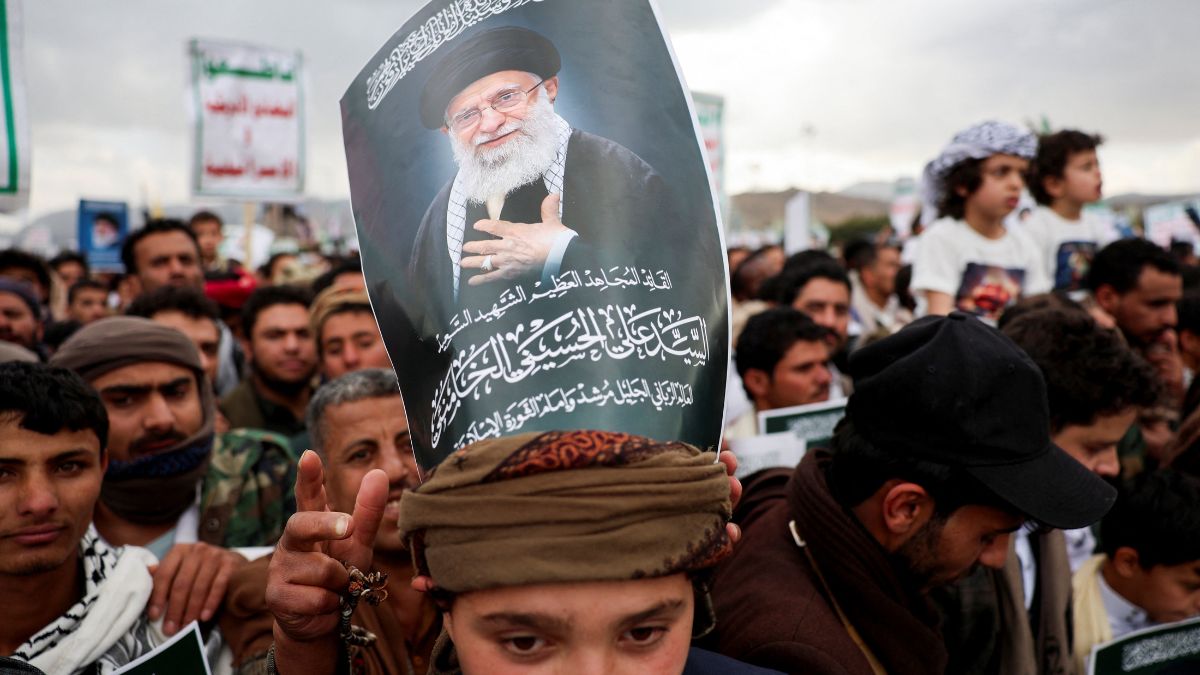
 "Why have Yemen’s Houthis entered the West Asia war now?")
Yemen’s Iran-aligned Houthi movement is now an active participant in the ongoing confrontation between the United States-Israel and Iran.
Their weekend missile and drone launches towards Israel mark the first such attacks since the current conflict began, signalling a potential widening of the war across multiple fronts in West Asia.
Who are the Houthis?
The Houthis, formally known as Ansar Allah, are a political, military, and religious movement based in northern Yemen.
Led by members of the Houthi family, the group follows the Zaydi branch of Shi’ite Islam and has evolved over the past two decades from a local insurgency into a key player in regional geopolitics.
Their rise accelerated in the aftermath of the 2011 Arab Spring protests, which destabilised Yemen’s political system. Taking advantage of the turmoil, the Houthis expanded their territorial control and, in 2014, seized the capital, Sanaa.
This prompted a military intervention in 2015 led by Saudi Arabia and supported by a coalition of Arab states, aimed at restoring the internationally recognised government.
Despite years of intense fighting, the Houthis retained significant control over large parts of Yemen, particularly in the north and along the Red Sea coastline.
The conflict led to widespread devastation and was described as one of the world’s most severe humanitarian crises before a truce brokered by the United Nations in 2022 brought a relative pause in hostilities.
During this period, the Houthis developed increasingly sophisticated military capabilities. They demonstrated the ability to deploy ballistic missiles, drones, and anti-ship weapons, targeting oil facilities and infrastructure in Saudi Arabia and the United Arab Emirates.
The United States has consistently maintained that Iran has played a role in equipping, funding, and training the Houthis, often with support from Lebanon’s Hezbollah.
The Houthis, however, have rejected these claims, asserting that their weapons are domestically produced and that their decision-making is independent.
Why have the Houthis entered the conflict at this stage?
The Houthis’ decision to launch attacks now comes after weeks of escalating tensions in the region. A month into the US-Israeli confrontation with Iran, Israel detected a missile launched from Yemen, marking the first such instance since the current phase of the conflict began.
This move followed repeated warnings from the group. On March 5, Houthi leader Abdul Malik Al-Houthi signalled readiness for military action, stating, “Regarding military escalation and action, our fingers are on the trigger at any moment should developments warrant it.”
The group reiterated this stance as the conflict boiled, declaring that it would act if what it described as escalation against Iran and the “Axis of Resistance” continued. Within hours of such warnings, Israel reported detecting a missile launch originating from Yemen.
Subsequently, the Houthis confirmed carrying out attacks using both missiles and drones, including a second strike within a 24-hour period. Their military spokesperson Yahya Saree said the operations would continue in the coming days, indicating that this was not a one-off action but part of a broader strategy.
Nasr al-Din Amer, a member of the Houthis’ politburo, told CNN, “The truth is, (Israel is) at war with us and in a state of continuous aggression against us.”
He added, “They have not stopped, nor have they concealed their pursuit of what they call ‘Greater Israel’ and ‘changing the Middle East.’”
Houthi leader Abdel-Malik Houthi also emphasised the group’s alignment with Iran, stating that Yemenis “repay loyalty with loyalty, and Iran was the only state, officially, that stood with us against the aggression on our country.”
At the same time, analysts suggest that the group’s actions are calibrated. Yemeni analyst Mohammad Basha noted on X, “It lets them restart military action without getting pulled into a wider fight with the U.S. or Saudi Arabia.”
My commentary published in @ArgusMedia :
— Basha باشا (@BashaReport) March 28, 2026
Mohammed al-Basha — founder of a consultancy specialising in Middle East risk analysis — said today's strike was intended as a signal rather than a step into full-scale war, allowing the Houthis to act militarily without being drawn into a…
He added, “Their main focus is still the Palestinian cause. By striking Israel, they are telling people in Yemen, their partners in the Iran-backed network, and supporters abroad that their priority has not changed.”
Why had the Houthis stayed out of the war until now?
Despite their rhetoric and alignment with Iran, the Houthis had not formally joined the conflict in its earlier stages. Unlike other Iran-aligned groups such as Hezbollah in Lebanon or armed factions in Iraq, they refrained from immediate military engagement.
One reason lies in their distinct ideological structure. While Iran considers the Houthis part of its broader “Axis of Resistance,” the group does not adhere to Iran’s supreme leadership in the same way as Hezbollah or certain Iraqi militias.
This allows for a degree of autonomy in decision-making.
Experts on Yemen have noted that the Houthis are primarily driven by domestic objectives, even as they maintain political and strategic ties with Iran and other regional actors. Their involvement in the Yemen conflict, including longstanding tensions with Saudi Arabia, continues to shape their priorities.
Another factor is strategic timing. Some observers believe the Houthis deliberately delayed their involvement to maximise impact, potentially coordinating their actions with broader developments in the region.
Their earlier statements suggest a cautious approach. Rather than immediately committing to the conflict, they indicated readiness to act depending on how the situation evolved. This approach allowed them to retain flexibility while monitoring the trajectory of the war.
Additionally, their leadership has sought to balance regional engagement with domestic considerations.
Much of Abdel-Malik Houthi’s recent messaging has been directed at Saudi Arabia, including demands for compensation linked to the blockade and the effects of the 2015-2022 military campaign.
How significant are the Houthis’ military capabilities?
Although the Houthis have demonstrated the ability to strike targets at considerable distances, their direct impact on Israel has so far been limited. Between 2023 and 2025, they launched nearly 100 missiles and over 300 drones towards Israel, resulting in only one fatality, reported CNN.
Their recent attacks appear to follow a similar pattern, with Israel confirming missile launches but reporting no casualties or significant damage. However, their capabilities extend beyond direct strikes on Israel.
The Houthis possess a range of weapons, including drones and anti-ship missiles, that have proven effective in targeting infrastructure and maritime assets.
Their past operations against Saudi Arabia and the United Arab Emirates highlight their ability to strike critical facilities, including oil installations.
The group’s control over Yemen’s Red Sea coastline, including the port of Hodeidah, enhances their ability to influence maritime activity. This geographic advantage, combined with their arsenal, positions them as a significant threat to shipping routes.
Their involvement in the Gaza war illustrated this capability. In response to Israel’s military campaign, the Houthis targeted more than 100 ships in the Red Sea, leading to disruptions in global shipping and increased insurance costs.
Why is the Red Sea and Bab al-Mandab Strait so crucial?
One of the most significant implications of the Houthis’ involvement lies in their potential to disrupt key maritime chokepoints.
The Bab al-Mandab Strait, located between Yemen and the Horn of Africa, connects the Red Sea to the Gulf of Aden and serves as a gateway to the Indian Ocean. At its narrowest point, it is approximately 29 kilometres wide.
This route is vital for global trade, with nearly 15 per cent of the world’s maritime commerce passing through it. It is particularly important for the transportation of crude oil, liquefied natural gas, and other commodities moving between the Gulf, Europe, and Asia.
The Houthis have explicitly indicated that targeting this chokepoint is under consideration. Mohammed Mansour, the group’s deputy information minister, said they are “conducting this battle in stages, and closing the Bab al-Mandeb strait is among our options”.
Such a move would have far-reaching consequences. The Strait of Hormuz, another critical passage for global energy supplies, has already seen significant disruption, with most shipping traffic curtailed.
If the Bab al-Mandab Strait were similarly affected, it would compound the impact on global trade and energy markets.
Shipping companies have already shown caution. Major operators have previously rerouted vessels around southern Africa to avoid the Red Sea, adding significant time and cost to voyages. Industry estimates suggest that earlier disruptions in the region cost approximately $20 billion annually.
Ports along the Red Sea, including those in Saudi Arabia, have also seen increased activity as trade patterns shift. This includes the port of Yanbu, which is handling rerouted oil exports, and Jeddah, which is managing higher volumes of container traffic.
Both locations could become potential targets if the conflict escalates further.
Could the conflict expand further across the region?
The Houthis’ entry into the conflict raises the possibility of a broader regional war involving multiple actors and theatres. Israel has already acknowledged the threat and indicated that it is preparing for sustained engagement on this front.
Israel Defense Forces spokesperson Nadav Shoshani said, “We have to be ready for this becoming a part of this war, and that’s how we’re preparing for it.”
He added, “We’re taking their word and preparing to defend ourselves for as long as needed from that front as well.”
The United States, meanwhile, has deployed additional forces to the region, including Marines, as part of its broader military posture. US Secretary of State Marco Rubio said the US expected to conclude its operations within weeks, even as reinforcements arrived.
The Houthis have also issued warnings regarding further escalation. They have indicated that they could expand their operations if other countries join the war against Iran or if the Red Sea is used as a staging ground for attacks.
If the Houthis resume large-scale attacks on shipping or infrastructure, it could significantly alter the trajectory of the conflict, drawing in additional actors.
With inputs from agencies

 "Iran War Live Updates: Israel strikes Tehran as Trump says Iran deal could be reached 'soon'")
 "Is the US preparing for ground offensive in Iran?")
 "Marines arrive, Houthis join, aluminum plants hit: Iran war is widening faster than diplomacy can contain it")
 "India-Canada ties 're-normalising': India's former envoy says was 'treated like a criminal' during Nijjar crisis")
 "Iran War Live Updates: Israel strikes Tehran as Trump says Iran deal could be reached 'soon'")
 "Is the US preparing for ground offensive in Iran?")
 "Marines arrive, Houthis join, aluminum plants hit: Iran war is widening faster than diplomacy can contain it")
 "India-Canada ties 're-normalising': India's former envoy says was 'treated like a criminal' during Nijjar crisis")