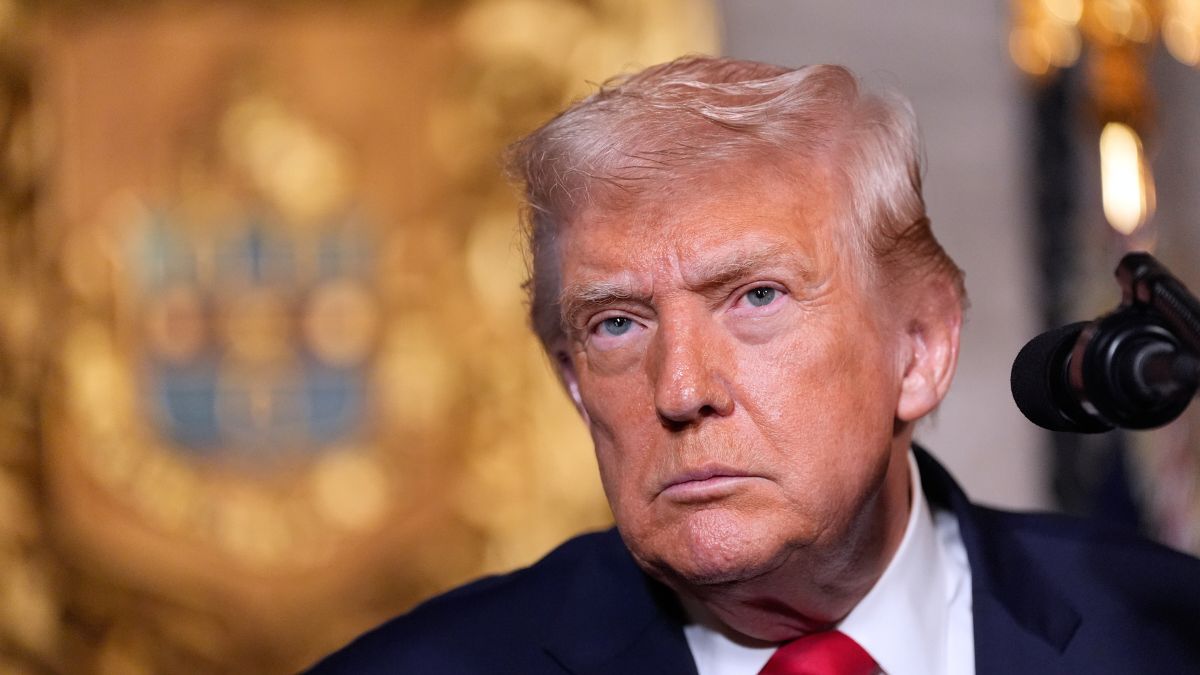
 "US President Donald Trump has been flagging violence against Christians in Nigeria for months. File Photo/AP")
The United States carried out airstrikes against the Islamic State targets in northwestern Nigeria, President Donald Trump announced on Thursday (December 25). The attack comes amid the American leader’s claims of the terrorist group persecuting Christians in the region.
In a post on Truth Social, Trump said that he ordered the US military to launch a “powerful and deadly strike against ISIS Terrorist Scum in Northwest Nigeria, who have been targeting and viciously killing, primarily, innocent Christians, at levels not seen for many years, and even Centuries!”
US Africa Command (Africom) and the Nigerian government have confirmed the strikes.
Let’s take a closer look.
US military strikes ISIS in Nigeria
The US military’s Africa Command said it conducted strikes in Sokoto state, which borders Niger to the north, that killed several terrorists.
The attack targeted two ISIS camps in Sokoto State, a US military official told New York Times (NYT) on the condition of anonymity.
As per Associated Press (AP), officials say the targets were likely members of Islamic State Sahel Province (ISSP), known locally as Lakurawa. The group has become more prominent in border states like Sokoto and Kebbi in the last year, often targeting remote communities and security forces.
The US attacks were “in coordination with Nigerian authorities.” Africom’s initial assessment is that “multiple Isis terrorists were killed in the Isis camps,” as per a news release.
In a now-deleted statement posted on X, Africom said it had conducted the strikes at the “request” of Nigerian authorities, CNN reported.
A video posted by the Pentagon showed the launch of at least one projectile from a warship.
Quick Reads
View AllUS Defense Secretary Pete Hegseth said he was “grateful for Nigerian government support & cooperation.”
Confirming the attack, Nigeria’s foreign ministry said early Friday (December 26) morning that precision air strikes hit “terrorist targets” in the West African country’s northwest. It further stated that it remains engaged with the US in “structured security cooperation.”
American President Donald Trump wrote on his Truth Social post, “I have previously warned these Terrorists that if they did not stop the slaughtering of Christians, there would be hell to pay, and tonight, there was. The Department of War executed numerous perfect strikes, as only the United States is capable of doing.”
“Under my leadership, our Country will not allow Radical Islamic Terrorism to prosper. May God Bless our Military, and MERRY CHRISTMAS to all, including the dead Terrorists, of which there will be many more if their slaughter of Christians continues,” he concluded.
In a statement to CNN, Daniel Bwala, special advisor to Nigerian President Bola Tinubu, said: “The US and Nigeria are on the same page in the fight against terrorism.”
Bwala told The Washington Post that the Nigerian government “considers the repeated emphasis on Christian killings as needless because firstly terrorists don’t target any particular religion and, secondly, the rhetoric along that line will only feed into the desire of the terrorists to further create a broader crisis.”
In a Christmas message posted on X before Trump’s announcement, Nigerian President Bola Ahmed Tinubu called for peace in his country, “especially between individuals of differing religious beliefs.”
He also said he would do “everything within my power to enshrine religious freedom in Nigeria and to protect Christians, Muslims, and all Nigerians from violence.”
Why US targeted Islamic State in Nigeria
The US strikes come after months of allegations by Christian evangelical groups and senior Republicans that Christians were being targeted in widespread violence in Nigeria.
The US president has repeatedly made references to what he said was the killing of innocent Christians in Nigeria.
In late October, Trump accused Nigeria of religious freedom violations, saying that Christianity faces an “existential threat” in the West African nation. Later, he designated the nation as a “Country of Particular Concern” under the International Religious Freedom Act, as per CNN.
After the US designation, Nigerian President Tinubu said on November 1 that the characterisation of Nigeria as “religiously intolerant does not reflect our national reality, nor does it take into consideration the consistent and sincere efforts of the government to safeguard freedom of religion and beliefs for all Nigerians.”
He said that the Nigerian government is “committed to working with the United States government and the international community to deepen understanding and cooperation on [the] protection of communities of all faiths.”
Last month, Trump wrote on Truth Social that he directed the Pentagon to “prepare for possible action” in Nigeria after accusing the country’s government of failing to stop violence against Christians.
He threatened to immediately stop all aid and assistance to Africa’s most populous country, warning that the US would enter Nigeria “guns-a-blazing” to protect the Christian population and “completely wipe out the Islamic Terrorists who are committing these horrible atrocities.”
“If we attack, it will be fast, vicious, and sweet, just like the terrorist thugs attack our CHERISHED Christians! WARNING: THE NIGERIAN GOVERNMENT BETTER MOVE FAST!” Trump said in his post last month.
Following Trump’s order, US Africa Command in November chalked up plans to target insurgents in Nigeria and sent them to the Pentagon and the White House. These options included airstrikes on the few known compounds in northern Nigeria used by militant groups, officials told NYT.
The Christmas attack in Nigeria comes after Reuters reported earlier this week that the US had been conducting intelligence-gathering flights over large parts of Nigeria since late November.
Nigeria rocked by widespread violence
Nigeria has been gripped by an insurgency for more than a decade. The diverse, multiethnic country, which has more than 230 million (23 crore) people, houses both Christians and Muslims. While Muslims dominate the north, Christians primarily reside in the south.
Most insurgent attacks have targeted the northern region.
Nigeria’s government has reportedly said that both Christians and Muslims have been targeted by armed groups. It has also dismissed the assertion of a Christian genocide, saying such claims do not represent a complex security situation and ignore efforts to safeguard religious freedom.
Responding to US Secretary of State Marco Rubio, who decried the “slaughter of thousands of Christians," Bayo Onanuga, Tinubu’s press secretary, called the portrayal “a gross exaggeration of the Nigerian situation,” adding that “Christians, Muslims, churches and mosques are attacked randomly."
On Wednesday, a suicide bombing at a mosque during evening prayers in the town of Maiduguri, in Nigeria’s Borno State, killed five people and injured 35 others. The officials attributed the attack to Boko Haram, an extremist Islamist armed group.
Most violent attacks in Nigeria have been reported in the northeast, where Boko Haram has regularly attacked churches and kidnapped children and killed tens of thousands of people over the past 15 years.
Human rights experts have said more Muslims have been killed by Boko Haram than Christians, Reuters reported.
Speaking to The Washington Post, Aneliese Bernard, a former State Department adviser who has a private consulting firm working in West Africa, said the part of northwest Nigeria, which US strikes targeted, are mostly affected by violence from bandits, who work with the Islamic State-Sahel Province and al-Qaeda affiliate Jama’at Nusrat al-Islam wal-Muslimin (JNIM).
Bernard said evidence to support a specific Islamic State cell in that area is “dubious at best.”
“This feels incredibly reactionary, and it doesn’t feel like it will do anything,” she said of the US strikes. “There is very little evidence that targeted airstrikes reduce armed group activity.”
With inputs from agencies