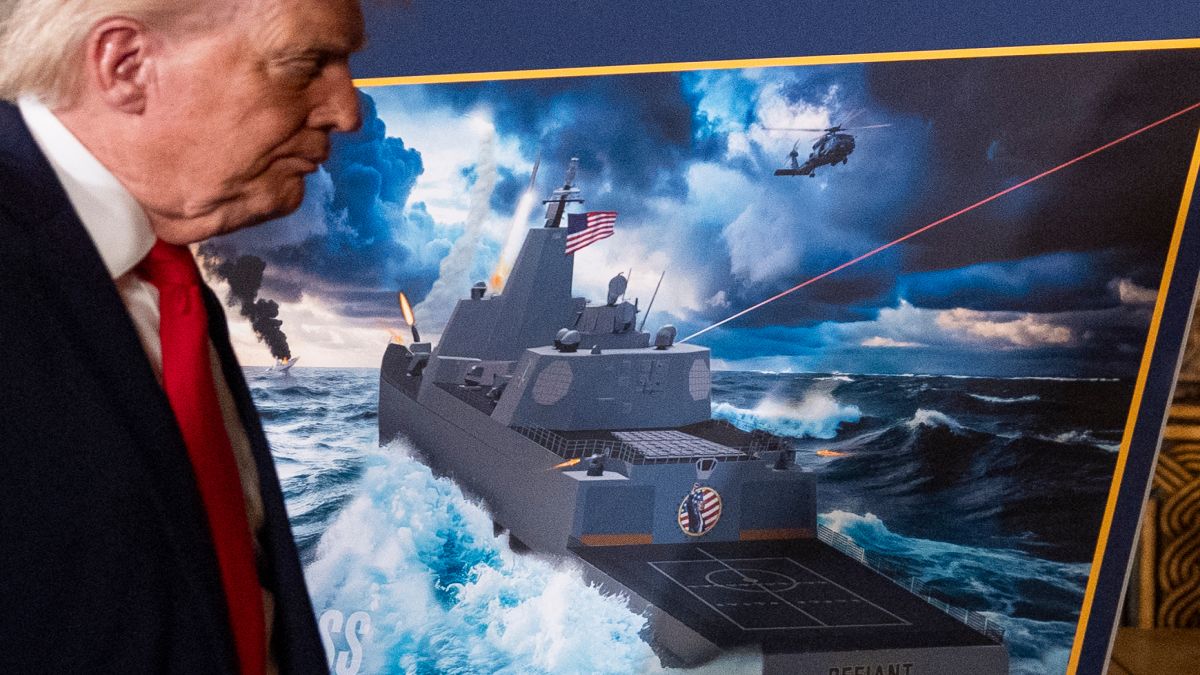
 "US President Donald Trump departs after speaking at his Mar-a-Lago club in Palm Beach, Florida. Trump announced plans for the US navy to build a new generation of warships – known as “Trump-class”. AP")
Donald Trump loves himself. The proof? He just announced plans for the United States navy to build a new generation of warships – known as “Trump-class”.
Making the announcement on Monday, the US president, speaking from his Florida residence, said that the new ‘Trump class’ of battleships will “help maintain American military supremacy, revive the American ship building industry, and inspire fear in America’s enemies all over the world”.
Trump, flanked by his Secretary of War, Pete Hegseth, and Secretary of State, Marco Rubio, further announced that the battleships would form part of a broader naval modernisation drive called the “ Golden Fleet, ” aimed at countering China and other adversaries.
‘100 times more powerful than any battleship ever built’
On Monday, speaking from Mar-a-Lago, Trump announcing the new warships said, “As you know, we’re desperately in need of ships. Some of them have gotten old and tired and obsolete, and we’re going to go the exact opposite direction.”
He then announced the ‘Trump class’ of warships, adding that he would take an active role in their design. “The US navy will lead the design of these ships along with me because I’m a very aesthetic person,” Trump added.
In the past, Trump has complained about the look of some US ships. “I’m not a fan of some of the ships you do. I’m a very aesthetic person and I don’t like some of the ships you’re doing aesthetically,” he had told a gathering at Quantico earlier this year. “They say, ‘Oh, it’s stealth.’ I say that’s not stealth. An ugly ship is not necessary in order to say you’re stealth,” he said.
The US president stated that he had approved the construction of two new battleships to start, with a plan to build up to 25. The first would be named USS Defiant. “They’ll be the fastest, the biggest, and by far, 100 times more powerful than any battleship ever built,” Trump said.
And once completed, Trump said the armed vessels would be equipped to carry hypersonic and “extremely lethal” weapons, and would be the flagships of the US navy. It is reported that the Trump class ships will also be armed with a new nuclear-armed sea-launched cruise missile, or SLCM-N, now in development. The US president noted that the ships would also be command and control platforms, overseeing crewed and uncrewed platforms. Moreover, unspecified artificial intelligence-driven capabilities would be part of the design.
According to documents provided, the ships will weigh between 30,000 and 40,000 tonnes. Moreover, Trump added that they will also “carry the nuclear-armed sea-launched cruise missiles currently under development”.
The US president also said that the new warships would be domestically made, using American steel and assembled by robots and humans.
When asked if the new battleships are meant as a deterrent, Trump said: “It’s a counter to everybody. It’s not China. We get along great with China. It’s just everybody. You don’t know who comes along, but we just wanted peace through strength. Hopefully we never have to use them, but there will never be anything built like these.”
Significance of Trump’s battleships announcement
The timing behind Trump’s announcement of the new battleships is significant. Defence analysts have warned that the US shipbuilding industrial base has struggled to keep pace with demand, citing workforce shortages, fragile supplier networks, ageing infrastructure, and persistent delays at major shipyards.
In fact, according to a report in The Politico, the US Navy has long struggled to build ships on schedule and on budget. Currently, every navy ship under construction is at least a year behind schedule. Shipyards have for years struggled to hire and retain enough employees to work their production lines.
Additionally, a report by the US Congress noted that Washington had fallen significantly behind China when it comes to the number of ships in its navy. Even a report released by the Center for Strategic and International Studies (CSIS) noted that China has grown to be the dominant player in shipbuilding. A CSIS assessment also revealed that China was operating 234 warships, compared with the US navy’s 219, although Washington continued to hold an advantage in guided missile cruisers and destroyers.
Challenges await Trump’s battleship plans
While Trump and his administration hail the move of adding new warships to the US navy, it is not without challenges.
Firstly, there is no clear funding in the current Pentagon budget for the programme, making it unclear when and how the work would start. Moreover, defence analysts believe that Trump’s timeline of delivering the new ships in two-and-a-half years is highly ambitious. Two people close to the project told Politico that the schedule would likely be next to impossible to meet, given the lack of engineering plans for the ship.
Mark Montgomery, a retired US navy officer now with the Foundation for the Defense of Democracies, also added that it would be “a massive life cycle maintenance challenge — the cost of maintaining supply chains, maintenance support and system training for a large number of small ship classes will break the navy’s [operational] budget for decades”.
US Representative Joe Courtney further noted that the plan was “vague”, adding that the “proposal to bring back battleships raises many questions for Congress to scrutinise.” “There is a reason that the US navy stopped building battleships in 1944 and that President Ronald Reagan’s 600 ship fleet didn’t bring them back,” Courtney was quoted as saying by The Politico.
Others also argue that Trump’s idea of the warships is outdated. Some note that large surface ships can be more visible and vulnerable targets in modern, missile-heavy conflicts. Those against the plan note that in an age when Ukrainian drone boats devastated the Russian Black Sea fleet and of hypersonic weapons, the US might benefit from smaller, faster and more nimble ships.
But despite the arguments, Secretary of War, Pete Hegseth, noted that the new vessels would leave future Americans in Trump’s debt. “For decades, for centuries, the American people will look back and thank President Trump for having the vision and the willingness to invest right now in capabilities we need.”
With inputs from agencies