

 "Bangladesh at the brink: How Islamist extremism threatens the nation’s Bengali soul")
For much of its post-independence history, Bangladesh stood apart from other Muslim-majority nations. It was founded not on theology, but on language, culture, and resistance to religious domination. The 1952 Language Movement and the 1971 Liberation War forged a nation where Bengali identity—rooted in pluralism, music, poetry, and ethnic pride—took precedence over religious absolutism. Today, that founding philosophy is under existential threat.
That vision is now under siege as Islamist extremism moves from the fringes towards the centre of national life.
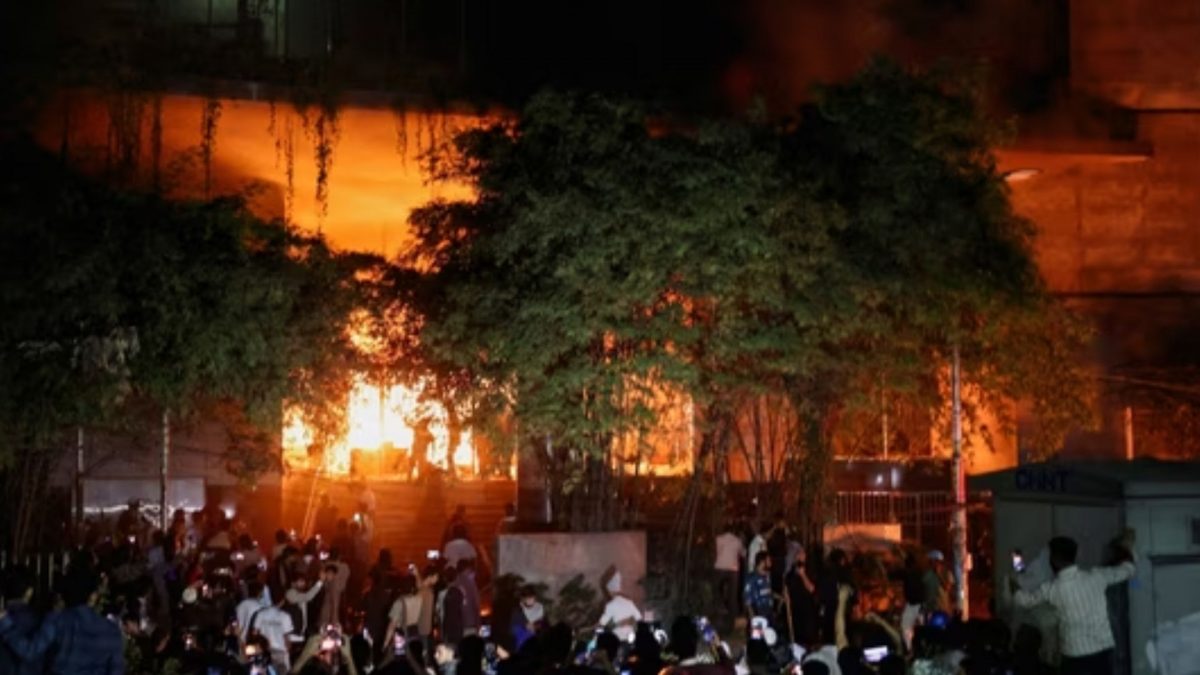
In recent days, radical Islamist groups including Hizb-ut-Tahrir, Ansar al-Islam (Al-Qaeda’s South Asian affiliate), and their street enforcers have carried out coordinated attacks across the country. Offices of two of Dhaka’s largest newspapers were ransacked. Iconic cultural institutions such as Chhayanaut—the cradle of Rabindra Sangeet and Bengali cultural resistance—and Udichi, long associated with secular humanism, were vandalised. These were not symbolic targets chosen by accident; they represent the very soul of Bengali civilisation.
Most horrifying was the public lynching and burning alive of Dipu Chandra Das, a young Hindu falsely accused of blasphemy. After nearly three days of silence, Bangladesh’s elite Rapid Action Battalion (RAB) admitted that it found no evidence whatsoever against him. Video footage shows police handing Dipu over to Islamist mobs, who murdered him while chanting jihadist slogans: “Naraye Takbir, Allahu Akbar”.
Following attacks on newspaper offices, Hindu communities, and even the Indian High Commission in Dhaka and its consulates in other cities, emboldened Islamists began further expanding their notoriety by publicly waving flags of Islamic State (ISIS) and chanting jihadist slogans such as “Naraye Takbir, Allahu Akbar”. Their influence has reached such an alarming level that Islamists and jihadists are openly attempting to turn the country into a Caliphate, with Muhammad Yunus projected as a Supreme Leader.
Quick Reads
View AllThe violence did not stop there. Islamist mobs attempted to storm the Indian High Commission in Dhaka and consulates in other cities. Subsequently, due to acute security concerns, the Indian High Commission was forced to suspend issuing visas to Bangladeshi nationals for an indefinite period.
Jihadists were even seen storming the National Parliament complex on 20 December—an act that would be unthinkable in any functioning democracy.
Following the murder of Dipu, US Congressman Andy Ogles expressed anger in a post on X, drawing the attention of authorities in Bangladesh and India.
Shockingly, within less than 48 hours of Dipu’s killing, in Bangladesh’s Jhenaidah district, a Hindu rickshaw-puller named Gopal Biswas, also known as Govinda Biswas, was falsely accused of being an Indian spy simply for the “crime” of wearing a spiritual wristband and chanting “Jai Ma Durga”. This reflects a chilling reality: Hindu identity itself is now being criminalised.
Such a well-orchestrated series of incidents raises a genuine question in the minds of the public: why are Islamists in Bangladesh posing direct threats to Bengali identity, and does this growing notoriety indicate the deeply disturbing possibility of Bangladesh racing towards a Caliphate? In my opinion, the barbaric murder of Dipu Chandra Das, and the attacks on newspapers and cultural institutions, appear to follow the playbook of Pakistan’s spy agency, the ISI, aimed at destabilising Bangladesh.
This was not mob justice; it was ideological terror. Such attacks echo patterns seen in Pakistan and Afghanistan, where blasphemy accusations are weaponised to terrorise minorities and silence dissent. Bangladesh is now sliding down the same path.
This assault on minorities is inseparable from the assault on Bengali culture. Islamists reject music, dance, poetry, women’s public participation, and linguistic nationalism—all pillars of Bengali identity. Groups like Hizb-ut-Tahrir openly call for dismantling nation-states in favour of a Caliphate.
The current interim regime under Muhammad Yunus has failed—or refused—to act. Despite his international reputation, Yunus presides over a system where radical groups operate with impunity. Western silence is particularly striking given extensive US documentation warning about jihadist expansion in South Asia.
Bangladesh is approaching a point of no return. When cultural institutions burn, minorities are lynched, and jihadist flags fly unchallenged, the issue is no longer domestic instability—it is civilisational survival.
If Bengali identity collapses, Bangladesh will not become more stable or more Islamic. It will become another ideological battleground exporting extremism beyond its borders. The world ignores this at its peril.
(Salah Uddin Shoaib Choudhury is an award-winning journalist, writer, and Editor of the newspaper ‘Blitz’. He specialises in counterterrorism and regional geopolitics. Follow him on X: @Salah_Shoaib. Views expressed in the above piece are personal and solely those of the author. They do not necessarily reflect Firstpost’s views.)


 "Zelenskyy takes a step back to push peace plan with Russia forward, offers a demilitarised Donetsk")
 "How ‘bankrupt’ Pakistan stays afloat on foreign loans")
 "Trump rewires US asylum system with quiet legal end-runs")
 "India set to get new airlines, thanks to Indigo fiasco")
 "Zelenskyy takes a step back to push peace plan with Russia forward, offers a demilitarised Donetsk")
 "How ‘bankrupt’ Pakistan stays afloat on foreign loans")
 "Trump rewires US asylum system with quiet legal end-runs")
 "India set to get new airlines, thanks to Indigo fiasco")



