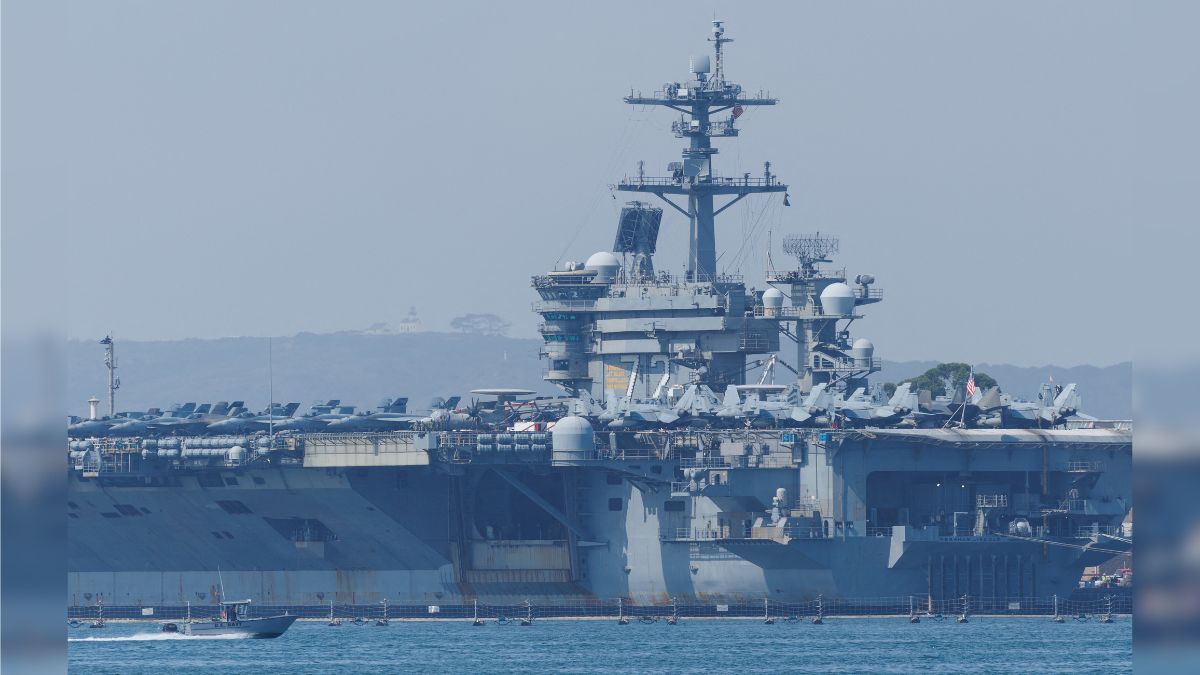
 "Can Iran take out the powerful US battleship Abraham Lincoln deployed to West Asia?")
Can Iran strike USS Abraham Lincoln?
As tensions between the United States and Iran continue, Washington has sent some of its most powerful naval ships to West Asia.
This includes the USS Abraham Lincoln, a Nimitz-class aircraft carrier, as well as three accompanying warships under Carrier Strike Group 3 (CSG-3).
The carrier, along with three destroyers, “is currently deployed to the Middle East to promote regional security and stability,” US Central Command said on Monday on social media.
The development comes in the backdrop of US President Donald Trump having threatened to launch airstrikes on Iran over its crackdown on protesters. Trump last week said he had an ‘armada’ heading towards Iran.
But can Iran strike the USS Abraham Lincoln?
Let’s take a closer look.
USS Abraham Lincoln
First, let’s take a brief look at the aircraft carrier USS Abraham Lincoln (CVN-72).
The nuclear-powered aircraft carrier is the flagship of Carrier Strike Group 3 (CSG-3). It was named in honour of the 16th President of the United States. Its home port is Naval Air Station North Island in San Diego, California.
The craft’s keel was laid on November 3, 1984, in Newport News, Virginia. The hull was launched on February 13, 1988. It was christened by Jo Ann K. Webb, wife of former Secretary of the Navy James H. Webb.
The ship was acquired by the US Navy on October 30, 1989, and formally commissioned on November 11, 1989. At the time, the cost of the ship was $2.24 billion (approximately Rs 206.06 billion). It has a 50-year operational lifespan.
The ship is 1,092 feet (333 metres) long, has a beam of 252 feet and a displacement of around 100,000 tons. Powered by two Westinghouse A4W nuclear reactors and 260,000 shaft horsepower, it can hit a top speed of over 30 knots (56 kilometres per hour).
The ship can carry around 5,700 personnel, including 3,200 crew. It can carry between 60 to 75 planes and helicopters, including F/A-18 Hornet and F-35 Lightning II aircraft. It has a virtually unlimited range, limited only by crew fatigue and food supplies.
The ship is armed with two Mk 57 Mod 3 Sea Sparrow missile launchers, two RIM-116 Rolling Airframe Missile systems, and two Phalanx Close-In Weapon Systems (CIWS) for defence against missiles and aircraft. It is equipped with advanced sensors such as AN/SPS-48E 3-D air search radar, AN/SPQ-9B target acquisition, and electronic warfare suites such as SLQ-32A(V)4 for situational awareness and countermeasures.
Crucially, the carrier’s air wing also includes E-2D Hawkeye airborne early-warning aircraft, which provide long-range radar surveillance and early detection of incoming aircraft or missiles.
The ship served during the Gulf War era and has been deployed to West Asia and the Indo-Pacific.
Iran’s weapons
While Iran is one of the top 20 global military powers, its air force is generally not considered much of an offensive threat. The small, ageing fleet is primarily made up of American-made aircraft acquired before 1979, such as the F-4 Phantom II and F-14 Tomcat, and Soviet-made MiG-29 ‘Fulcrums’ and Su-24 ‘Fencers’. Over the years, international sanctions have made it difficult for Iran to upgrade its air force. Iran is estimated to operate roughly 250 combat-capable fighters and around 140 helicopters.
However, where Iran truly shines is its missile programme. Iran has one of the largest arsenals of ballistic missiles and drones in West Asia, including long-range projectiles, drones, cruise missiles and anti-ship missiles.
Iran claims its ballistic missiles have a range of up to 2,000 kilometres. This includes the Sejil, which has a range of approximately 2,000–2,500 kilometres, as well as the Kheibar, boasting a range of around 1,400 kilometres, and the Fattah-2. This means that Tehran can theoretically strike targets across West Asia, including Israel.
Incidentally, Iran last year test-fired an anti-warship cruise missile with a reported range of 1,000 kilometres, capable of reaching US Navy ships operating in regional waters.
“This is a Ghadr-380 missile type L. It has over 1,000 kilometres range. It has anti-jamming capability,” said General Ali Reza Tangsiri, the head of the navy of the Revolutionary Guard.
The report elaborated neither on the warhead that the missile carried nor the time of the test. Tangsiri said the facility is “only one part of the missile systems of the Guard,” adding that the missiles can create “a hell for the enemy’s warships.”
Can it take out the USS Abraham Lincoln?
Maybe in theory. While no aircraft carrier has been sunk since World War II, no such vessel is invulnerable.
However, realistically, this would be a tough task for Iran, given the fact that the USS Abraham Lincoln is protected by advanced defensive measures. Also, aircraft carriers are not known for staying in one position too long out of an abundance of caution.
The USS Abraham Lincoln is also unlikely to remain within missile range inside the Persian Gulf. Instead, it would most likely operate in the more open waters of the Gulf of Oman or the Arabian Sea, where it has greater room to manoeuvre and more time to react to incoming threats.
Even if it ventures too close to Iran, the USS Abraham Lincoln isn’t alone. It is being accompanied by Arleigh Burke-class guided missile destroyers USS Frank E. Petersen Jr. (DDG-121), USS Spruance (DDG-111), and USS Michael Murphy (DDG-112) — all of which provide defence and strike support.
These ships are equipped with the Aegis Combat System, which can track hundreds of air and missile targets simultaneously and destroy the most dangerous ones mid-air through their vertical launch cells. They also carry long-range interceptor missiles (SM-6 class) that can destroy targets hundreds of kilometres away.
Any projectiles that survive the outer shield will have to contend with the Evolved SeaSparrow Missile (ESSM). The ships can also deploy Phalanx Close-In Weapon Systems (CIWS) — cannons that can fire thousands of rounds per minute to take down incoming missiles.
Iran’s strategy could be to try to overwhelm the carrier group with a volley of missiles — much like it did with Israel during the conflict last year.
However, according to India Today, Iran would need technology it does not yet possess — a rapid, resilient kill chain, real-time satellite surveillance, data fusion, command-and-control systems, and the capacity to launch such missiles in minutes — in order to successfully strike an aircraft carrier.
The outlet warned that without such a system and its accompanying data, the likely result is that even advanced missiles could fail to find or accurately hit a moving target at sea. While Iran could potentially attempt to strike the USS Abraham Lincoln, the chances of a successful hit remain low.
With input from agencies


 "Russian losses twice than Ukraine’s as casualties near 2 million: Study")
 "India-EU FTA drawing global attention, many calling it ‘a game-changer’: PM Modi")
 "India vs New Zealand Live Score 4th T20 at Vishakhapatnam: Santner run out as IND keep taking wickets")
 "Gold hits fresh record above $5,200 as dollar weakens; Deutsche Bank eyes $6,000")
 "Russian losses twice than Ukraine’s as casualties near 2 million: Study")
 "India-EU FTA drawing global attention, many calling it ‘a game-changer’: PM Modi")
 "India vs New Zealand Live Score 4th T20 at Vishakhapatnam: Santner run out as IND keep taking wickets")
 "Gold hits fresh record above $5,200 as dollar weakens; Deutsche Bank eyes $6,000")