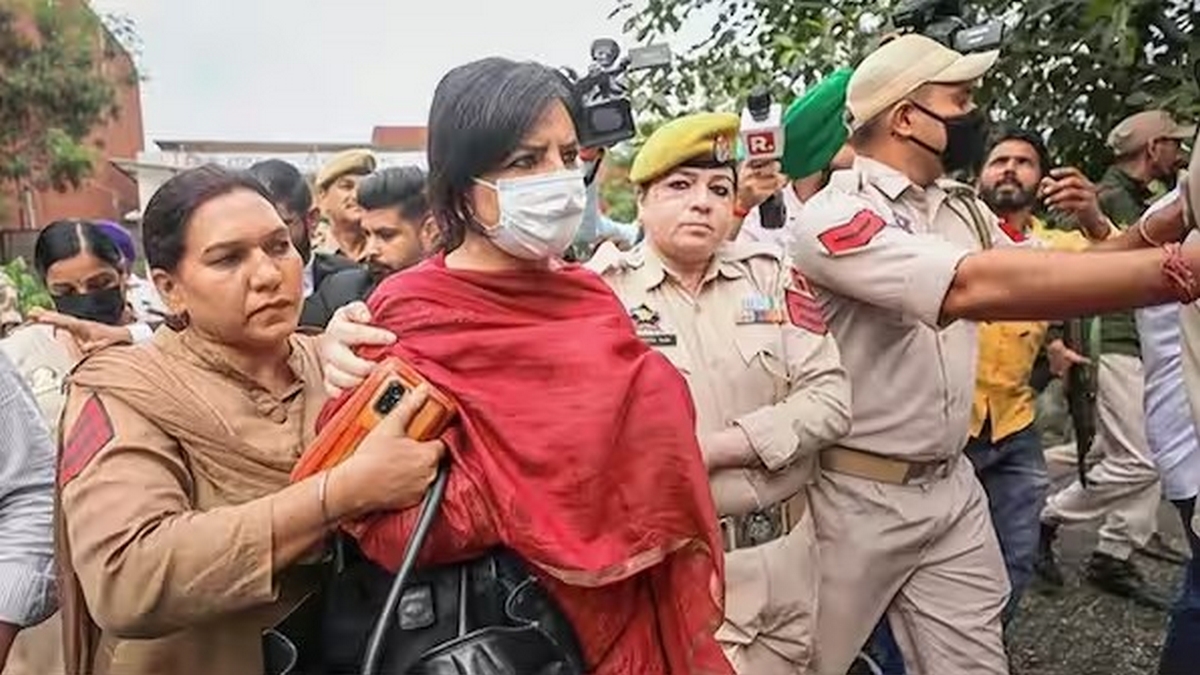
 "Rubaiya Sayeed, the daughter of former Jammu and Kashmir chief minister Mufti Mohammad Sayeed and sister of Mehbooba Mufti. PTI")
An arrest has been made in a decades-old case in which the daughter of the then home minister was abducted. The Central Bureau of Investigation (CBI) has taken into custody a Srinagar man in the 1989 Rubaiya Sayeed kidnapping. Rubaiya is the third daughter of former Jammu and Kashmir chief minister Mufti Mohammad Sayeed and sister of PDP president Mehbooba Mufti.
The arrested individual, Shafat Ahmad Shangloo, hails from Srinagar’s Nishat. The CBI has accused Shangloo of conspiring with Jammu and Kashmir Liberation Front (JKLF) chief Yasin Malik to kidnap Rubaiya. The authorities had announced a reward of Rs 10 lakh for Shangloo’s capture. Shangloo is a member of the JKLF and was allegedly looking after its finances.
“The Central Bureau of Investigation (CBI) has arrested an absconder, Shafat Ahmed Shangloo, wanted in a 35-year-old CBI case relating to the kidnapping of Dr Rubiya Sayeed, D/o Shri Mufti Mohd. Sayeed, ex-Home Minister,” CBI said in a press release. “He will be produced before the TADA Court, Jammu, within the stipulated time as per law.”
But what happened when the then home minister’s daughter was abducted 35 years ago? Let’s take a closer look.
The kidnapping
The incident occurred on December 8, 1989. It came just days after Sayeed was sworn in as a Union Minister in the then VP Singh Janata Dal government. Sayeed had made history as India’s first Muslim home minister. Rubaiya, then a 23-year-old intern at Srinagar’s Lal Ded Maternity Hospital, was kidnapped while heading to her Nawgaon home on the outskirts of the city.
Rubaiya, who was on a minibus, was just a few hundred metres away from home when four gunmen stopped the vehicle. The gunmen then abducted Rubaiya, put her into a waiting Maruti vehicle and took her to an undisclosed location.
Sayeed, a few hours later, received a phone call from an unidentified individual confirming that his daughter had been kidnapped. The terrorists, who were linked to the JKLF led by Malik, who planned the operation, demanded that five of their associates be set free.
A case into the abduction was registered at Srinagar’s Saddar Police Station the same day under Section 364 of the Ranbir Penal Code (RPC), Section 3 of TADA and Section 3/25 of the Arms Act.
An under-pressure VP Singh government tried to negotiate for a few days. However, seeing that it had no choice, the government acceded to the kidnappers’ demands on December 13. The kidnappers then released Rubaiya. This was reportedly the first time the Indian government had made such an exchange.
However, not everyone concurred with this decision by the central government. The then chief minister of Jammu and Kashmir, Farooq Abdullah, made his opposition known to the hostage exchange.
Some of those released later participated in the hijacking of Indian Airlines flight IC-814 to Kandahar in 1999. Incidentally, Abdullah was also chief minister during the IC-814 hijacking when the Indian government handed over three prisoners — Ahmed Omar Saeed Sheikh, Masood Azhar and Mushtaq Ahmed Zargar — to the Taliban.
Omar Abdullah, National Conference leader and son of Farooq Abdullah, said, “This is the second time my father was forced to release people.
“With Rubaiya Syed freed, the families of the hijacked victims [of IC-814] used the Rubaiya Syed incident as a benchmark. They said when you could release terrorists for a home minister’s daughter, is our family not precious? Why is it only that she is precious to the country?”
Omar claimed that this case had a bearing on the demands made during the IC-814 hijacking. “Even if they had taken my daughter hostage, I would not have released a single terrorist,” Farooq insisted in 2015.
The aftermath
The case is still ongoing in the TADA court in Jammu. The court was set up to handle cases under the Terrorist and Disruptive Activities (Prevention) Act (TADA) of 1987. Rubaiya, who now lives in Tamil Nadu, remains listed as a witness for the prosecution.
However, charges in the case were framed in 2019, decades after the incident.
The TADA court had in January 1999 ordered the release of three accused in the case — Showkat Ahmad Bakhshi, Manzoor Ahmad Sofi and Mohammad Iqbal Gundroo — on bail. The court said this was because the accused had been in jail for nearly a decade without trial. By then, Malik had already received bail.
In 2009, Malik petitioned the J&K High Court to transfer the case from Jammu to Srinagar. The J&K High Court then stayed proceedings against Malik in the designated TADA court in Jammu. However, the CBI successfully petitioned against the stay. The TADA court in 2021 then framed charges against 10 people, including Malik.
Malik, who is the prime accused in the kidnapping case, is lodged in Tihar Jail. Malik was sentenced by a special NIA court in May 2023 in a terror-funding case. Rubaiya has identified Malik as one of the men who kidnapped her. Another eyewitness identified Mohammad Zaman as one of the kidnappers.
With inputs from agencies