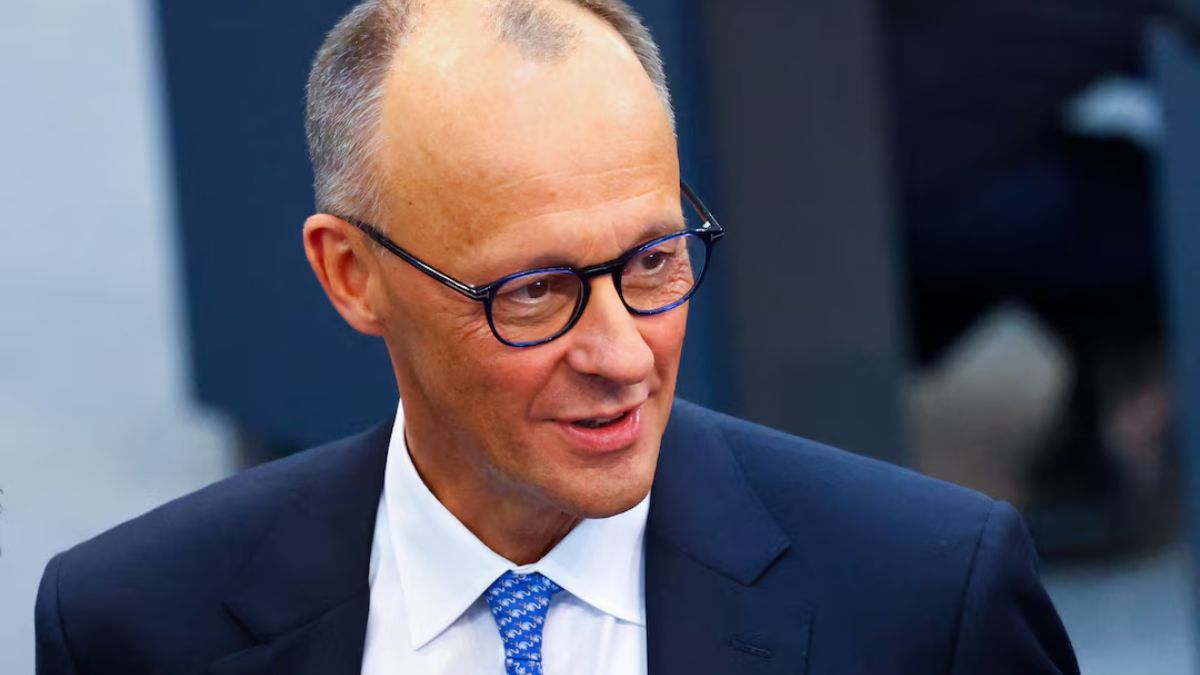
 "Germany’s Merz leads corporate heavyweights to China, pushes for trade reset")
German Chancellor Friedrich Merz arrived in Beijing on Wednesday with a heavyweight delegation of nearly 30 top executives, seeking to recalibrate Germany’s economic relationship with China.
On his first official visit to China since taking office in May, Merz struck a pragmatic tone, emphasising “fair cooperation and open communication” during talks with Chinese Premier Li Qiang at the Great Hall of the People.
“We have very specific concerns regarding our cooperation, which we want to improve and make fair,” Merz said, underscoring Berlin’s push for a level playing field for German firms operating in China.
Balancing act between rivalry and reliance
China was Germany’s largest trading partner last year, but the relationship has grown increasingly fraught. German manufacturers — particularly in the auto and machinery sectors — are grappling with intensifying competition from Chinese rivals, contributing to a growing trade imbalance and calls within Berlin for a tougher stance.
Merz, a conservative leader who has previously warned about overdependence on Beijing, made clear that Germany’s strategy remains one of “de-risking” rather than decoupling.
“It would be a mistake for us to seek to decouple ourselves from China,” he said before departing Berlin. “That kind of policy would only harm our own interests.”
At the same time, he has cautioned that China’s dominance in critical raw materials and key technologies poses strategic vulnerabilities. “Raw materials, technologies, and supply chains become instruments of power in the zero-sum game of the great,” he warned earlier this month.
China controls a significant share of global rare earth supplies — essential for electric vehicle batteries, semiconductors and defence equipment — adding urgency to Europe’s diversification drive.
ALSO READ: Germany's Merz to carry common European position on tariffs before US trip
CEOs in tow
Merz’s delegation includes senior representatives from Germany’s industrial backbone, including carmakers such as Volkswagen and BMW, both of which face mounting pressure from Chinese electric vehicle makers in their largest overseas market.
The chancellor is scheduled to visit a plant operated by Mercedes-Benz Group in Beijing and later travel to Hangzhou, where he will tour facilities of robotics firm Hangzhou Unitree Technology and Germany’s Siemens Energy.
Quick Reads
View AllThe strong business presence underscores the stakes for Europe’s largest economy, which has been shedding roughly 10,000 manufacturing jobs a month amid what some analysts describe as a “second China shock” — a fresh wave of competitive pressure from China’s advanced manufacturing sector.
Beijing courts Europe amid US tensions
For Beijing, the visit offers an opportunity to present itself as a stable economic partner at a time when trade tensions with Washington remain elevated.
Li called on both sides to safeguard multilateralism and free trade — a pointed reference to the trade policies of US President Donald Trump — and urged closer cooperation between two of the world’s largest economies.
“China and Germany… should strengthen our confidence in cooperation, jointly safeguard multilateralism and free trade, and strive to build a more just and fair global governance system,” Li said.
Merz is also scheduled to meet President Xi Jinping, with discussions expected to centre on competition, market access and supply-chain resilience.
Competition at the core
Ahead of the visit, Berlin signalled that “competition” would be a central theme of the talks. German officials have long argued that state subsidies, favourable industrial policies and “Buy Chinese” procurement rules tilt the playing field in favour of domestic firms.
The European Union has grown increasingly vocal about what it sees as structural distortions in the Chinese economy. EU Trade Commissioner Maroš Šefčovič this week warned of China’s rising dominance in key manufacturing sectors and shrinking market share for European firms.
Yet business sentiment remains nuanced. Surveys cited in Chinese state media suggest that innovation gains in China are still feeding back into German headquarters, highlighting the complexity of disentangling economic ties.
A defining year for EU-China ties
Merz joins a list of Western leaders who have travelled to Beijing this year seeking to stabilise ties, even as Europe debates how far to push its “de-risking” strategy.
Engagement between Berlin and Beijing is widely seen as a bellwether for broader EU-China relations in 2026. Germany’s export-driven model has been deeply intertwined with China’s rise for two decades, but the political mood has shifted toward greater caution.
“Our China policy has to take account of the fact that China has risen to the ranks of the major powers,” Merz said before departure. “Only if we in Germany and Europe are united, strong and competitive can we shape a balanced partnership with China.”


 "‘Want to come back home, but can’t’: Why Indian medical students are reluctant to leave Iran")
 "Four years later, how close is Russia to achieving its goals in Ukraine?")
 "What is Trump’s Dalilah Law that targets Indian-origin truck drivers?")
 "After Kerala gets nod for Keralam, will Bengal be renamed Bangla?")
 "‘Want to come back home, but can’t’: Why Indian medical students are reluctant to leave Iran")
 "Four years later, how close is Russia to achieving its goals in Ukraine?")
 "What is Trump’s Dalilah Law that targets Indian-origin truck drivers?")
 "After Kerala gets nod for Keralam, will Bengal be renamed Bangla?")