

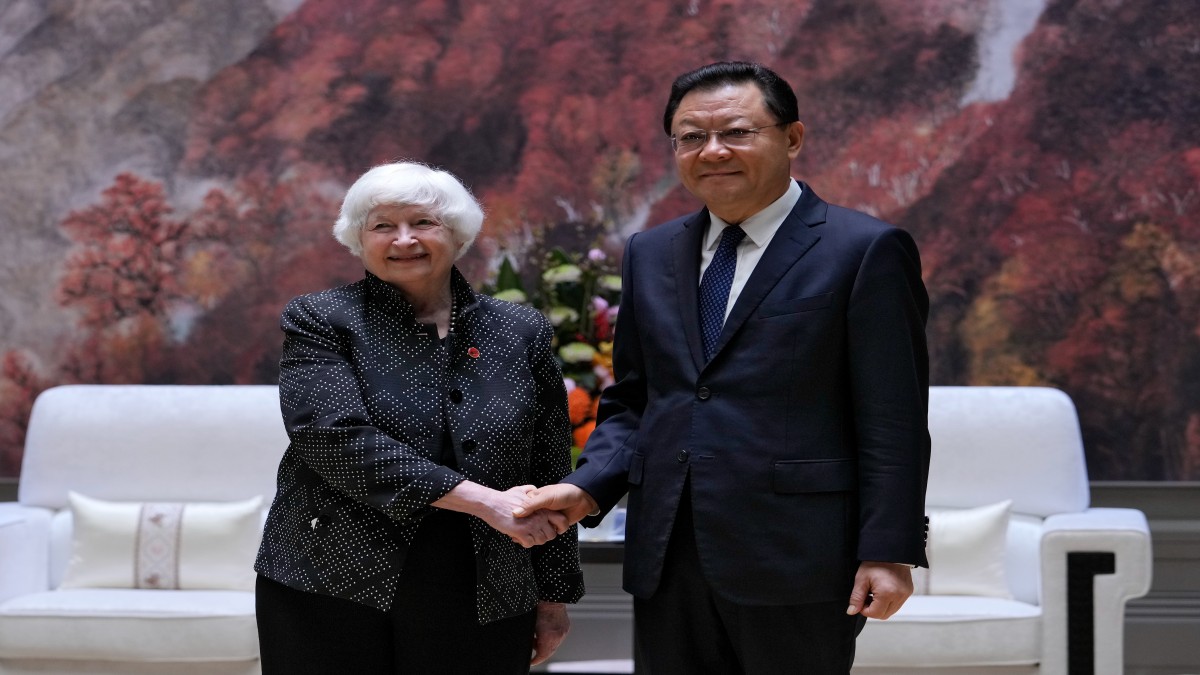
 "Yellen calls for level playing field for US workers and firms during China visit")
As she started a five-day visit to China on Friday in one of the nation’s main export and manufacturing centres, US Treasury Secretary Janet Yellen demanded fairness for American businesses and labourers.
Guangdong provincial governor Wang Weizhong was informed by Yellen that open and honest communication between the US and China is crucial when it comes to areas of dispute.
“This includes the issue of China’s industrial overcapacity, which the United States and other countries are concerned can cause global spillovers,” she said.
As the first Cabinet-level official to visit China since President Joe Biden met with Chinese leader Xi Jinping in November of last year, Yellen has hinted that she will bring up the US’s and many European nations’ concerns about what they view as unfair trade practices by China.
She visited with business executives from the United States, Europe, and Japan to learn about their problems prior to her conversations with the governor. She will likely have difficult discussions with senior Chinese government officials over trade and other matters.
Yellen also addressed American business executives on Friday and fielded their questions in an auditorium of a marble-topped convention centre located in Guangzhou’s Baiyun District.
“I’ve heard from many American business executives that operating in China can be challenging,” Yellen said at an event hosted by the American Chamber of Commerce in China on Friday afternoon.
Impact Shorts
More ShortsCiting a recent survey by the Chamber that found that a third of American firms in China say they have experienced unfair treatment compared to local competitors, Yellen said the US has seen China “pursue unfair economic practices, including imposing barriers to access for foreign firms and taking coercive actions against American companies.”
“I strongly believe that this doesn’t only hurt these American firms: ending these unfair practices would benefit China by improving the business climate here. I intend to raise these issues in meetings this week,” she said in her speech.
Guangzhou is the capital of Guangdong province, a Chinese manufacturing and export hub that is home to telecom giant Huawei and BYD, China’s largest EV maker. Huawei has been hit hard by US restrictions on semiconductor exports to China and is at the vanguard of Chinese efforts to become self-sufficient and a leader in technology.
“There are a broad swath of economic interactions” between the US and China “that should remain uncontroversial,” she said during a question and answer session with Michael Hart, president of AmCham China. But, she said, there are “Chinese practices tilting the playing field away” from US firms.
Government subsidies and other policy support have encouraged solar panel and EV makers in China to invest in factories, building far more production capacity than the domestic market can absorb.
The massive scale of production has driven down costs and ignited price wars for green technologies, a boon for consumers and efforts to reduce global dependence on fossil fuels. But Western governments fear that that capacity will flood their markets with low-priced exports, threatening American and European jobs.
Yellen will head to Beijing next.
Eswar Prasad, a trade professor at Cornell University, expects Yellen to push Beijing to bolster domestic consumption and ensure fair competition in new technology sectors, especially green energy and electric vehicles, along with adequate market access for US companies.
“Concerns about China attempting to export its overcapacity and simultaneously making a big push into these sectors will be top of mind for the US delegation,” he said.
China has pushed back against the overcapacity concerns expressed by both the US and Europe.
Foreign Ministry spokesperson Wang Wenbin said earlier this week that the growth in Chinese EV and solar exports is conducive to green development globally and the result of the international division of labor and market demand.
He accused the US of interfering with free trade by restricting technology exports to China.
“As for who is doing non-market manipulation, the fact is for everyone to see,” he said. “The US has not stopped taking measures to contain China’s trade and technology. This is not ‘de-risking,’ rather, it is creating risks.”
Yellen said at the American Chamber event that “excess capacity is a concern that many countries share — from a range of advanced and developing countries and is not something that’s new.”
“This is not anti-China policy, this is an effort to mitigate the risks,” to the global economy, she said “if China does not adjust its policies.”
Scott Paul, president of the Alliance for American Manufacturing — an alliance of businesses and the US Steelworkers union — told The Associated Press ahead of Yellen’s trip that “there is a limited amount of expectations we should have about the Chinese government and how it responds; one thing that Yellen hopefully can and should say is that the US is prepared to use all the tools that we have available through policy to ensure that China’s industrial overcapacity doesn’t negatively harm our economic and national security interests.”
The Alliance released a report in February that says the introduction of inexpensive Chinese autos to the American market “could end up being an extinction-level event for the US auto sector.” The US auto sector accounts for 3% of America’s GDP, according to the report.
Yellen told reporters Wednesday during an Alaska refueling stop en route to Asia that the US “won’t rule out” tariffs to respond to China’s heavily subsidized manufacturing of green energy products.


 "Russian drones over Poland: Trump’s tepid reaction a wake-up call for Nato?")
 "As Russia pushes east, Ukraine faces mounting pressure to defend its heartland")
 "Why Mossad was not on board with Israel’s strike on Hamas in Qatar")
 "Turkey: Erdogan's police arrest opposition mayor Hasan Mutlu, dozens officials in corruption probe")
 "Russian drones over Poland: Trump’s tepid reaction a wake-up call for Nato?")
 "As Russia pushes east, Ukraine faces mounting pressure to defend its heartland")
 "Why Mossad was not on board with Israel’s strike on Hamas in Qatar")
 "Turkey: Erdogan's police arrest opposition mayor Hasan Mutlu, dozens officials in corruption probe")



