 "Why US’ ‘sanctions threat’ to India is counter-productive on China front")
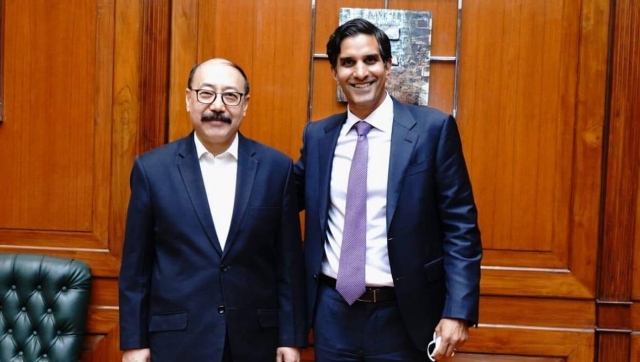
Interacting with India’s Foreign Secretary Harsh Vardhan Shringla, the visiting US Deputy National Advisor for International Economics, Daleep Singh, threatened India with sanctions if it did business with Russia, against Washington’s trade and economic ban under force against Moscow. He is also reported to have told his Indian interlocutor that when India needed Russia against China in times of a military conflict, Moscow, as ‘junior’, would side only with Beijing.
“I come here in a spirit of friendship to explain the mechanisms of our sanctions, the importance of joining us, to express a shared resolve and to advance shared interests,” Singh told Delhi newsmen in between his meetings in the Indian capital on Thursday. “And yes, there are consequences to countries that actively attempt to circumvent or backfill the sanctions,” he added. According to Singh, America is also “very keen for all countries, especially our allies and partners, not to create mechanisms that prop up the (Russian) rouble, and those than attempt to undermine the dollar-based financial system,” The Hindu quoted him as responding to a specific question from the newspaper’s Suhasini Haidar at the media-meet.
So, that was it. After going relatively easy on India when it came to the Ukraine-linked Russia sanctions, the US is suddenly finding out that any trade outside of the existing dollar scheme could hit the greenback harder than anything else since the Bretton Wood arrangement, soon after the Second World War. From sanctioning Putin’s Russia more than already, and thus seeking to ‘discipline’ whom US President Joe Biden uncharitably called a ‘butcher’, ‘war-criminal’, et al, today, Washington is sending out envoys to defend the dollar from collapsing — if it came to that.
Thus far, no more
In a way, it is a belated acknowledgement that Putin had strategised better for possible sanctions if and when he had to bomb Ukraine as he did. Once the war commenced and sanctions came in place, Russia announced deep discounts on its oil price. Western pundits then predicted that rouble and Russia, not necessarily in that order, would collapse eventually, and possibly imminently. They had a vision of the earlier Soviet collapse in the last quarter of the previous century.
***
Also Read
**Does road to end the war in Ukraine run through Delhi?** **The Ukraine crisis: How India stands to gain from its neutral stance going forward** **India’s Russia policy has been spot on so far, but going ahead it needs to break free of the dependence for truer strategic autonomy**Quick Reads
View All***
Instead, Russia and rouble have seemingly withstood the US-EU sanctions than thought of. The discounted oil price is working to Russia’s advantage. By announcing rouble-only trade and fixing gold price at 5,000 roubles, Putin has done two things at the same time. One, he has told Russia’s oil buyers, including those EU members, that dollar would not be of use to them in their trade with the nation. Translated, it means that if the US did not want rouble and Russia, Moscow too would not want dollars. This is a risky yet bold step, which the Americans did not seem to have strategized for.
Next and more importantly, by pegging a rouble price for gold, Moscow has also reminded European capitals and the rest of the world as to how the US, after committing to a gold-linked dollar as the global ‘reserve currency’, went on to unilaterally de-link the same, when none could oppose – and none did oppose. That was full 50 years back, in 1971, when Richard Nixon was the US President. It was thus a polite reminder to the world, how the US had taken unilateral decisions on sensitive economic and monetary issues without global consultations — and how it had held, thus far, but possibly no more.
Unilateral decisions
That has also been India’s problems in adhering to the US sanctions on third nations, be it Iran or Russia, as New Delhi has both economic and more so political ties with Teheran and Moscow. Russia also remains the single largest supplier of weapons and fighter jets. Sanctions on Russia now mean that New Delhi cannot get the required spares to keep the Indian fighting machine in a fit condition.
By extension, India would then have to go back to the US and its European allies for procuring new weapons, which would also be the latest — but would cost a bomb, and cripple the Indian economy, too, as is happening in neighbouring Sri Lanka, though for entirely different reasons. In the absence of new procurement — whatever the commercial terms, including payment schedule — India would feel vulnerable and remain so viz China and Pakistan, and both together.
Against this, India can also not expect the US and the latter’s NATO allies to join India’s war with its northern neighbours, and rightly so. If it were to happen, then, yes, Russia could well become China’s partner — viz NATO, and even may apply pressure on them in Europe, so that they do not get distracted to look at South Asia. Of course, all these are only in the realm of theoretical possibilities. Yet, should it happen this way or some other such ways, India could well be caught in a military conflict that Western strategist thinkers may then dub ‘Third World War’.
Net provider of security
Daleep Singh is considered President Biden’s ‘sanctions czar’, but his tough-talking to India in capital Delhi is not going to be liked on the Indian streets, both by the ruling BJP brand of hyper-nationalists and even the traditional nationalists belonging to the 20th century. It has the potential to trigger anti-NRI sentiments in the country, especially those in the US administration, if others of the ilk or going to talk down on India. How the rest of the NRI crowd reacts would be interesting to observe.
But that is only an insignificant part, so to say. The real issue for India is that the US threat of sanctions and citing the China angle has come at a time when New Delhi’s stock is slowly but surely increasing in the immediate neighbourhood. Former Prime Minister Manmohan Singh said that India would be the ‘net-provider of security’ in the region. It was understood to cover (only) the traditional spheres of security.
Today, however, India has proved to be the net provider of ‘composite security’, which includes all forms of traditional and non-traditional security. The non-traditional component includes human/humanitarian security and economic security.
The Covid pandemic was witness to how India volunteered human security to the neighbourhood, and beyond, by offering required test kits first, and vaccines, when ready, with ill-will towards none. Today, when Sri Lanka is stuck in an economic morass of an unprecedented kind, India has extended all help to mitigate the morass in what all forms possible.
During Covid, the Indian vaccine assistance went to neighbours before New Delhi had even begun addressing local concerns, needs and demands. Now when the world is supposedly facing a fuel crisis, owing to the Russo-Ukraine War, India has risked its ‘energy security’, even if only by a small measure, to supply fuel to Sri Lanka, whose forex crisis has made living conditions impossible in what still goes by the name ‘emerald island’.
Moving equidistant
For the West especially, the ruling Rajapaksas are the villain of the piece, thanks to their perceived proximity, over-dependence and believed loyalty to China. It will remain a mystery why Colombo tilted towards New Delhi under the incumbent regime of President Gotabaya Rajapaksa, even if without moving completely away from Beijing’s so-called vice-grip. From an Indian and western perspective, Sri Lanka, that too under the Rajapaksas, moving equidistant between China and India should be welcome, whether or not it’s only a welcome first step.
This is only as far as the economic and development aid quotient is concerned. On traditional security, which is of greater concern to the strategic community, both in India and the West, successive governments in Colombo, especially in this 21st century, have kept China away. Though during the LTTE war, the governments of President Mahinda Rajapaksa, preceded by that of Chandrika Bandaranaike-Kumaratunga acknowledged procuring weapons and fighter aircraft from China and Pakistan, post-war, Colombo’s security dealings have mostly been with India and India alone.
It began with Sri Lanka joining the bi-annual India-Maldives Dhosti Coast Guard exercises in 2011, followed since by the upgradation of the three-nation ‘Maritime Security Agreement’ into a ‘Maritime and Security Cooperation Agreement’ at the Colombo meeting of the National Security Advisors (NSA) of the three nations in November 2020. The nomenclature, Colombo Security Conclave (CSC) has stuck, with a secretariat, yes, in Colombo, and the expansion of the same with the inclusion of Mauritius, another IOR littoral as a full-member and the continuance of Bangladesh and Seychelles as ‘Observers’.
The CSC still has a long way to go in terms of exploring and exploiting its full potential, to be able to provide a security cover for the IOR in these parts, to the possible exclusion of non-regional players, including the US. What is important from an American/Western perspective is the way India has managed the relations through quiet diplomacy that does not belong to the Daleep Singh variety.
Diplomatic muscle-flexing
Yes, the evolution of such a security-net, if and when it came to that, could render the US-initiated Quad and Indo-Pacific that much less relevant — though not totally irrelevant — but if the idea is only to keep China at bay, that is being achieved by India. In context, New Delhi needs encouragement, not threats of sanctions. If forced, New Delhi, if it has to prove itself in the neighbourhood as a reliable regional leader that they can count on, would have to indulge in diplomatic muscle-flexing that it has avoided thus far.
It is not only Sri Lanka, and also common neighbour Maldives, that have acknowledged the Indian leadership in the region through the CSC, which of course is a common arrangement among sovereigns. Closer to the north-eastern land border, Bangladesh has emerged as a reliable ally of India over the past decade, and has also evolved an independent economic power, capable of helping Sri Lanka with credit-line. Now, Nepal, another tough customer in the perception of the Indian strategic community, has problems with China, and Prime Minister Sher Bahadur Deuba is/was in Delhi over the weekend.
From a larger Indian perspective, the US sanctions czar’s visit came between those of Chinese Foreign Minister Wang Yi and his more important Russian counterpart, Sergey Lavrov, given especially the contemporary context. Through the past weeks since the Ukraine War commenced on 21 February, Western leaders and special envoys have been landing in New Delhi in quick succession.
No-nonsense approach
Some of the West’s current interest in India, especially on the Ukraine war and the accompanying sanctions issue, owe to New Delhi’s non-permanent membership of the UNSC, where Amb TS Tirumurti has been putting across the no-nonsense Indian approach effectively and clearly, for all world to hear, whatever be the position of individual governments and leaderships. The Indian line is principled, deriving from the past behaviour of nations like the US and the US-led NATO, in Afghanistan and Iraq, but New Delhi has never ever embarrassed those nations with such details.
India’s term ends this year-end. Come 2023 and the barring Quad and Indo-Pacific, whose characterisation remains confused even within member-nations, the West’s interest in New Delhi may involve less of politics and diplomacy, and more of trade, economics — and possible sanctions. Alongside, India’s place in the region is getting increasingly clear. It is a position New Delhi cannot afford to risk, though the inherent dynamics may have owed to the nation’s concept of ‘Vasudeva Kudumbagam’, or the ‘world is one family’, as Prime Minister Narendra Modi has been imploring from time to time.
Just as nations like Sri Lanka and Maldives, Bangladesh and Nepal, not to leave out Bhutan, Mauritius and Seychelles, are trying to balance their India-China relations with a strategic tilt towards the former, New Delhi too has to strike a balance with extra-regional powers, as they seek to re-create an Europe-centric world (though that is not their intention), where India would continue to remain and also expand its activities as the ‘net-provider’ of regional security in every which way and in every which form and forum!
The writer is Policy Analyst & Commentator, based in Chennai, India. Views expressed are personal.
Read all the Latest News, Trending News, Cricket News, Bollywood News,
India News and Entertainment News here. Follow us on Facebook, Twitter and Instagram.


 "'Indian food, our pride': $200k settlement in Palak Paneer case a moral victory against racism in the west")
 "India’s air dominance in Operation Sindoor forced Pakistan to seek ceasefire, European report says")
 "How Pakistan’s support may have led Bangladesh towards a very costly mistake")
 "India vs New Zealand Live Score 3rd T20: Abhishek on fire once again as India slam over 80 in powerplay")
 "'Indian food, our pride': $200k settlement in Palak Paneer case a moral victory against racism in the west")
 "India’s air dominance in Operation Sindoor forced Pakistan to seek ceasefire, European report says")
 "How Pakistan’s support may have led Bangladesh towards a very costly mistake")
 "India vs New Zealand Live Score 3rd T20: Abhishek on fire once again as India slam over 80 in powerplay")