

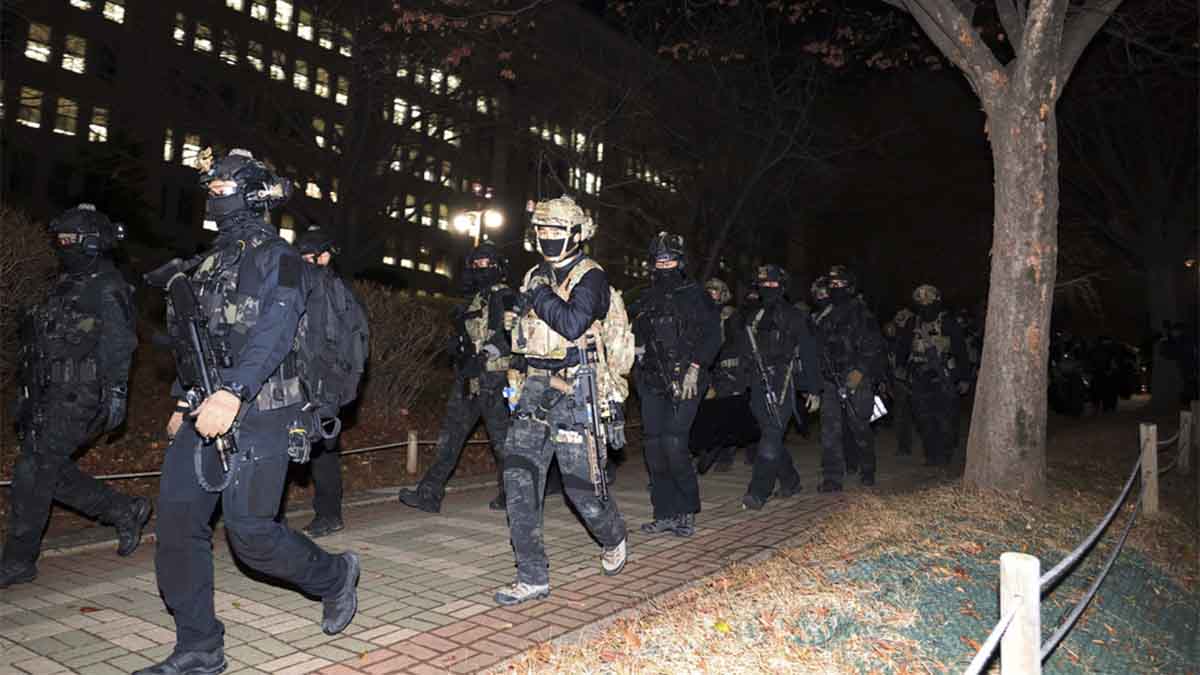
 "Why political stability in South Korea is critical for US and its military")
The United States, a close ally of South Korea, welcomed President Yoon Suk Yeol’s decision on Wednesday to lift martial law, following a dramatic series of events. The move came after South Korean lawmakers swiftly blocked the president’s emergency declaration in a tense vote, plunging the nation into its worst political crisis since the 1980s.
US Secretary of State Antony Blinken said in a statement, “The United States has been closely monitoring the situation in the Republic of Korea over the past 24 hours. We welcome President Yoon’s announcement to revoke the martial law order in line with the ROK Constitution, following the National Assembly’s unanimous decision to reject it.” He added, “We hope political disagreements will continue to be resolved peacefully and within the framework of the law. The United States stands firmly with the Korean people and values the U.S.-ROK alliance built on democracy and the rule of law.”
Given its significant military presence in South Korea, including personnel and weapons, the US expressed deep concern over the unfolding crisis and expressed hope for a swift return to stability.
South Korea is an important defence ally of the US, located in East Asia next to North Korea, which poses a major security threat. The US and South Korea have worked together for many years, with the US providing troops, advanced weapons and defence technology to help protect against North Korean threats and maintain regional stability.
This partnership also supports US interests in the broader Asia-Pacific region. With a strong military presence in South Korea, the US can influence the region and counter China’s growing power. The combined defence efforts of the two countries are vital for maintaining peace and preventing conflict, making South Korea a key part of US defence strategy.
Impact Shorts
More ShortsUS military presence in South Korea
According to Facts and Details, the United States Forces Korea (USFK) operates as part of the United States Indo-Pacific Command (USINDOPACOM). Its key components include the Eighth US Army, Seventh Air Force, Naval Forces Korea, Marine Forces Korea and Special Operations Command Korea.
The main role of USFK is to support South Korea in defending against threats from North Korea. Additionally, their presence helps maintain stability in the broader East Asian region. A Reuters report said that at its peak, the US had around 100,000 troops stationed in South Korea, along with nuclear-armed missiles. Today, about 28,500 American troops remain, making it the third-largest US overseas military presence after Japan and Germany, according to the US Defence Manpower Data Centre. This includes around 19,500 army personnel, 7,800 air force members, 350 navy sailors and 120 marines.
The US military presence in South Korea stems from the 1953 Korean-American Mutual Defence Treaty, signed after the Korean War. This treaty ensures mutual defence if either country is threatened in the Pacific region. According to the USINDOPACOM website, the Status of Forces Agreement (SOFA) inked in 1966 established rules for US personnel in South Korea. These agreements laid the foundation for the ongoing US-South Korea military partnership, including joint exercises like “Team Spirit” to enhance cooperation and readiness.
Since the end of the Korean War, the US has played a significant role in South Korea’s defence. The Republic of Korea-US Combined Forces Command (CFC), established in 1978, oversees the combined defence of South Korea. The CFC, led by a four-star US general with a South Korean counterpart as deputy, manages joint training and coordinates over 600,000 troops from both countries. The United Nations Command, created in 1951 with the US as its executive agent, also continues to oversee the 1953 armistice agreement.
Cost of the US-South Korea defence alliance
According to a CNN report, starting in 2026, South Korea will contribute 1.13 trillion Korean won (about $1.13 billion) to the cost of maintaining US troops in the country, an 8.3 per cent increase from 2025, as per South Korea’s foreign ministry. This new agreement will remain in place from 2026 to 2030.
Although the current agreement lasts until the end of 2025, both countries felt it was important to finalise the deal early, driven by concerns over a potential second Trump administration. Previous negotiations under President Donald Trump had strained the alliance, with Trump demanding South Korea pay up to 400 per cent more for the US military presence.
Under Article V of SOFA, the US covers most costs for maintaining its troops, except for specific contributions from South Korea, which includes providing facilities, land and infrastructure needed by US forces.
From 2016 to 2019, the US spent $13.4 billion on maintaining about 28,500 troops in South Korea, which covered salaries, military operations and building and maintaining housing. During the same period, South Korea contributed $5.8 billion to offset US expenses. This funding helped with labour, construction, utilities and training costs, according to reports from the US Government Accountability Office (GAO) and Stars and Stripes.
South Korea’s military under US command
At the start of the Korean War, South Korea placed its military under the command of General Douglas MacArthur, who led the UN forces. This arrangement remained even after the war ended. For 25 years, the UN Command, without any South Korean officers, was in charge of South Korea’s defence and had operational control over most of its military units.
The UN Command focussed on preparing for a potential North Korean attack during peacetime and led all South Korean and US forces in wartime. In 1978, the South Korea-US CFC was created, taking over control of South Korea’s frontline units. The CFC, led by a US military officer, reported to both South Korean and US national authorities.
South Korea and US military agreements
In 1968, South Korea and the US began holding annual Security Consultative Meetings. These gatherings provided a platform for defence leaders from both nations to evaluate the threat from North Korea, agree on defence strategies and clarify each country’s role in preventing a North Korean attack.
At the 1989 meeting in Washington, both countries expressed concern about North Korea’s growing military strength supported by the Soviet Union. The Soviet-backed modernisation of North Korea’s air force and army highlighted the tense and unpredictable security situation in Northeast Asia. While leaders doubted the Soviet Union would directly target South Korea, they believed Moscow would likely support Pyongyang in the event of war.
In 2002, protests erupted in South Korea after two schoolgirls were tragically killed by a US military vehicle. Following this incident, US troops were moved away from the DMZ, with South Korea assuming more responsibility for missions in the area.
US military weapons in South Korea
According to South Korea’s 2020 Defence White Paper, the US military operates a variety of advanced weapons in the country. These include around 90 combat planes, 40 attack helicopters, 50 tanks and 60 Patriot missile launchers. Among the deployed equipment are state-of-the-art Apache helicopters, Paladin howitzers equipped with GPS for precision targeting, M1-A2 Abrams tanks, Cobra attack helicopters and advanced night-vision systems. Some Apache and Cobra helicopters are also equipped with laser-guided bombs.
For many years, the US maintained nuclear weapons in South Korea. However, in 1991, the US withdrew approximately 100 tactical nuclear weapons as part of a broader disarmament policy. However, to prepare for potential chemical or biological attacks by North Korea, US troops and diplomatic staff in South Korea have been issued gas masks.
US military bases in South Korea
US military bases are spread across South Korea, with several located near the DMZ. The 210th Field Artillery of the US 2nd Infantry Division, stationed in Dongducheon, counters North Korea’s long-range artillery threat and is set to relocate by the mid-2020s as South Korea bolsters its firepower.
The largest US base is Camp Humphreys in Pyeongtaek, south of Seoul, which hosts USFK headquarters, troops, civilian staff and their families. Other key bases include Yongsan Garrison in Seoul, Camp Walker in Daegu and air bases in Osan and Gunsan.
In 2016, the US 8th Army Command began moving from Yongsan Garrison to Camp Humphreys, which is now the largest overseas US military base, spanning 7,140 square metres with 513 buildings, training facilities, schools, hospitals and barracks.
Key air bases like Osan and Kunsan remain strategically important for US troops, offering advanced aircraft and missile capabilities to secure South Korea and the region.
The path ahead
The US has a strong military presence in South Korea making political stability in the country crucial for both regional and global security. A stable and cooperative South Korean government is key to helping the US achieve its goals in East Asia, especially as it deals with threats from North Korea and the growing influence of China.


 "Russian drones over Poland: Trump’s tepid reaction a wake-up call for Nato?")
 "As Russia pushes east, Ukraine faces mounting pressure to defend its heartland")
 "Why Mossad was not on board with Israel’s strike on Hamas in Qatar")
 "Turkey: Erdogan's police arrest opposition mayor Hasan Mutlu, dozens officials in corruption probe")
 "Russian drones over Poland: Trump’s tepid reaction a wake-up call for Nato?")
 "As Russia pushes east, Ukraine faces mounting pressure to defend its heartland")
 "Why Mossad was not on board with Israel’s strike on Hamas in Qatar")
 "Turkey: Erdogan's police arrest opposition mayor Hasan Mutlu, dozens officials in corruption probe")



