

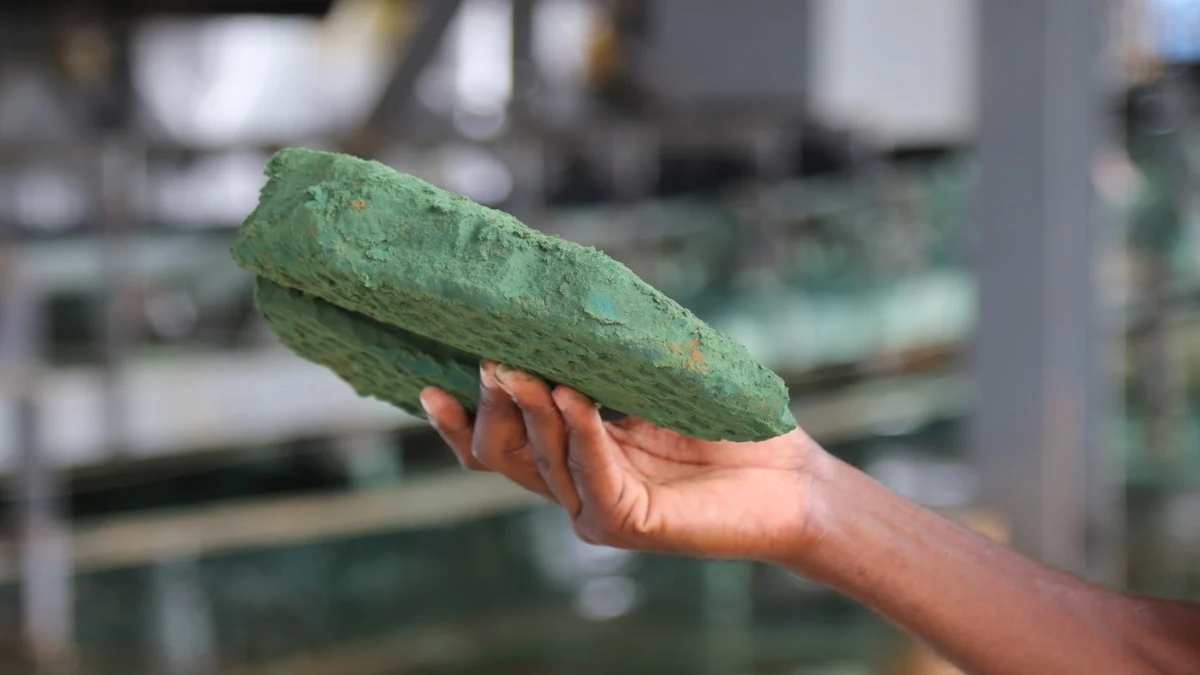
 "Why has India set its sight on Sri Lanka's untapped seabed cobalt?")
While India formally launched a new $6 million Maritime Rescue Coordination Centre (MRCC) in Sri Lanka recently, designed to help broadcast weather warnings and security information, India’s true interest lies in gaining access to the cobalt-rich Afanasy Nikitin Seamount, situated potentially within Sri Lanka’s maritime boundaries.
According to a South China Morning Post report, citing experts, India’s recent diplomatic maneuvers, including External Affairs Minister S Jaishankar’s visit to Colombo, underscore its strategic pursuit of a significant cobalt deposit in Sri Lanka’s seabed. The move is seen as part of a broader strategy to bolster ties with its island neighbour and assert dominance in the Indian Ocean region.
Cobalt is an essential mineral in rechargeable batteries, a critical component in the global transition away from fossil fuels to electric vehicles and renewable energy storage.
Dr Bhagya Senaratne, a postdoctoral fellow at New York University Shanghai’s Centre for Global Asia, told South China Morning Post that the emphasis on the launch of the MRCC was Delhi’s way of strategically communicating to the world its focus on the Indian Ocean region.
“It was also a move to demonstrate to other countries, including China, that India is going to retain Sri Lanka within its sphere of influence,” she was quoted as saying.
Senaratne said India has a history of seeking to gain the “upper hand” over strategic resources in the Indian Ocean. And its latest manoeuvre is hardly unexpected, given the disputes that have previously flared up between India and Sri Lanka over oil exploration rights in the Mannar Basin, she added.
Impact Shorts
More Shorts“If India can’t have it, then the likelihood of it allowing Sri Lanka to work with another actor to extract (a resource) is slim to none,” she told South China Morning Post.
Sri Lanka has sought to expand its continental shelf beyond the usual 200 nautical miles to assert a broader claim over the seabed, the approval for which is still awaited from the International Seabed Authority (ISA) after the island nation first submitted the request in 2009.
Senaratne said India, initially, did not contest the claim but after New Delhi realised the economic potential and geopolitical influence Sri Lanka could wield from resource extraction beneath those waters has captured India’s attention and interest.
Chinese presence
Given Sri Lanka’s strategic location, Colombo often finds itself caught in the middle of geopolitical tensions between Beijing and Washington and its allies, as evident with the arrival of Chinese research vessels at Sri Lanka’s ports.
After Colombo’s decision in December to impose a one-year moratorium on the docking of research vessels, believed to be influenced by pressure from India and the US due to Chinese research activities in Sri Lankan waters, Delhi has increased its diplomatic engagement.
Senaratne said the Chinese research activities likely prompted India to intensify its scrutiny of the seabed to understand the nature of the Chinese vessels’ studies.
What’s at stake?
KV Thomas, a retired scientist from the National Centre for Earth Science Studies in Thiruvananthapuram, told Al Jazeera that China was a key factor behind India’s decision.
He said that India’s efforts in deep-sea mining are in their early stages. However, it has shown significant ambition recently.
In 2021, India initiated the Deep Ocean Mission to explore deep-sea resources, committing $500 million over five years to this project.
By 2023, the Indian government revealed plans under this mission to develop a manned deep-sea mining submersible for the exploratory extraction of polymetallic nodules from the seabed. These nodules, known as manganese nodules, are crucial reservoirs of essential minerals such as cobalt.
Currently, China dominates the global supply with 70 per cent of cobalt and significant shares of lithium and manganese, as highlighted by the International Renewable Energy Agency. India, aiming for net-zero emissions by 2070, seeks access to these minerals to support its transition to a clean energy economy.
Sri Lanka’s claim
Usually a nation’s continental shelf spans up to 200 nautical miles (370 km) from its coastline, defining an exclusive economic zone where it can exclusively exploit resources, although foreign ships can freely navigate through.
However, coastal nations can petition the United Nations Commission on the Limits of the Continental Shelf (CLCS), asserting that their continental shelf extends beyond this limit.
In 2009, Sri Lanka applied to extend its continental shelf beyond 200 nautical miles. The CLCS has yet to make a decision on Sri Lanka’s claim, but if approved, it would encompass the Afanasy Nikitin Seamount within Sri Lanka’s maritime boundaries.
The CLCS reviews such claims from countries seeking extended continental shelf boundaries. In previous instances, Pakistan, Australia, and Norway have successfully secured rights to maritime territories extending beyond 200 nautical miles from their shores.
Initially, in 2010, India did not contest Sri Lanka’s claim before the CLCS. However, in 2022, India changed its stance, arguing that Sri Lanka’s claim would adversely affect its interests. India urged the commission not to endorse Sri Lanka’s submission.
India seeks approval for exploring cobalt
In January, India approached the Jamaica-based International Seabed Authority (ISA) to seek approval for exploring the cobalt-rich Afanasy Nikitin Seamount, located in the central Indian Ocean, east of the Maldives and approximately 1,350 km (850 miles) from India’s coast.
Established in 1994, the ISA is an autonomous international organisation mandated by the United Nations Convention on the Law of the Sea to regulate economic activities on the seabed.
India submitted an application to the ISA along with a $500,000 fee, outlining its plan to conduct extensive geophysical, geological, biological, oceanographic, and environmental studies in the proposed area spanning 15 years. The Afanasy Nikitin Seamount comprises 150 blocks spread over 3,000 sq km (1,158 sq miles).
During the evaluation of India’s application, the ISA determined that the Afanasy Nikitin Seamount is entirely situated within an area claimed by another country as part of its continental shelf.
According to Al Jazeera, while the ISA did not specify the country in its communication, experts believe it refers to Sri Lanka.
A country’s continental shelf refers to the underwater edge of its landmass.
The ISA communicated its findings of competing territorial claims to India and requested a response. However, on March 12, India informed the ISA that it would not be able to provide a timely response for consideration during the ISA’s 29th Session of the Legal and Technical Commission, where the application was under review.
Consequently, the ISA has placed India’s application “on hold” pending further response from India. The ISA is expected to revisit the application once India submits its response.
With inputs from agencies


 "Russian drones over Poland: Trump’s tepid reaction a wake-up call for Nato?")
 "As Russia pushes east, Ukraine faces mounting pressure to defend its heartland")
 "Why Mossad was not on board with Israel’s strike on Hamas in Qatar")
 "Turkey: Erdogan's police arrest opposition mayor Hasan Mutlu, dozens officials in corruption probe")
 "Russian drones over Poland: Trump’s tepid reaction a wake-up call for Nato?")
 "As Russia pushes east, Ukraine faces mounting pressure to defend its heartland")
 "Why Mossad was not on board with Israel’s strike on Hamas in Qatar")
 "Turkey: Erdogan's police arrest opposition mayor Hasan Mutlu, dozens officials in corruption probe")



