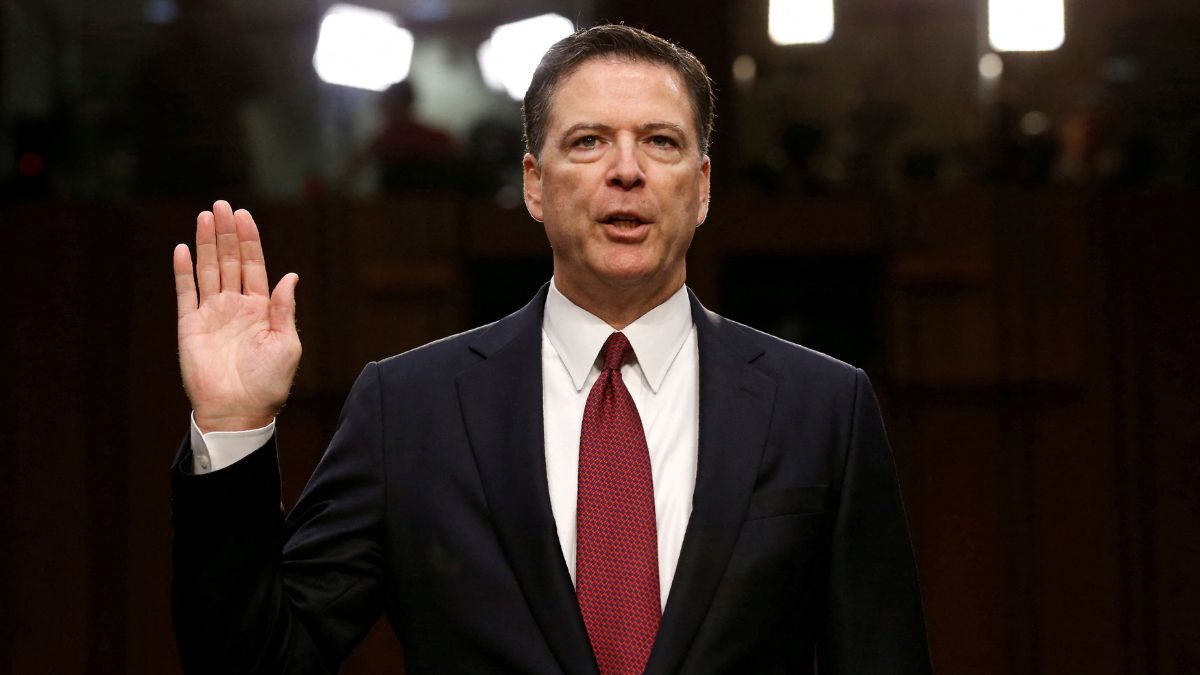
 "Former FBI Director James Comey is sworn in prior to testifying before a Senate Intelligence Committee hearing on Russia's alleged interference in the 2016 US presidential election on Capitol Hill in Washington, US, June 8, 2017. File Image/Reuters")
In a major blow to the US Justice Department’s efforts to re-indict former FBI Director James Comey , a federal judge has blocked the prosecutors’ access to key evidence from email accounts and a computer belonging to a close Comey friend and attorney, Daniel Richman.
US District Judge Colleen Kollar-Kotelly on Saturday granted a temporary restraining order sought by Richman’s lawyers, who claim that the government illegally retained his emails and other data. “The Court concludes that Petitioner Richman is likely to succeed on the merits of his claim that the Government has violated his Fourth Amendment right against unreasonable searches and seizures by retaining a complete copy of all files on his personal computer (an ‘image’ of the computer) and searching that image without a warrant,” Kollar-Kotelly wrote in a four-page order filed Saturday, a day after Richman’s attorneys requested the emergency order.
Interestingly, Kollar-Kotelly is a Clinton appointee based in Washington. In the hearing, the federal judge issued a restraining order before getting a formal response from prosecutors to a petition Richman filed last week seeking the return of his data.
However, she said that a lack of clear indication about who currently has the data and where it is stored supported her conclusion that a temporary order limiting access to the crucial records is needed. “Uncertainty about its whereabouts weighs in favour of acting promptly to preserve the status quo,” Kollar-Kotelly wrote in the ruling.
Why it matters
Prosecutors argue that Richman’s communications with Comey are a central aspect of the case they are attempting to bring against the former FBI director. Back in 2017, the DoJ obtained a copy of the law professor’s personal computer, iCloud account and Columbia University email accounts.
The data was retrieved shortly after Trump fired Comey as FBI director. Richman allowed investigators to make an image of his computer during an investigation into an alleged disclosure of classified information. The FBI later obtained other records through search warrants.
Quick Reads
View AllIn September this year, the DoJ charged Comey with allegedly lying to Congress about his contacts with the media. At that time, the former FBI Director’s lawyer contended that prosecutors had improperly relied on Richman’s records, some of which may have included information protected by attorney-client privilege.
Meanwhile, Richman’s attorneys have argued that prosecutors and investigators were obliged to return or destroy the data once the initial investigations concluded. They also noted that the FBI appears to have examined data not within the scope of the warrants. However, it remains unclear exactly how significant the lack of access to Richman’s records would be for the DoJ’s probe.
With inputs from agencies.