

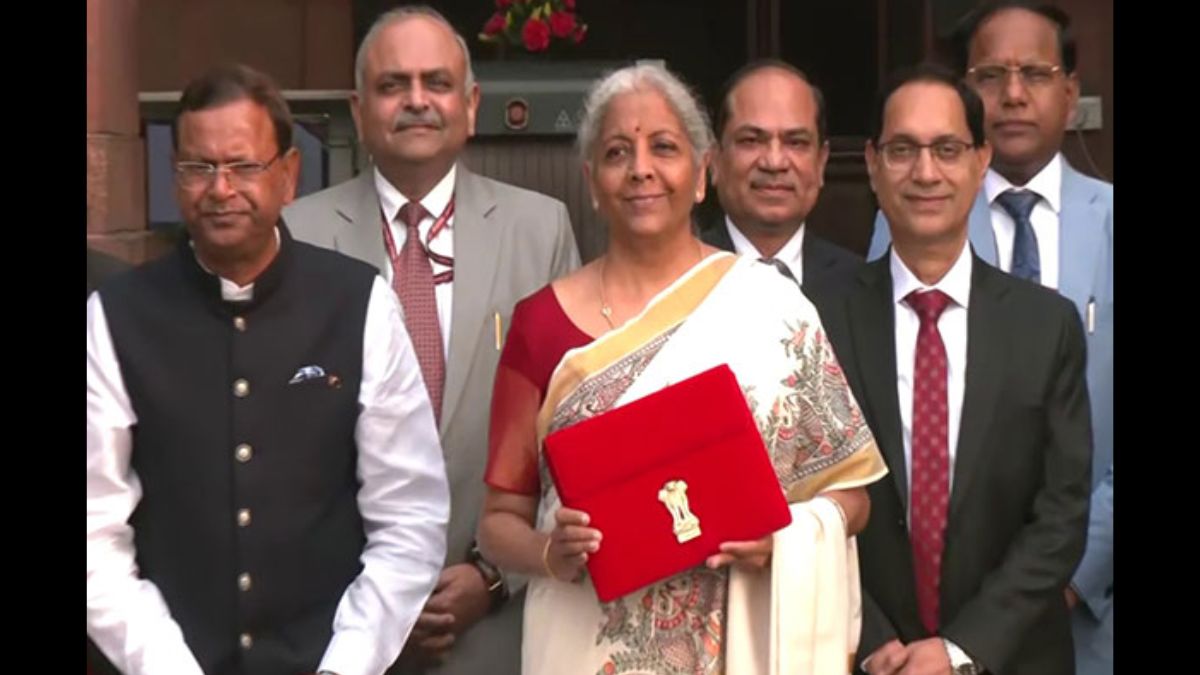
 "Union Budget 2025: Big income tax relief, push to Make in India and other highlights")
Finance Minister Nirmala Sitharaman presented the Union Budget 2025 in Parliament on Saturday with much-awaited announcements.
In a big win for taxpayers, the Finance Minister announced that from the next financial year, taxpayers will not have to pay income tax on income up to Rs 12 lakh.
She also announced major reforms for the ease of doing business and measures to support MSMEs and startups.
In the budget address, the Finance Minister emphasised that India’s economic resilience remains strong, with an estimated real GDP growth of 6.4 per cent in FY25 and robust private consumption contributing to economic momentum.
Here are the key highlights from the Finance Minister’s address:
Pointers on economy
The global economy grew by 3.3 per cent in 2023. The IMF projects global growth to average around 3.2 per cent over the next five years, which is modest by historical standards. While the overall global outlook remains steady, growth varies across different regions.
Inflation rates across economies have trended downward steadily, approaching central bank target levels. Taking stock of the steep decline in inflation, major central banks have been reducing policy rates.
Geopolitical risks remain elevated due to on-going conflicts and tensions, which pose significant risks to the global economic outlook.
Despite global uncertainty, India’s real GDP growth of 6.4 per cent in FY25 (as per first advance estimates of national income) remains close to the decadal average.
Private Final Consumption Expenditure as a share of GDP (at current prices) is estimated to increase to 61.8 per cent in 2024-25, the highest since 2002-03.
S.N. Country GDP Growth (y-o-y) Reference Period
1. India 5.4% Jul-Sep 2024
2. Japan 0.3% Jul-Sep 2024
3. Germany -0.3% Jul-Sep 2024
4. France 1.3% Jul-Sep 2024
5. UK 1% Jul-Sep 2024
6. Euro Area 0.9% Jul-Sep 2024
7. USA 2.8% Jul-Sep 2024
8. China 4.6% Jul-Sep 2024
9. Indonesia 4.95% Jul-Sep 2024
10. Philippines 5.2% Jul-Sep 2024
11. Malaysia 5.3% Jul-Sep 2024
12. Thailand 3.0% Jul-Sep 2024
Source: Trading Economics
High-frequency indicators indicate that the domestic economy continues to remain resilient and buoyant:
Gross GST collection rose by 9.4% y-o-y in April - October 2024, reflecting continued momentum in the economic activity
E-way bill generation growth signals a rise in economic activity
E-way bill generation increased by 17% y-o-y in October 2024, reaching an all-time high of 11.72 crore.
E-way bill volumes rose 16.6% y-o-y from Apr-Oct 2024.
India continues to record the highest PMI reading among major economies for both manufacturing and services.
Manufacturing PMI: rose to 57.5 in October 2024 (expansionary for nearly 3 consecutive years), reflecting the continued improvement in the economy’s operating conditions
Services PMI: rose to 58.5 in October 2024 (from 57.7 in September), having been expansionary for 39th consecutive month.
UPI has revolutionized digital payments and continues to register strong growth
UPI transactions hit record high in Oct 2024, growing 45% y-o-y by volume.
From Apr-Oct 2024, UPI volumes have grown 45.7% y-o-y
Retail inflation
- Average inflation rate was 4.8% during Apr-Oct 2024 (down from 5.5% during the same period last year)
Demand conditions remain firm:
Domestic Auto sales registered 13.1% year-on-year growth in Apr-Oct 2024
Power consumption rose by 22.1% year-on-year from Apr-Oct 2024
Domestic Tractor Sales rose by 5% from Apr-Oct 2024, and registered record-high sales in Oct 2024 (22.4% y-o-y growth)
Data on fast moving consumer goods sales for Q2 FY25 released by Nielsen IQ point towards improving urban and robust rural volume growth.
Strengthening Rural Economy
Demand under MGNREGA declined by 14.9% during April-Oct 2024. In Oct 2024, demand declined for 12th consecutive month on a y-o-y basis, pointing to increased availability of alternative employment opportunities.
NABARD’s bi-monthly Rural Economic Conditions and Sentiments Survey (Sep 2024) shows that during the 12 months preceding the survey, 37.6% of the rural households reported an increase in income, and 80.1% reported an increase in consumption expenditure, highlighting buoyant momentum in rural economic activity.
Increased MSP support for various crops for both Kharif and Rabi seasons will support farmers’ income.
Kharif marketing season 2024-25: MSPs increased by 1.4% to 12.7%
Rabi marketing season 2025-26: MSPs increased by 2.4% to 7.0%
Investment Activity Remains Buoyant
Private sector companies announced new projects worth Rs 4.1 trillion in the 3 months ended September 2024, a 42% rise from the year-ago period as per CMIE.
Manufacturing was the biggest contributor, with new project announcements worth Rs 3.39 trillion in the September quarter.
Foreign direct investment (FDI) flows remain strong in 2024-25:
- Net FDI rose 37.6% y-o-y to USD 14.3 billion in H1 of FY25.
FDI between 2014 and 24 (till FY 24) are estimated to have more than doubled over the preceding 10 years.
Years Cumulative FDI Inflows
2004-14 $304 billion
2014-24 (Prov) $665 billion (2.2X )
External Sector
Services exports continued to rise, growing by 12.5% from Apr-Oct 2024, while services imports rose by nearly 12% over the same period.
After surpassing the USD 700 billion mark, India’s foreign exchange reserves moderated to USD 684.8 billion at the end of October 2024, sufficient to cover 11.8 months of imports and more than 100 per cent of external debt at the end of June 2024.
The Indian rupee emerged as one of the least volatile currencies during FY25, staying within the range of USD 84.3-84/dollar during April-October 2024, exhibiting a coefficient of variance of 0.28%
Employment
Quarterly PLFS for Jul-Sep 2024 suggest a healthier and more engaged urban labour market
urban unemployment rate has shown a year-on-year improvement, dropping from 6.6 per cent in Q2 FY 2023-24 to 6.4 per cent in Q2 FY 2024-25.
During the same period:
Labour Force Participation Rate (LFPR) increased from 49.3% to 50.4%,
Worker-to-Population Ratio (WPR) rose from 46% to 47.2%.
Employees’ Provident Fund Organization
EPFO added 9.5 lakh new members in September 2024.
9% cent of the new members added in September 2024 were in the 18–25 age group, consistent with the trend that most individuals joining the organized workforce are youth, mainly first-time job seekers.
Annual Survey of Industries 2022-23:
The total number of employees in manufacturing industries increased by 7.5% to 1.84 crore in 2022-23 from 1.72 crore in 2021-22, the highest rate of increase in employment in manufacturing industries in the last 12 years.
This translates into an addition of over 22 lakh jobs in FY 23 over FY 19 (pre-pandemic level), underscoring the sector’s robust post-pandemic recovery.
During the pandemic in FY 21, the sector lost approximately 5 lakh jobs. The growth of the sector in FY 23 indicates a strong rebound of the sector as economic conditions improved.
Total number of factories increased from 2.49 lakh in 2021-22 to 2.53 lakh in 2022-23 – the first year marking the full recovery phase after the Covid-19 pandemic.
Healthy and Resilient Financial Sector
Gross non-performing assets (GNPA) ratio of banks was 2.7% as at end-June 2024, the lowest since end-March 2011.
- New NPA accretions as a percentage of standard advances (annualised slippage ratio) had declined to 1.3% as at June end 2024, as against 1.6% a year ago.
Key health parameters of NBFC sector are also moving in tandem with the banking sector.
- GNPA and NNPA ratios of NBFC sector (excluding NBFCs under resolution) in June 2024 were 2.6% and 1.1%, respectively, compared with 3.2% and 1.2% in the same quarter of the previous year.
Public Sector Banks recorded the highest-ever aggregate Net Profit of ₹ 1.41 lakh crore in FY 2023-24 (almost 4 times higher than FY 2014 of Rs 35,000 crores).
In H1FY25 (April-October 2024), PSBs recorded 25.6% y-o-y growth in Net Profit (rose to Rs.85,520 crore).
Their bad loans have declined sharply - the Gross NPA ratio of Public Sector Banks declined to 3.47%, and the Net NPAs of PSBs declined to 0.76% in March 2024.
Bad loans have declined further - the Gross and Net NPA of PSBs stood at 3.12% and 0.63% as on Sep-24 (on a year-on-year basis, gross and Net NPA declined by 108 bps and 34 bps respectively).
Banks are financially stronger now because their Capital to Risk-weighted Assets Ratio (CRAR) has increased and capital adequacy has improved significantly.
Other Indicators of Continued Economic Improvements
SBI Research (October 2024): income disparity has declined by 74.2% for individuals earning up to Rs 5 lakh annually between FY14 and FY23.
In May 2024, S&P Global raised India’s country outlook to positive from stable after 14 years.
WTO’s Global Trade Outlook and Statistics report (April 2024): India has become the world’s fourth-largest exporter of digitally delivered services.
- India’s exports of digitally delivered services registered a 17% increase in 2023, better than Germany and China (which registered a growth of 4% each).
Insights from Motilal Oswal’s ‘India Strategy: Embracing India’s Magnitude’: Structural Factors Supporting Market Growth
Global Share: India’s share in global market cap grew to 4.3% in 2024, up from 1.6% in 2013.
Weight in MSCI Index: India overtook China in the MSCI Emerging Markets Index weight in September 2024, peaking at ~22% from ~7% in 2014.
Growing retail participation: Demat accounts expanded from 22 million in 2014 to 180 million in 2024.


 "Russian drones over Poland: Trump’s tepid reaction a wake-up call for Nato?")
 "As Russia pushes east, Ukraine faces mounting pressure to defend its heartland")
 "Why Mossad was not on board with Israel’s strike on Hamas in Qatar")
 "Turkey: Erdogan's police arrest opposition mayor Hasan Mutlu, dozens officials in corruption probe")
 "Russian drones over Poland: Trump’s tepid reaction a wake-up call for Nato?")
 "As Russia pushes east, Ukraine faces mounting pressure to defend its heartland")
 "Why Mossad was not on board with Israel’s strike on Hamas in Qatar")
 "Turkey: Erdogan's police arrest opposition mayor Hasan Mutlu, dozens officials in corruption probe")



