

 "UK unveils AI-powered naval tech to counter Russian submarine threat")
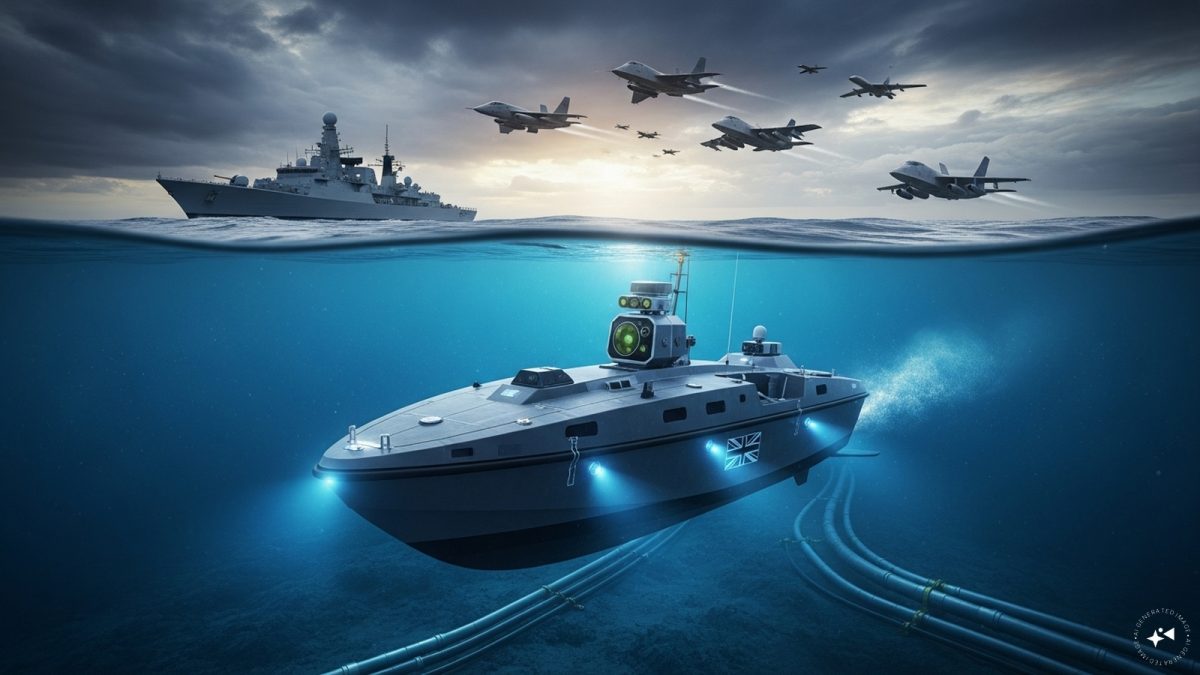
The UK Ministry of Defence (MoD) is developing autonomous vessels equipped with artificial intelligence to work alongside warships and aircraft, aiming to safeguard Britain’s undersea cables and pipelines from Russian threats.
According to Politico report, under the Atlantic Bastion programme, surface and underwater vessels, submarines, and aircraft will be linked through AI-powered acoustic detection systems and integrated into a “digital targeting web” of weapons systems, enabling faster operational decisions.
The government said that the programme was in response to a resurgence of Russian submarine and underwater activity in British waters. British intelligence has warned that President Vladimir Putin is modernising his fleet to target critical undersea infrastructure.
Last month, the Russian spy ship Yantar directed lasers at UK forces monitoring its movements—marking the first such incident after it entered UK waters. The vessel had also been observed in January.
Defence Secretary John Healey said the ship is “designed for gathering intelligence and mapping our undersea cables.”
The MoD said Atlantic Bastion will create a hybrid naval force capable of detecting, tracking, and, if necessary, taking action against underwater threats.
A total of £14 million has been invested by the MoD and industry, with 26 UK and European firms submitting proposals to develop anti-submarine sensor technology. Deployment of the capabilities is expected from 2026.
“People should be in no doubt of the new threats facing the UK, and our allies under the sea, where adversaries are targeting infrastructure that is so critical to our way of life,” Politico quoted Defence Secretary John Healey as saying.
“Our pioneering Atlantic Bastion programme is a blueprint for the future of the Royal Navy. It combines the latest autonomous and AI technologies with world-class warships and aircraft to create a highly advanced hybrid fighting force to detect, deter and defeat those who threaten us,” added Healey.
Quick Reads
View AllBritain’s Chief of the Naval Staff, Gwyn Jenkins, was expected to say at the International Sea Power Conference on Monday: “We are a Navy that thrives when it is allowed to adapt. To evolve. We have never stood still — because the threats never do.”
The first sea lord general added: A revolutionary underwater network is taking shape — from the Mid-Atlantic Ridge to the Norwegian Sea. More autonomous, more resilient, more lethal — and British built.”
With inputs from agencies


 "‘Beggar thy neighbour’: The problem with cheap Chinese exports flooding the world")
 "Zelenskyy arrives in London for high-stakes talks with European allies")
 "India warns travellers to exercise 'discretion', seeks China's assurance after Arunachal woman’s ordeal")
 "Why countries are watching Australia's social media ban for children")
 "‘Beggar thy neighbour’: The problem with cheap Chinese exports flooding the world")
 "Zelenskyy arrives in London for high-stakes talks with European allies")
 "India warns travellers to exercise 'discretion', seeks China's assurance after Arunachal woman’s ordeal")
 "Why countries are watching Australia's social media ban for children")



