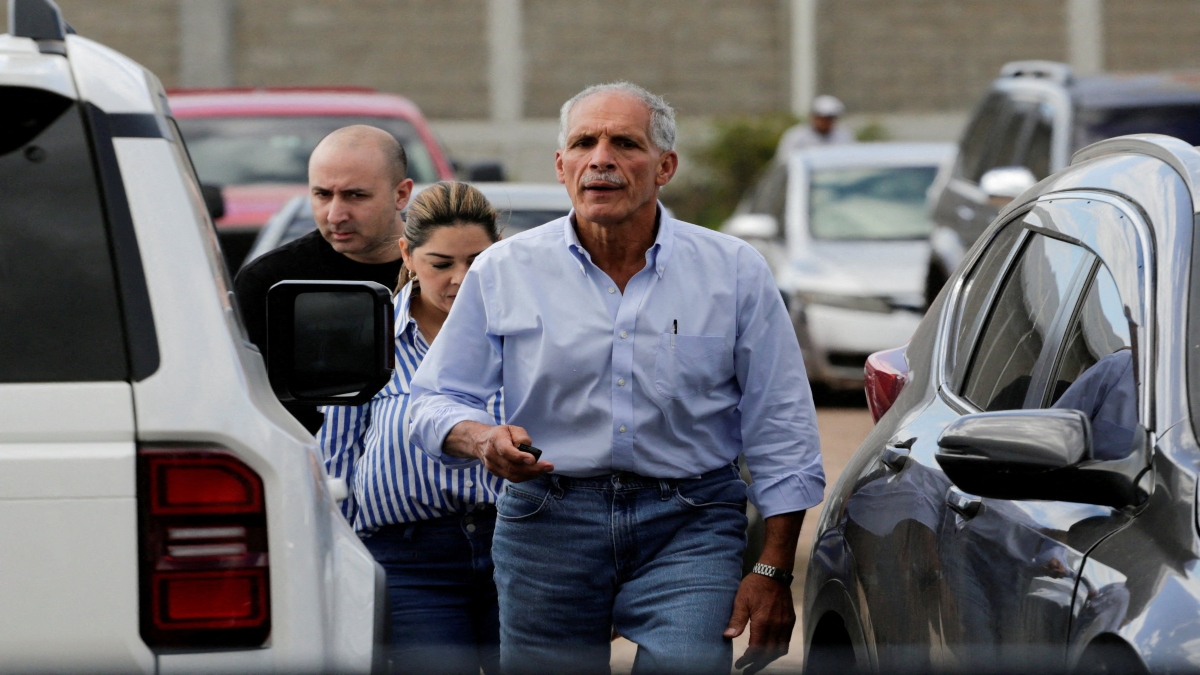
 "Presidential candidate Nasry Asfura of the National Party of Honduras arrives to hold a press conference following the general election, in Tegucigalpa, Honduras, on Monday. Reuters")
In a dramatic, last-minute intervention that echoed his recent role in Argentina’s elections, US President Donald Trump warned Honduras that US support would dry up if his preferred candidate lost — and announced he would pardon a disgraced former Honduran president.
By Monday morning, the impact was visible as Trump’s endorsed contender surged into a virtual tie in one of the country’s tightest races in years.
According to The New York Times report, about 36 hours before polls opened, Trump declared online that the United States would “not be throwing good money after bad” if Nasry Asfura — a right-wing former mayor — failed to win.
In the same post, he said he would pardon Juan Orlando Hernández, the former Honduran president convicted in the US of conspiring with drug cartels, added the report.
Hernández belongs to Asfura’s National Party.
Early results suggested that the message landed. With 57% of ballots counted by Monday afternoon, Asfura, 67, and fellow right-wing candidate Salvador Nasralla, 72, were tied at 40% each, separated by only 515 votes. The governing left-wing party languished far behind.
“The race isn’t over,” NYT quoted Ricardo Zuniga, a former senior US State Department official, as saying. “But I think the endorsement clearly tilted the undecideds toward Asfura,” Zuniga added.
According to a France 24 report, election officials labeled it a “technical tie” and began a manual recount amid growing tensions.
The National Electoral Council (CNE) urged “patience” as it reviewed the November 30 vote.
Quick Reads
View AllBut Trump quickly escalated his involvement.
“Looks like Honduras is trying to change the results of their Presidential Election. If they do, there will be hell to pay!” he claimed on Truth Social offering no evidence.
CNE president Ana Paola Hall maintained that the count remained too close to call.
Hondurans, already disenchanted with the governing Libre party, had been split between Asfura and Nasralla.
Trump’s barrage of messages — branding Nasralla a “borderline Communist” and threatening Honduras with consequences if Asfura lost — dominated the national conversation heading into Election Day.
“Hondurans as a society do not want conflict with the United States,” Zuniga said.
According to The New York Times, citing analysts, polls days earlier showed Nasralla with a lead and a large pool of undecided voters.
“It changed in the last four days,” NYT quoted Carlos Hernández of Transparency International. “You know the reason why.”
Both candidates had sought Trump’s favour in Washington. But Trump ultimately turned against Nasralla, calling him “no friend of Freedom” despite his previous alliance with the governing party — a partnership he ended years ago.
The razor-thin margin now opens the door to a possible power struggle between the two right-wing contenders, each of whom has spent weeks warning of fraud.
US’ new Latin strategy
The episode underscores a dramatic shift in US posture in Latin America. While previous administrations emphasised neutrality and election integrity, Trump has sought to build an ideological bloc of allied leaders, backing figures like Argentina’s Javier Milei, El Salvador’s Nayib Bukele and others.
Trump had previously threatened to cut aid to Argentina. In October, the Trump administration’s $20 billion bailout of Argentina helped Milei’s party take control of the country’s Congress in midterm elections, and U.S. officials celebrated when Bolivia ended two decades of leftist rule.
Honduras was next on the 2024–25 electoral map. Trump endorsed Asfura on Wednesday, praising his record as the former mayor of Tegucigalpa and portraying him as a bulwark against Venezuela’s Nicolás Maduro.
The US Embassy in Tegucigalpa had been strictly neutral.
“Like everything else, it wasn’t until Trump became personally involved that the policy changed dramatically,” Zuniga said. “The policy is whatever the president decides it is.”
How Asfura secured Trump’s nod remains unclear, but the simultaneous pardon of Hernández cut both ways.
It brought renewed attention to the National Party’s history of corruption and cartel ties. Opponents quickly seized on the association; Asfura responded only to say the pardon ended “the family’s suffering.”
Known as “Tito” and “Papi,” Asfura campaigned as a populist, dancing in jeans and accusing the governing party of plotting to steal the election.
Nasralla pitched himself as the anticorruption candidate but faced lingering doubts over his political shifts. A well-known television personality, he campaigned with his wife — a congresswoman and former beauty queen — and projected confidence just days before Trump’s intervention.
“It’s now or never,” Nasralla said in an interview before the vote.
Days later, Trump entered the race — and the playing field shifted.
With inputs from agencies