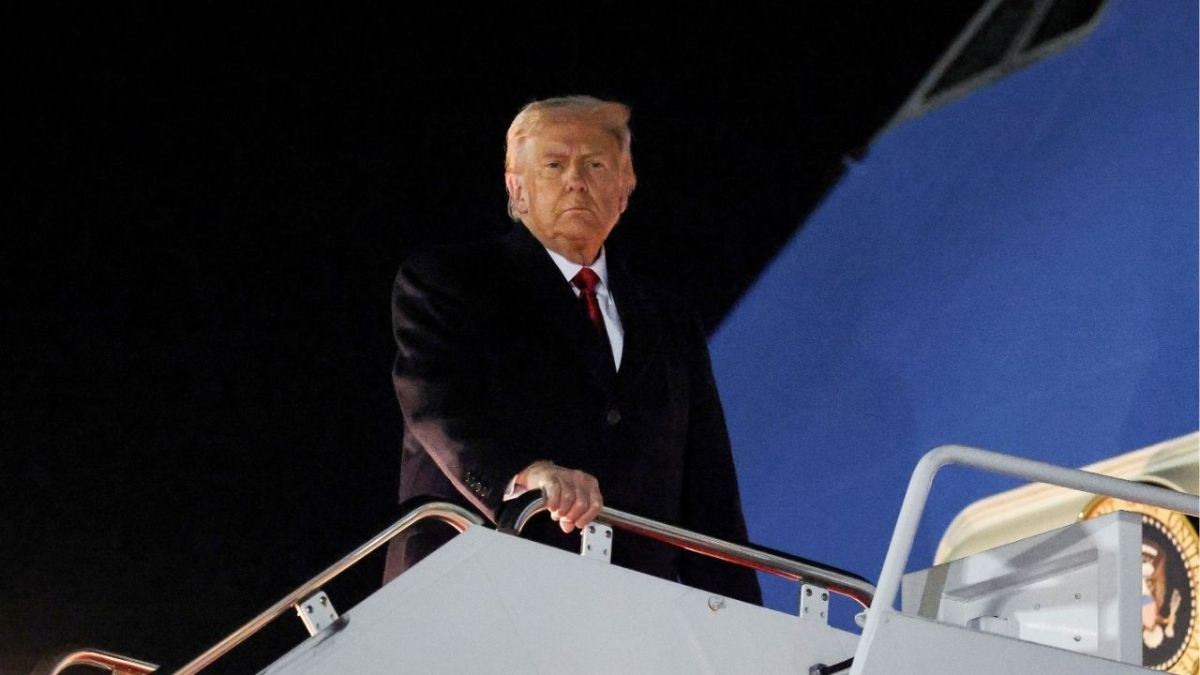
 "US President Donald Trump looks on while boarding Air Force One as he departs for Asia at Joint Base Andrews, Maryland, US, on October 24, 2025. (Photo: Evelyn Hockstein/Reuters)")
US President Donald Trump on Sunday declared he had achieved a regime change in Iran and said he was “pretty sure” he would strike a deal to end the war.
“I think we’ll make a deal with them, pretty sure… but we’ve had regime change. We’re dealing with different people than anybody’s dealt with before. It’s a whole different group of people. So I would consider that regime change,” said Trump.
The statement came amid great pressure on Trump to wrap the war that has incurred the United States and partners in the Gulf great economic costs. As Iran has struck energy sites across the region, oil and gas prices have surged, rattling average Americans ahead of the mid-term elections.
Follow our live coverage of the US-Israeli war on Iran here
Trump launched the war on Iran to overthrow the Islamic Republic by triggering a domestic uprising with decapitation strikes. But that did not happen as the Iranian regime continued functioning despite the assassination of Supreme Leader Ayatollah Ali Khamenei.
Even as the Strait of Hormuz remains closed and 20 per cent of the world’s oil and gas supplies remain cut off, Trump hailed Iran’s purported gift of “20 boats of oil, big, big boats of oil going through the Hormuz Strait” over the next few days “out of a sign of respect”.
In the wake of the failure to change the regime, Trump has claimed the victory in a ‘mission accomplished’ moment.
Contrary to Trump’s claims, Iran’s regime continues to be in place. He has neither overthrown the Islamic Republic not replaced Khamenei with a favourable leader he propped Delcy Rodrigues in Venezuelan after ousting Nicolas Maduro.
Quick Reads
View AllAfter Khamenei’s assassination, Iran appointed Mojtaba Khamenei, his son, as the new Supreme Leader of Iran. Even as a host of top officials from the elected government, Islamic Revolutionary Guards Corps (IRGC), and military have been killed, new appointments have been made and war as well as diplomacy have continued unabated.
President Masoud Pezeshkian, Foreign Minster Seyed Abbas Aragchi, and Speaker Mohammad-Bagher Ghalibaf have emerged as key stakeholders in dialogues with intermediaries and foreign governments. Currently, Pakistan has taken the lead in attempts to hold direct talks between the United States and Iran . Egypt and Turkey are also part of the mediation.