

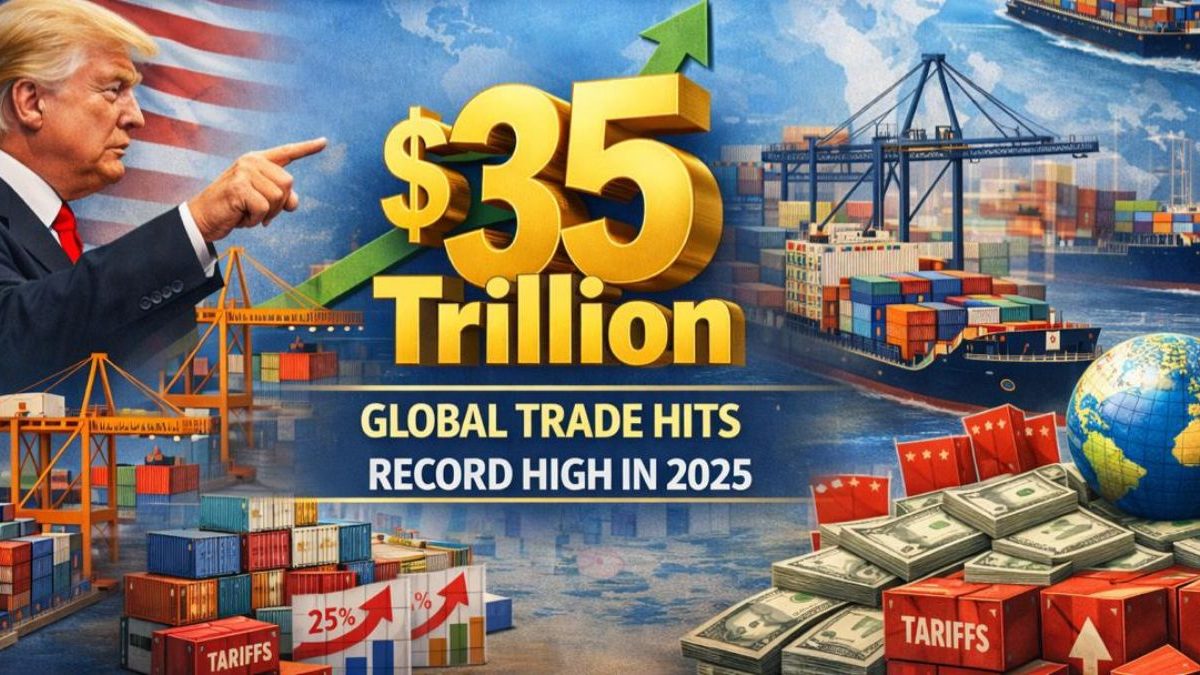
 "Trade over tariff: Global transactions surpass record $35 tn in 2025 despite Trump's levies")
Global commerce has delivered an unexpected performance in 2025, shrugging off widespread fears that sweeping US tariffs would choke cross-border activity. Instead, worldwide trade flows are on track to cross the $35 trillion mark for the first time, underscoring the resilience of supply chains and the powerful lift from technology demand.
According to data from UN Trade and Development (UNCTAD), global trade is projected to grow by 7 per cent in 2025, double the pace seen in 2024. Trade in goods – the primary focus of the Trump administration’s tariff measures, rather than services, where the US runs a surplus – is expected to expand by 6 per cent, triple last year’s growth rate.
China reported trade surplus
China, despite its trade war with Washington, reported a trade surplus of $1 trillion in the first 11 months of 2025, marking the first time any country has reached that level within a year.
At the same time, Taiwan, South Korea and Malaysia have emerged as major beneficiaries of a surge in semiconductor demand linked to the artificial intelligence (AI) boom.
China’s shipments to the US between January and November fell by 18.9 per cent compared with 2024 amid intensifying tensions. However, stronger demand elsewhere more than offset the decline, with exports to the European Union rising by 8.2 per cent, while sales to Asean and Africa jumped by 13.7 per cent and 26.3 per cent respectively.
Taiwan’s export performance has been particularly striking. Record growth has prompted the island to sharply revise its 2025 economic growth forecast to 7.37 per cent, a 15-year high, driven largely by AI-related demand. In October, outbound shipments surged by 49.7 per cent year on year to a record $61.8 billion, the fastest pace in nearly 16 years. For the first 10 months of 2025, exports rose 48.4 per cent year on year, supported by electronic parts and information and communication technology products.
Quick Reads
View All“We think that the export boom has further to run… all the signs point to demand for AI-related goods remaining strong over the next year or so,” said deputy chief emerging markets economist Jason Tuvey from London-headquartered Capital Economics.
South Korea is also expected to exceed $700 billion in annual exports for the first time, largely on the back of strength in its semiconductor sector.
Dark clouds ahead?
Despite the strong showing, questions persist over whether momentum can be sustained beyond technology in 2026, particularly as global growth is expected to slow, according to the International Monetary Fund and the Organisation for Economic Cooperation and Development. UNCTAD data points to a deceleration in the fourth quarter of 2025, with growth less than half the 2.5 per cent quarter-on-quarter expansion recorded in the third quarter.
The agency noted that much of the earlier surge was driven by front-loading, especially for tech-related products, as companies moved ahead of potential changes in US trade policy. “In 2026, global trade growth is expected to be more muted as slowing global economic growth, geopolitical fragmentation, continued policy uncertainty and heightened vulnerability weigh on trade activity. In addition, rising trade costs contribute to an outlook marked by caution,” UNCTAD said in its December update.
Even among those optimistic about AI, uncertainty remains over Washington’s next steps on semiconductors. The sector, alongside pharmaceuticals and critical minerals, is currently under a national security investigation under the Trade Expansion Act. Tuvey highlighted the risk of the US imposing punitive tariffs on semiconductors, which are presently exempt from country-based levies.
Malaysia Semiconductor Industry Association president Wong Siew Hai said the outcome of the probe will be crucial, as it also covers manufacturing equipment and derivative products. Still, he expressed confidence that strategic considerations would prevail. “This (US-Malaysia) model of business, with the high-end fabrication in the US and assembly and testing in Malaysia, is a win-win for both sides. Since the reciprocal trade agreement was signed, we do not expect any changes going into 2026,” he said. The agreement locks in a 19 per cent tariff for Malaysian goods, aside from exempted items imported into the US.
The World Semiconductor Trade Statistics organisation expects global semiconductor sales to approach $1 trillion in 2026, up more than 26 per cent from the estimated 2025 level.
Malaysia, where total trade is projected to reach RM3 trillion ($951 billion) for the first time, recorded a 10.7 per cent rise in its trade surplus for January to November 2025 to RM132.56 billion. Datuk Seri Tengku Zafrul Aziz, who served as trade minister until Dec 2, said November’s 15.8 per cent increase in imports was mainly due to capital and intermediate goods, signalling “ongoing industrial investment and supply-chain deepening, a positive sign for future productivity and export capacity”.
“To sustain this momentum, Malaysia should continue diversifying its export markets beyond traditional partners, deepen regional economic integration via ASEAN and new FTAs (free trade agreements), and strengthen supply-chain flexibility to mitigate tariff risk,” added Zafrul, now chairman of the Malaysian Investment Development Authority.
Singapore has also benefited from the tech upswing, with non-oil domestic exports rising 11.6 per cent year on year in November, marking a second straight month of double-digit growth. Chua Hak Bin, regional co-head of macro research at Maybank, said the city state’s role in the AI supply chain will deepen in 2026 with the opening of Micron’s US$8.9 billion advanced packaging facility and UMC’s US$6.5 billion wafer plant. “Singapore is also attracting investments in AI research and development facilities and as a global test bed for new technologies,” he said.
HSBC’s Asean economist Yun Liu noted that diversification has also played a role, with transport engineering exports continuing to expand at a double-digit pace. “This does not only contribute to the manufacturing sector but has also boosted related services sectors such as wholesale,” she said. Singapore’s low 10 per cent baseline tariff gives it a competitive edge over other US trading partners and is likely to divert further investment to the Republic.
Supply chain resilience
Trade has increasingly become a tool of geopolitical strategy, and that shift carries risks. OCBC Bank’s head of Asia macro research, Tommy Xie, said China’s unprecedented trade surplus will be hard to maintain and could fuel further frictions beyond the US. Mexico has already imposed tariffs of up to 50 per cent on more than 1,400 products from Asian countries, widely seen as targeting Chinese imports.
China and Europe have also exchanged anti-dumping duties since last summer on products including electric vehicles and pork. French President Emmanuel Macron has warned of additional measures if Beijing does not reduce its trade surplus with the EU, which exceeded US$350 billion in 2024.
Many analysts believe China cannot continue to rely on exports as a primary growth engine. “The economic support from external demand will decline. It can’t be as high as it was this year or last year. This is why domestic demand has become so important. But whether the latter can be held up is uncertain,” said Xie.
Concerns are also growing over heavy dependence on technology. Chen Mei-chu, head of Taiwan’s National Development Council’s Department of Economic Development, said the island’s economy remains uneven, with tech dominating while traditional industries lag. Machinery exports fell to US$24.1 billion in 2024, the lowest level in four years, amid intense competition from lower-cost producers such as China.
In his October National Day address, Taiwanese President Lai Ching-te said the government would invest tens of billions of dollars more each year to help small and medium enterprises pursue digital transformation and net-zero emissions. In November, Thomas Wu, chairman of the Chinese National Association of Industry and Commerce in Taipei, urged further action to address the imbalance. “Taiwan’s AI hardware suppliers have delivered strong earnings results and underpinned robust exports, but the nation cannot lean on the AI boom indefinitely,” he said.

 "‘Do I get credit?’: Trump caught on hot mic ranting about Nobel snub, India-Pakistan claims")
 "Hamas must disarm, Iran threat & more: Key takeaways from Trump and Netanyahu’s meeting in Florida")
 "Russia claims Ukraine fired drones at Putin’s residence: Will this derail the peace talks?")
 "'Deeply concerned': PM Modi expresses worry as reports of drone strikes on Putin’s residence emerge")
 "‘Do I get credit?’: Trump caught on hot mic ranting about Nobel snub, India-Pakistan claims")
 "Hamas must disarm, Iran threat & more: Key takeaways from Trump and Netanyahu’s meeting in Florida")
 "Russia claims Ukraine fired drones at Putin’s residence: Will this derail the peace talks?")
 "'Deeply concerned': PM Modi expresses worry as reports of drone strikes on Putin’s residence emerge")



