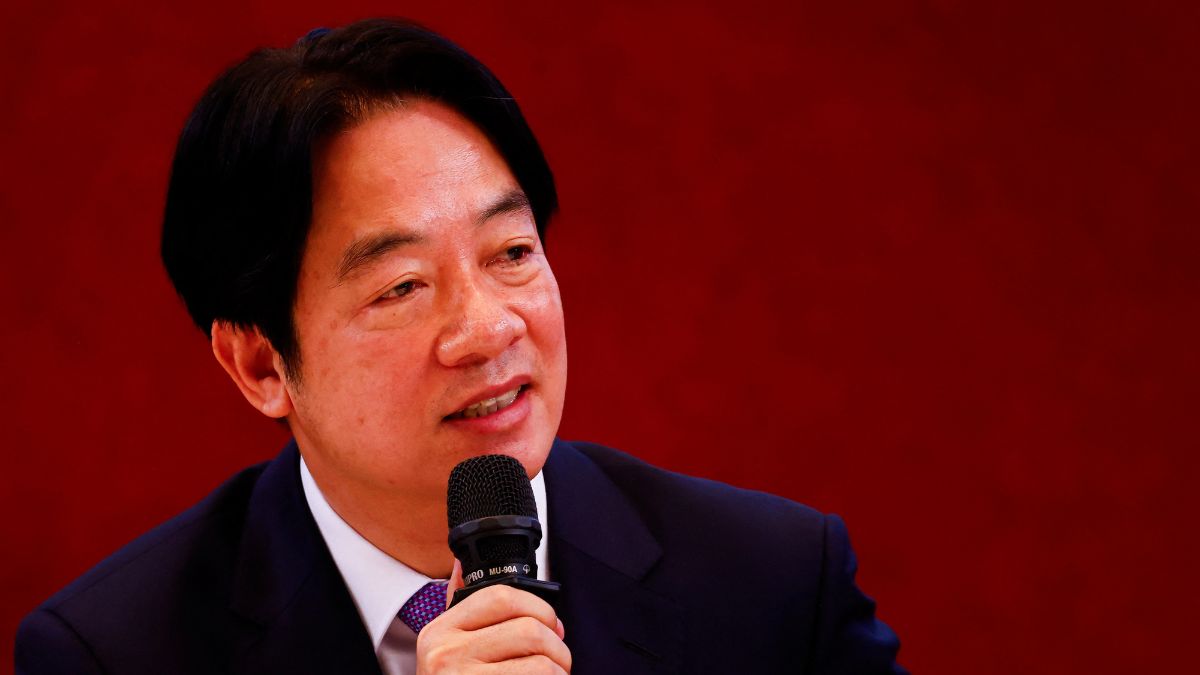
 "'Sovereignty is non-negotiable': Taiwan President Lai says in New Year address after Chinese drills")
Taiwanese President Lai Ching-te struck a defiant yet measured tone in his New Year’s address on Thursday, pledging to safeguard the island’s sovereignty just days after China staged fresh military drills around Taiwan.
The drills saw Beijing fire missiles and send dozens of fighter jets, naval vessels and coastguard ships to encircle Taiwan’s main island, moves Taipei swiftly denounced as “highly provocative”.
China, which claims Taiwan as part of its territory, has repeatedly warned it could use force to bring the self-governed island under its control.
“My stance has always been clear: to steadfastly defend national sovereignty, strengthen national defence and whole-of-society resilience, comprehensively establish effective deterrence capabilities, and build robust democratic defence mechanisms,” Lai said, speaking from the Presidential Office in a televised address.
China’s latest show of strength comes amid a series of US arms sales to Taiwan, as well as remarks from Japan’s prime minister suggesting that any use of force against Taiwan could prompt a response from Tokyo, comments that further angered Beijing.
Against this backdrop, Lai stressed that Taiwan’s international standing has only grown stronger. He said global backing for the island “has never wavered”, adding that it shows “Taiwan is no longer just Taiwan”.
“We are not only indispensable, we are also a trustworthy, responsible force for good in the international community,” Lai said.
At home, however, the president warned that political infighting could weaken Taiwan’s deterrence posture. He pointed to opposition delays in approving the government’s annual budget and a proposed $40 billion defence spending package, cautioning that such roadblocks could raise doubts about “Taiwan’s resolve” to defend itself.
Quick Reads
View All“In the face of China’s grave military ambitions, Taiwan has no time to wait, nor any time for internal strife,” Lai said.
“We may hold differing views on many issues, but without a resilient national defence, there will be no nation, nor any space for debate.”
China’s latest drills mark the sixth major round of military manoeuvres since 2022, when a visit by then US House Speaker Nancy Pelosi to Taiwan sharply escalated tensions.
In response, Taiwan has been investing more heavily in smaller, mobile weapons systems designed for asymmetric warfare against China’s far larger military. Still, Washington has urged Taipei to accelerate and expand those efforts.
Lai’s administration plans to raise defence spending to more than three percent of GDP in 2026, with an ambitious target of five percent by 2030.
‘Unity not division’
The president’s address came at the end of a turbulent few weeks for Taiwan, marked by a fatal stabbing attack in a Taipei metro station and a worsening political standoff in parliament.
Opposition parties—the Kuomintang (KMT) and the Taiwan People’s Party—have clashed with the government after Premier Cho Jung-tai refused to sign amendments to a revenue-sharing bill backed by them. Lai publicly backed Cho’s move, leading to accusations that the government was “defying the Constitution” and triggering impeachment proceedings.
“I hope that our ruling and opposition parties can stand united,” Lai said.
“Only through unity, not division, can we avoid sending the wrong signals to China that it could invade Taiwan.”

 "Trump announces 25% tariff on Iran’s trading partners. How India may be affected")
 "India, US to resume BTA talks after 5 months as Gor pushes for trade deal with 'real friends'")
 "ICC sources rubbish Bangladesh sports adviser’s sensational claim of BCB being asked to drop Mustafizur")
 "Jerome Powell: The 'Fed chair with a spine' taking on Trump")
 "Trump announces 25% tariff on Iran’s trading partners. How India may be affected")
 "India, US to resume BTA talks after 5 months as Gor pushes for trade deal with 'real friends'")
 "ICC sources rubbish Bangladesh sports adviser’s sensational claim of BCB being asked to drop Mustafizur")
 "Jerome Powell: The 'Fed chair with a spine' taking on Trump")