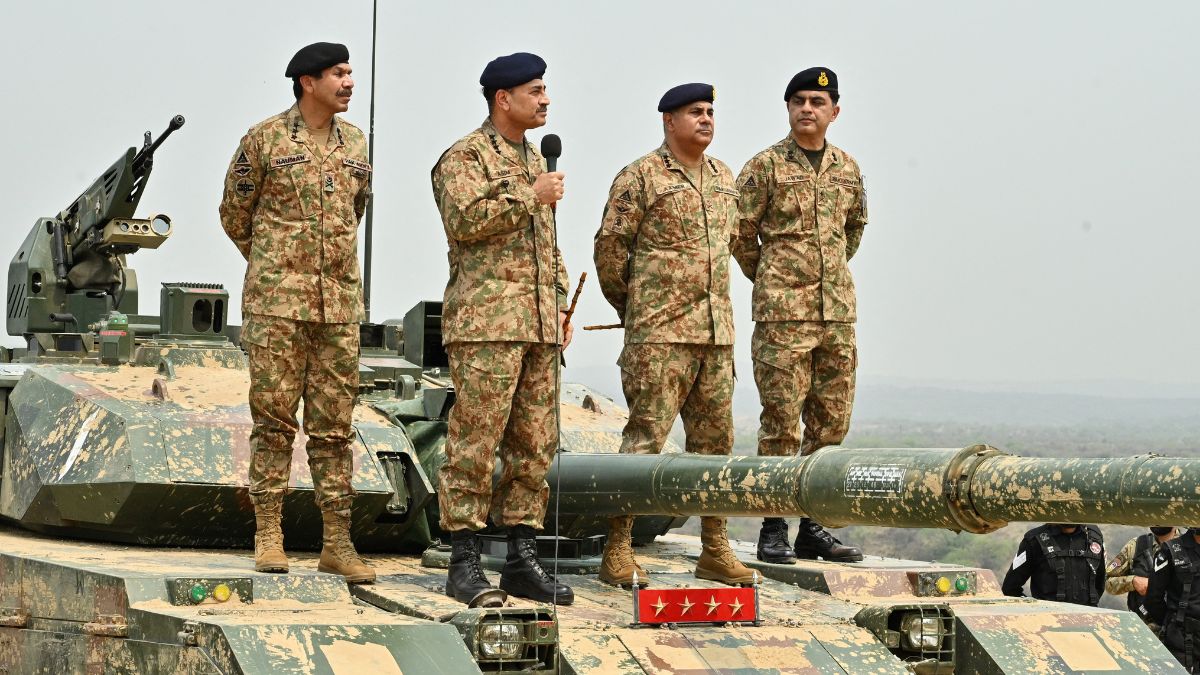
 "Pakistan Army chief, Field Marshal (then General) Asim Munir holds a microphone during his visit at the Tilla Field Firing Ranges (TFFR) to witness the Exercise Hammer Strike in Mangla, Pakistan, on May 1, 2025. (Photo: ISPR/Handout via Reuters)")
Six months after India’s Operation Sindoor battered Pakistan, the country’s army chief, Field Marshal Asim Munir, is eyeing to be the country’s czar.
With the 27th Amendment , Munir would seek to bury the ghosts of Operation Sindoor’s beating. In fact, even as Pakistani terrorist groups and military took a beating, Munir scored victories on a personal level.
Just 10 days after Pakistan requested a ceasefire, Prime Minister Shehbaz Sharif announced Munir’s promotion to field marshal — only the second after the military dictator Ayub Khan and the only one to have the rank while still being the army chief. This could have appeared like a consolation prize for a bruised general who triggered a war to embarrass his opponent but ended up getting blown up from the Himalayas to the coast. But that’s not the way of jihadists.
While Munir definitely sought to bolster his own position with the new rank and peddle the false narrative of victory, he knew that would not be enough.
ALSO READ: Pakistan Army owns the country — 27th Amendment to make it official today
And that’s how, on the six month-mark of India’s Operation Sindoor, Shehbaz’s government took up the proposal to appoint Munir as the country’s czar.
With the 27th Amendment, the open secret that Pakistan Army runs the country would become constitutional and legal reality. With that, Munir would turn Pakistan’s defeat into a personal victory.
From army chief to czar — how Munir climbed when Pak sank
In Pakistan’s beating, Munir sought victory.
In any other country, the kind of defeat India dealt Pakistan could have resulted in court martials. But Munir has continued to reap rewards from the defeat.
Quick Reads
View AllFirstly, Munir became the field marshal . Secondly, Munir went on foreign visits publicly as if he were Shehbaz’s constitutional equal. Thirdly, he met US President Donald Trump at the White House in a manner usually reserved for heads of states or governments. Fourthly, he struck a deal with the Trump administration and Israel for the Gaza Strip.
And, fifthly, Munir is now set to be Pakistan’s czar.
Sources have told CNN-News18 that the 27th Amendment would concentrate military’s decision-making and appointment powers with the field marshal. Currently, these powers —as mentioned in Article 243 of Pakistan’s constitution— effectively rest with the Prime Minister of Pakistan.
According to sources, these are the main security-related amendments proposed in the bill:
Establishment of the office of ‘Field Marshal of Pakistan’ with a five-year tenure just the fixed terms of the prime minister and president
Empowering the Field Marshal or Commander-in-Chief to appoint the chiefs of the army, air force, navy, and the ISI spy agency
Providing immunity to the field marshal from legal or political challenges
Fixing the tenure of service chiefs at five years
Amending the Pakistan Army Act, 1952, to overhaul the army’s command structure, which would likely involve the abolition of the office of Chairman Joint Chiefs of Staff Committee and creating a new post of Vice Chief of Army Staff that would report to the Field Marshal
With such a formal consolidation of powers, would Munir simply devote himself to peace and retire? That’s unlikely.
‘India can only impose costs’
Munir’s problem is not his alone. It’s the problem of the premise Pakistan was founded on — the opposition of India.
And nothing can solve that problem — not a war (Pakistan fought and lost four), not a promotion to field marshal, and not the 27th Amendment.
After a while of revelling in his formal anointment as Pakistan’s czar, Munir would want to turn to the very premise of his nation — the opposition of India.
Munir’s moves on India are driven by a self-consuming jihadist national ideology and that is why it’s unlikely to have absolute, everlasting deterrence despite military actions like Operation Sindoor. Analysts say that, at some point, Munir might again make a move against India because that’s the only thing he and his fellow Pakistani elites know. Pakistan observers say that India can only impose costs and make misadventures too costly to be attempted frequently.
“You can only impose costs on Pakistan — greater costs every time. At best, you can reduce the frequency of aggression from Pakistan or terrorists supported by Pakistan. But, as long as Pakistan remains, the anti-India terrorist campaign would continue as a perpetual religious war with India is the foundational ideology of the Pakistani nation,” Abhinav Pandya, a counter-terrorism expert and author, previously told Firstpost .
With Operation Sindoor, India imposed costs and raised the bar.
“India’s message was clear: If you would attack us, we would attack you and we would attack you closest to home,” said Pandya, who has authored books ‘Inside the Terrifying World of Jaish-e-Mohammed’, ‘Terror Financing in Kashmir’, and ‘Radicalization in India: An Exploration’.
While Pakistan’s jihadist war on India has remained the same, India now has the ‘Modi Doctrine’ that took final shape with Operation Sindoor.
Veteran journalist Shekhar Gupta said that now is the time for an all-hands-on-the-deck approach to prepare for the next round.
As Munir seeks to formalise himself as Pakistan’s czar, Pakistan watchers warn that the next round may come sooner than later.
“To think that this is a strategic lean-back period will be an unforgivable historic blunder. This is a lean-forward, all-hands-on-the-deck moment. The success of Operation Sindoor is a success to savour, but more importantly, it’s impetus for the future,” noted Gupta in a column for The Print.
I am a chief sub-editor at Firstpost. I primarily cover international affairs and India's foreign policy. I am a habitual reader, occasional book reviewer, and an aspiring tea connoisseur. You can follow me at @madhur_mrt on X and can reach out to me at madhur.sharma@nw18.com for tips, feedback, or Netflix recommendations. I was previously at Outlook magazine where I primarily covered national affairs at the intersection of policy, politics, and law.