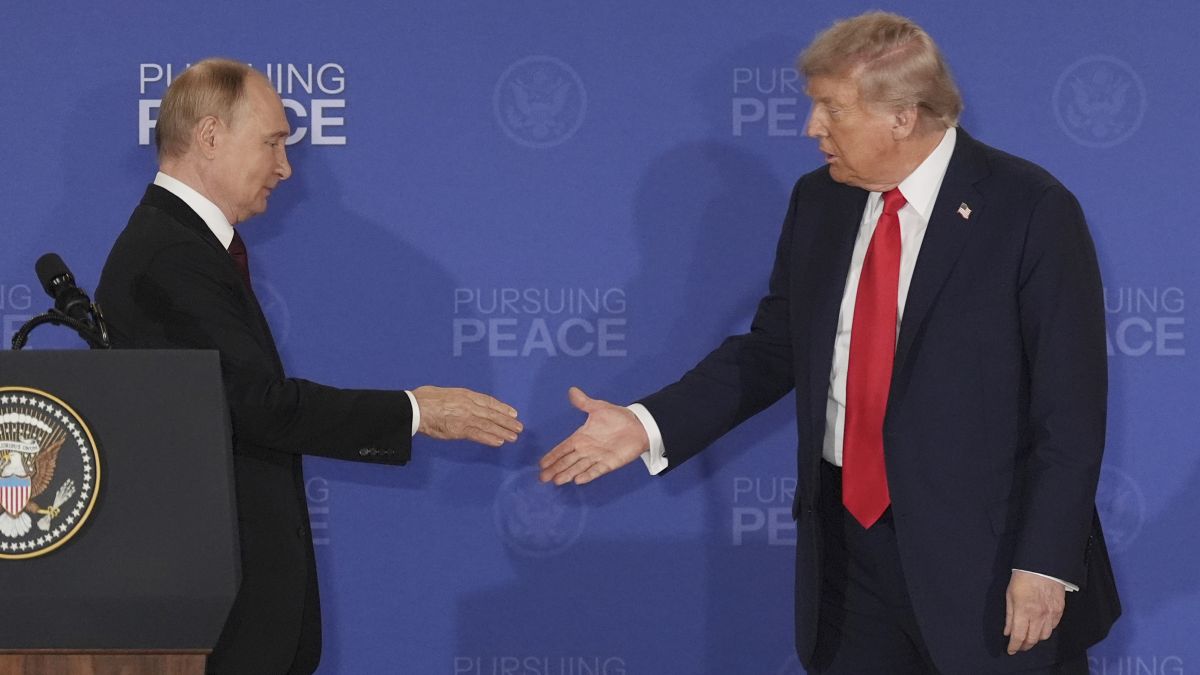
 "US President Donald Trump walks to shake the hand of Russian President Vladimir Putin during a joint press conference at Joint Base Elmendorf-Richardson, Alaska, on August 15, 2025. AP File")
Russian President Vladimir Putin has every reason to be satisfied as US President Donald Trump intensifies his feud with Europe, opening the door for Moscow to seize a new strategic advantage.
Trump’s envoys made little evident progress in Moscow last week during discussions on a potential Ukraine peace deal. Yet the Kremlin gained a different advantage: rapidly worsening tensions between Washington and its European allies.
In an interview with Politico on Tuesday, Trump renewed his criticism of European governments, saying they were “weak” and “decaying” because of their immigration policies.
He also claimed Russia holds the “upper hand” in its war in Ukraine and argued it was time for Ukrainian President Volodymyr Zelenskyy to “start accepting things” in negotiations.
“He’s going to have to get on the ball and start accepting things, you know, when you’re losing,” Politico quoted Trump as saying.
He also called on Zelenskyy to hold elections in statements that spooked Kyiv and Europe.
Trump’s remarks followed last week’s release of a new US national security strategy that sharply criticised European leaders for their approach to the Ukraine conflict.
The document faulted “European officials who hold unrealistic expectations for the war” for obstructing a peace deal, adding, “A large European majority wants peace, yet that desire is not translated into policy, in large measure because of those governments’ subversion of democratic processes.”
Quick Reads
View AllGerman Chancellor Friedrich Merz responded on Tuesday, saying at a news conference that “some of it is comprehensible, some of it is understandable, and some of it is unacceptable to us from a European perspective,” while stressing that Europe does not need US assistance to “save democracy” on the continent.
Still, the Trump administration’s framing of Europe as an anti-democratic barrier to stable relations with Russia has proved a political gift for Moscow, bolstering its efforts to portray Western unity as fractured.
Trump’s comments ‘very important’: Kremlin
Welcoming Trump’s statements on Ukraine, the Kremlin on Wednesday said US President remarks align with Russia’s view.
“In many ways, on the subject of Nato membership, on the subject of territories, on the subjects of how Ukraine is losing land, it is in tune with our understanding,” AFP quoted Peskov as saying on Wednesday.
He called Trump’s comments “very important”.
Following Trump’s interview, Zelenskyy said he was ready to hold new elections in Ukraine provided security would be assured.
Moscow’s offensive - which prompted Kyiv to introduce martial law - has made holding elections in the country impossible under Ukrainian law.
Russia has long called for Zelenskyy’s demise, calling him an illegitimate leader.
“We will see how the events will unfold,” Peskov said of Zelenskyy’s announcement.
Kirill Dmitriev, CEO of the Russian Direct Investment Fund and a central figure in recent diplomatic exchanges between Washington and the Kremlin, also moved quickly to capitalise on the moment.
In a series of posts on X, Dmitriev praised Trump’s broadside against European governments, highlighting the president’s warning that “Europe has to be very careful” and that it “is going in some bad directions … very bad for the people.”
Trump’s comments came after he was asked about X receiving a $140 million fine from EU regulators on Friday for violating European online content rules.
Elon Musk, the owner of X, responded by posting calls for the European Union to be abolished.
Russian policy has long focused on eroding European support for Ukraine and casting doubt on the durability of the Nato alliance — and the Trump administration’s new National Security Strategy offers Moscow fresh material for an information campaign aimed at influencing public opinion in both the United States and Europe.
The reaction across Europe to the strategy document mirrors the alarm felt earlier this year, after US Vice President JD Vance’s speech at the Munich Security Conference in February.
During his speech, Vance downplayed traditional threats such as Russia and China and instead zeroed in on Europe’s democratic health.
He urged leaders to heed populist concerns, defend free speech, and warned that suppressing dissent and pursuing “thought crimes” — citing cases like a Swedish activist and people praying near clinics — posed a greater danger than external adversaries.
Vance said the Trump administration would protect open debate, even when views diverge, and challenged Europe to take greater responsibility for its own security.
He also offered cooperation on safeguarding free expression, highlighting a clear shift in US foreign policy under the new administration.
The sense of triumph in Moscow over Washington’s latest rebukes of Europe also echoes the enthusiasm Russian officials displayed following Trump and Vance’s public scolding of Zelenskyy in the Oval Office later that month.
Zelenskyy, meanwhile, has been on a high-profile tour of Europe this week, meeting leaders in Britain, France and Germany in London, and holding talks with Nato and European Union officials in Brussels in an effort to reinforce support for Ukraine.
Russia escalates warnings
At the same time, Russian messaging directed at Europe — and warnings about its future — has grown more pointed.
In an interview on Russian state television, hardline political scientist Sergey Karaganov declared that Russia was “at war with Europe, not with a miserable, pitiful, misled Ukraine.”
He added that he does not speak for Putin, allowing him to offer his blunt assessment: “This war will not end until we smash Europe, morally and politically.”
Even if Karaganov was not acting as an official spokesperson, his remarks clearly reflected themes voiced by Putin himself.
On the eve of his meeting in Moscow last week with Trump’s special envoy Steve Witkoff and Trump’s son-in-law Jared Kushner, Putin issued a stark warning that Russia was “ready right now” for war with Europe — despite not intending to initiate one.
“We are not planning to go to war with Europe. I have already spoken about this a hundred times, but if Europe suddenly wants to go to war with us and starts, we are ready right now,” CNN quoted Putin as saying last Tuesday.
The intended audience for this saber-rattling is unmistakable. The Kremlin wants Europeans to feel the shockwaves of rhetoric that is increasingly shaking the foundations of trans-Atlantic relations.
With inputs from agencies