

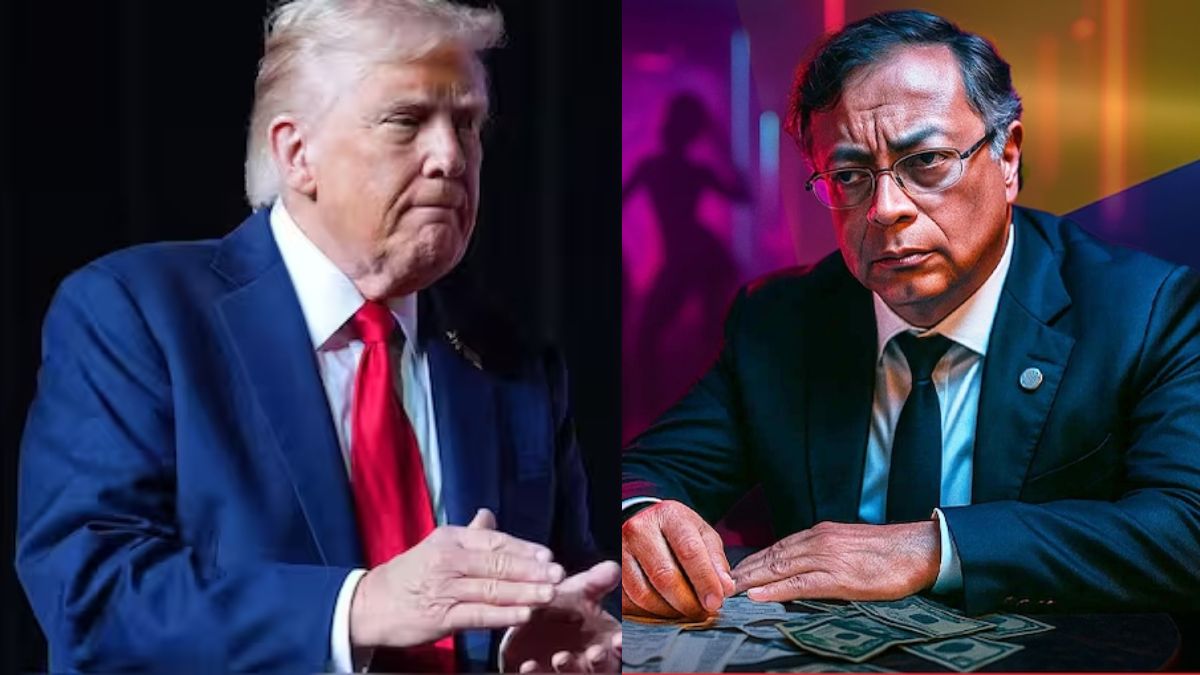
 "Petro calls US raid on Venezuela ‘abhorrent’ as Colombia enters dangerous standoff with Trump")
Colombian President Gustavo Petro has emerged as the fiercest international critic of the Trump administration’s military operation in Venezuela, denouncing it in blistering terms as an “abhorrent” assault on Latin American sovereignty and likening it to atrocities carried out by historical “enslavers” and even Nazi Germany.
As the United States seized Venezuelan President Nicolás Maduro, Petro intensified an already volatile confrontation with US President Donald Trump, who has openly mused that a military operation against Colombia “sounds good.” While most regional leaders have reacted cautiously to Washington’s actions, Petro has chosen escalation, using the Venezuela raid to amplify his rhetorical and diplomatic offensive against the White House.
On Wednesday, the leftist Colombian leader urged citizens to take to the streets to defend national sovereignty in response to what he described as Trump’s insults and threats of military intervention. He convened emergency consultations at the United Nations and the Organisation of American States, and went as far as suggesting armed resistance if Colombia were attacked, framing the moment as an existential challenge to the region’s independence.
That confrontational strategy has placed Colombia historically Washington’s closest ally in Latin America in an increasingly precarious position. Petro faces the delicate task of drawing domestic political capital from standing up to the United States ahead of a presidential election, while avoiding actions that could jeopardise vital security cooperation or provoke Trump into acting on his threats.
The contradiction was starkly visible this week. As Petro launched verbal attacks on Trump, senior members of his administration worked behind the scenes to reassure Washington that Colombia remains central to US counter-narcotics efforts. For three decades, the United States and Colombia have cooperated closely to dismantle drug trafficking networks, combat armed groups and support economic development in what remains the world’s largest cocaine-producing country.
Quick Reads
View AllAnalysts say Colombia still holds significant leverage in the relationship. The country provides much of the intelligence the US relies on to disrupt drug flows through the Caribbean, making it difficult for Washington to punish Bogotá without undermining its own strategic interests.
“There are people trying to warn Trump that punishing Petro too harshly is different from punishing Colombia as a whole,” said Michael Shifter of the Inter-American Dialogue think tank in Washington. Targeting the country itself, he argued, would weaken the fight against narcotics and ultimately harm US interests.
Yet uncertainty hangs over that calculation. Shifter cautioned that Trump’s unpredictability complicates efforts to manage the fallout. “He is impulsive, he shifts positions quickly, and his decisions are often driven by instinct rather than strategy,” he said.
Tensions between Petro and Trump have been building for months. The Colombian president has refused to accept US military deportation flights, called on American soldiers to defy Trump during a pro-Palestinian rally in New York, condemned US strikes on suspected drug-running vessels as acts of “murder,” and clashed repeatedly with Washington over Israel’s war in Gaza and US immigration policies.
Trump has responded with escalating hostility, using rhetoric previously directed at Maduro to attack Petro personally. He has branded the Colombian leader a “lunatic” and an “international drug leader,” revoked his US visa, imposed sweeping sanctions on Petro, his family members and his interior minister on alleged narcotics grounds, and threatened to cut off all American aid to Colombia. Trump has also warned of punitive tariffs on Colombian exports.
With Venezuela as the immediate flashpoint, the confrontation has now evolved into a dangerous standoff. Petro’s defiance has energised supporters at home, but it has also brought Colombia into Trump’s line of fire, raising the stakes for a country whose security, economy and regional standing remain deeply intertwined with the United States.
Thrilled by Maduro’s ouster, Trump pushed the fight even further in recent days. He called Petro a “sick man who likes making cocaine and selling it to the United States” and warned of a possible U.S. military operation on Colombian soil.
Petro can’t help relishing the conflict — as long as it remains only verbal. Frustrated with congressional resistance to his contentious reforms, failing to fulfil his promise of “total peace” with armed groups and facing a series of electoral tests, Petro has found in Trump the perfect foil as he fights for his legacy.
“He wants this stage where he is the clearest adversary, rhetorically or politically, to the U.S.,” said Sergio Guzman, a political risk analyst based in Bogotá.
The constitution bars Petro from seeking another term in May’s presidential vote but the country’s first leftist president wants his coalition to retain power over the resurgent right that blames his unpopular government for rising crime. Colombia will also hold legislative elections in March.
So far, Petro’s strategy of playing David to Trump’s Goliath seems to be paying off.
As Trump escalated his threats against Colombia this week, even some of Petro’s opponents rushed to his defense.
“Trump is misinformed and misfocused; his simplistic statements are counterproductive,” said Aníbal Gaviria, a right-wing presidential hopeful, praising his country’s strong democratic institutions. “Colombia is not Venezuela, nor Cuba, nor Nicaragua.”
A U.S. military operation against Petro who, unlike Maduro, was democratically elected, is unlikely, experts say.
But complicating the calculation for Colombian officials is Trump’s increasingly militaristic comments about Latin America that lump Colombia in with Venezuela as a source of narcotics and immigrants in the U.S.
“Whereas the Colombian institutions still maintain cooperation and have a lot to lose, Petro personally feels like that bridge has already burned,” said Elizabeth Dickinson, a senior analyst at the International Crisis Group.
Recent statements from top ministers betray the rising alarm. Fears are also building that Colombia — that shares a 2,200-kilometer (1,360-mile) volatile border with Venezuela and is the biggest host of Venezuelan refugees — could get sucked into a wider regional conflagration if its neighbor descends into chaos.
As Petro fired more salvos on social media, Colombia’s interior and justice ministers scrambled to put out the fire, announcing they had notified U.S. intelligence agencies the government would “continue to coordinate and cooperate in the fight against drug trafficking based on U.S. information and technology.”
In a news conference, Defense Minister Pedro Sánchez sought to reassure the public that the leaders’ latest spat had done nothing to upset security cooperation critical to the Colombian military and police as they fight leftist guerrillas and drug traffickers. Washington has provided Bogotá with roughly $14 billion in the last two decades.
“Today, we have a golden opportunity to invest even more in strengthening international cooperation,” Sánchez said, ticking off the government’s successes in destroying thousands of cocaine labs and intercepting fentanyl shipments.
Colombia is trying to resolve the tensions with Trump diplomatically, Foreign Minister Rosa Villavicencio told reporters on Tuesday. Nonetheless, Colombia is preparing for “the possibility of aggression against our country by the United States.”
“We have a highly trained, very well prepared army,” she said.
Indeed, the army has long received training from the U.S.
With inputs from agencies

 "Trump announces 25% tariff on Iran’s trading partners. How India may be affected")
 "India, US to resume BTA talks after 5 months as Gor pushes for trade deal with 'real friends'")
 "ICC sources rubbish Bangladesh sports adviser’s sensational claim of BCB being asked to drop Mustafizur")
 "Jerome Powell: The 'Fed chair with a spine' taking on Trump")
 "Trump announces 25% tariff on Iran’s trading partners. How India may be affected")
 "India, US to resume BTA talks after 5 months as Gor pushes for trade deal with 'real friends'")
 "ICC sources rubbish Bangladesh sports adviser’s sensational claim of BCB being asked to drop Mustafizur")
 "Jerome Powell: The 'Fed chair with a spine' taking on Trump")



