

 "Oreshnik missile strike nothing more than Putin’s ‘Reflexive Control’ strategy")
Around six decades ago, the world was on the precipice of a nuclear Armageddon—so the world believed.
It was the Cold War.
The US deployed the nuclear hypersonic PGM-10 Jupiter missiles in NATO members Italy and Turkey in 1958 and 1959, respectively, as a forward strike capability. The 30 Jupiters in Italy were a direct nuclear threat to the Soviet Union and its satellite states while 15 others in Turkey could hit Moscow and other major Russian cities.
America further ratcheted up tension with the USSR with the CIA’s Bay of Pigs Invasion and Operation Mongoose in Cuba.
Nikita Khrushchev was alarmed. The Soviet premier wanted to prevent further American hegemony and aggression, especially against its ally Cuba.
Khrushchev dispatched the first consignment of the thermonuclear hypersonic R-12 Dvina MRBMs on September 8, 1962, and the second batch on September 16. The Soviets also started building six sites for the R-12s and another three for the thermonuclear hypersonic R-14 Chusovaya IRBMs.
The Soviet missiles could target much of the eastern US within a few minutes.
On this day in 1962, the Cuban Missile Crisis reaches its climax as the U.S. warns its allies that war with the Soviet Union "may be necessary." pic.twitter.com/zzyFkIqrTX
— Military History Now (@MilHistNow) October 27, 2022
Impact Shorts
More ShortsWhen the US placed a naval blockade on Cuba to prevent further delivery of Soviet missiles, President John F Kennedy and Khrushchev exchanged messages that ended the crisis. Khrushchev removed the R-12s and didn’t deploy the R-14s and Kennedy withdrew the Jupiters from Italy and Turkey.
The 13-day Cuban Missile Crisis (October 16-28, 1962) was the closest the USSR-US confrontation came to escalating into a nuclear war.
The big question was would Kennedy have launched the Jupiters against the USSR and risked Doomsday by triggering an equally devastating retaliation from Khrushchev?
No. It was plain nuclear muscle flexing.
Theory of Reflexive Control
Though Khrushchev was the first to relent, Kennedy finally withdrew the Jupiters.
The USSR had only 75 ICBMs and 3,600 nuclear warheads compared to America’s 170 and 27,000—yet Khrushchev challenged Kennedy.
Knowing that Kennedy wouldn’t launch nukes at the USSR, Khrushchev used the old Soviet psychological manipulation theory of Reflexive Control, which affected his opponent’s decision-making processes.
Unlike traditional military strategies, Reflexive Control combines psychological and information manipulation, pressure tactics and geopolitical strategy to influence the enemy’s decision(s). It’s asymmetric warfare that changes the adversary’s perception of the situation and forces it to act accordingly to further Russian objectives.
According to Sergey Komov, a leading Russian thinker on information warfare, Reflexive Control can include one or more or a combination of the following tactics: distraction, overload, paralysis, exhaustion, deception, division, pacification, deterrence, provocation, suggestion and pressure.
Reflexive Control is “a means of conveying to a partner or an opponent specially prepared information to incline him to voluntarily make the predetermined decision desired by the initiator of the action”, says Timothy Thomas, a leading American expert on Russia’s information warfare.
Basically, Russia escalates the situation to force the adversary to de-escalate. In the process, Russia portrays itself as an irresponsible nuclear power—a bold yet restrained strategy—which either forces the enemy to change its course of action or end the conflict.
According to the Bulletin of the Atomic Scientists, “Escalation is a deliberate action taken primarily for the purpose of ending a conflict without any further increase in the intensity or level of fighting.”
In a nutshell, the enemy isn’t aware of being manipulated and decides in Russia’s favour.
Khrushchev’s strategic ambiguity and his psychological pressure on Kennedy obfuscated his real intentions and forced the US to avoid targeting Cuba in future. Using Reflexive Control, he established the military strategy of mutual assured destruction—if Kennedy launched a nuke against the USSR, he would launch a retaliatory nuclear strike against the US.
Oreshnik missile and reflexive control
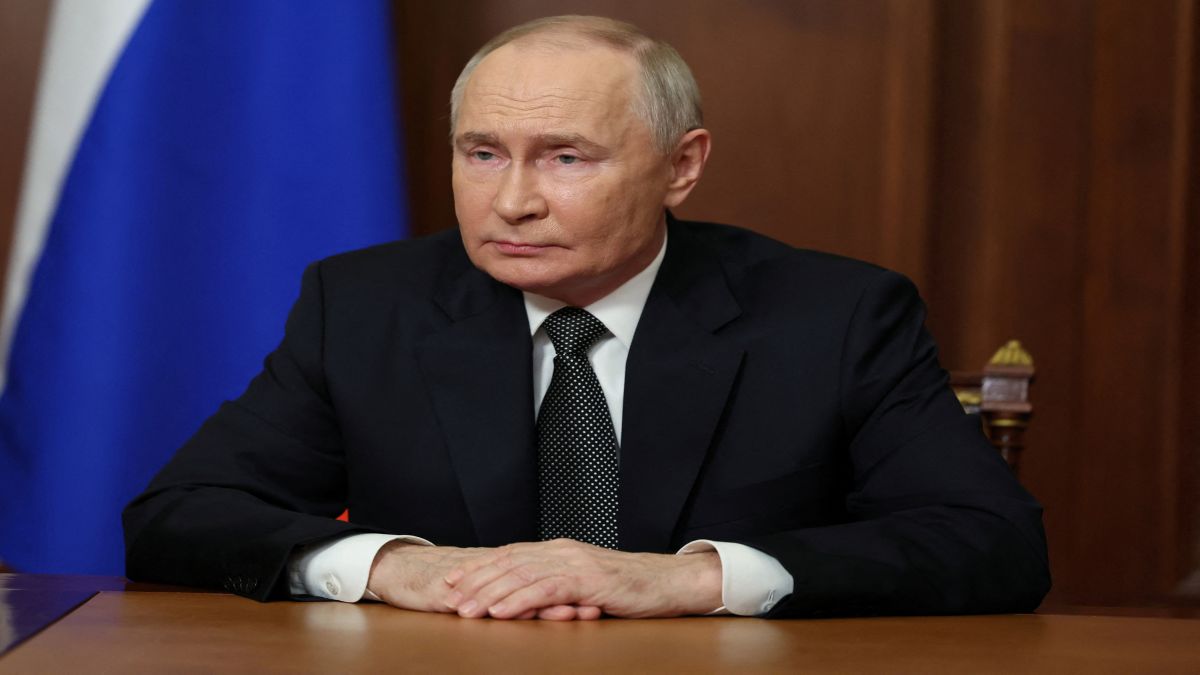
On November 21, a terrifying spectacle unfolded in the Russia-Ukraine War with President Vladimir Putin ordering the use of the hypersonic, non-nuclear Oreshnik missile against Ukrainian missile and space rocket company Pivdenmash (known as Yuzhmash), in Dnipro city.
The Western media, which often exaggerates Russian military manoeuvres and downplays NATO’s eastward expansion, went into overdrive.
Moscow launches ICBM at Ukraine one day after British Storm Shadows strike Russiahttps://t.co/iBMiGMt9jU
— Daily Express (@Daily_Express) November 21, 2024
Initial reports suggested the missile was an “ICBM” called RS-26 Rubezh, which has a nuclear warhead and can be equipped with a thermonuclear multiple independently targetable re-entry vehicle (MIRV) or a manoeuvrable re-entry vehicle and even the Avangard hypersonic glide vehicle.
Even Ukraine’s President Volodymyr Zelenskiy said that Russia attacked Ukraine with an ICBM launched from the Kapustin Yar test site, in Astrakhan Oblast.
If the reports and Zelensky’s claim were right, then an ICBM was used in war for the first time.
However, there are four types of ballistic missiles: SRBM (range less than 1,000 km), MRBM (1,000-3,000 km), IRBM (3,000-5,500 km) and ICBM (more than 5,500 km).
When Rubezh was successfully tested on May 26, 2012, it hit its target 5,800 km away. Therefore, it is barely classified as an ICBM. Moreover, Rubezh’s development was suspended from 2018 to 2027 as it violated the 1987 US-Soviet Intermediate-Range Nuclear Forces Treaty, which banned nuclear and conventional ground-launched ballistic and cruise missiles in the 500-5,500 km range of both countries but excluded air- or sea-launched missiles. The US and Russia withdrew from the treaty in 2019.
A few hours after the attack, Putin said that Russia had struck Ukraine with a “new” hypersonic IRBM that has a speed of Mach 10 and can’t be intercepted.
Is the Oreshnik completely new as claimed by Putin? There’s no clarity.
The Pentagon said the missile was based on the Rubezh, which wasn’t new but a shorter version of the thermonuclear, MIRV-equipped hypersonic RS-24 Yars. The Institute for the Study of War (ISW) also said that the missile was a “modified RS-26 Rubezh IRBM”.
On the other hand, Ukraine’s Main Intelligence Directorate (HUR) claimed that the missile was Kedr, a research project based on the Yars that was tested in Astrakhan—the same site from where Oreshnik was launched—in 2023 and early 2024. The HUR’s claim makes sense as the Rubezh project, based on the Yars, was shelved in 2018.
According to HUR chief Kyrylo Budanov, Kedr’s mass production hasn’t started—which again makes sense after Putin said that Russia would begin mass production of Oreshnik.
There are several reasons why Oreshnik’s use was nothing but Reflexive Control by Putin.
First, Russia doesn’t need an ICBM or an IRBM to target a neighbouring country when an MRBM or an SRBM can do the job. ICBMs or IRBMs are used for nuclear strikes on targets thousands of kilometres away.
What purpose will it serve when Russia already has used missiles that can carry nuclear warheads against Ukraine?
The Mach 5.9 9K720 Iskander is a mobile SRBM that can carry nuclear, conventional, cluster munitions, fuel-air explosive fragmentation, bunker-busting and electromagnetic warheads. The Mach 9 3M22 Zircon is a scramjet-powered, nuclear-capable hypersonic cruise missile. The Mach 10 Kh-47M2 Kinzhal is a Russian hypersonic air-launched ballistic missile that can carry nuclear and conventional warheads.
“Neither the Oreshnik ballistic missile strike nor Putin’s November 21 statement represents a significant inflection in Russian strike capabilities or likeliness to use a nuclear weapon. Russian forces fire nuclear-capable Iskander ballistic missiles, Kinzhal hypersonic ballistic missiles and nuclear-capable Kh-101 cruise missiles against Ukraine on a regular basis,” the ISW said.
NEW: Russian President Vladimir Putin intensified his reflexive control campaign aimed at Ukraine and its Western partners by conducting an ostentatious ballistic missile strike against Ukraine that used multiple reentry vehicles on November 21. 🧵(1/4) pic.twitter.com/K5L43oQVku
— Institute for the Study of War (@TheStudyofWar) November 22, 2024
Ukrainian air defence systems have shot down several such missiles with the most recent interception on November 17.
One difference between these missiles and Oreshnik/Kedr is that they aren’t equipped with MIRVs. That could explain the missile launch, the first time such a system was used in war. The missile had six warheads each carrying six submunitions. Pictures/videos showed six flashes each comprising a cluster of six individual projectiles.
Intercepting an MIRV-equipped missile is daunting, especially for Ukraine, as it has multiple warheads that can overwhelm the enemy’s air defence and strike different targets.
Second, satellite imagery showed little damage to the Ukrainian missile and space rocket plant after the attack.
Though Russian propaganda channels claimed that the plant was “destroyed”, Russian Z-channel Romanov Light released satellite images showing very little damage.
According to Julian Röpcke, a senior editor with the German tabloid Bild, the missile didn’t have explosives. “We don’t see explosions [in the videos of the attack], only kinetic energy from a fall from a height of several hundred kilometres,” he said.
Two senior Ukrainian government sources also told Reuters that the warheads didn’t contain explosives.
Third, a day after the attack, Putin claimed that several Oreshniks had the destructive power of a nuke and the missile couldn’t be intercepted.
“Due to its striking power, especially when used en masse and in combination with other long-range precision systems that Russia also has, using it against enemy targets will be comparable in effect and power to using strategic weapons,” he told a meeting of military officials, defence industry representatives and missile system developers in Moscow.
However, American missile defence systems like the THAAD and Aegis can counter fast-moving missiles, including some hypersonic ones.
“Systems like SM-3 from Aegis or Aegis Ashore as well as most likely Arrow 3 and THAAD can absolutely deal with this type of threat,” Fabian Hoffmann, a doctoral research fellow at the Oslo Nuclear Project, told CNN. Though a large number of interceptors would be needed to shoot the multiple warheads, he added.
Theodore Postol, a leading US missile technology expert and retired MIT professor emeritus of science, technology and national security policy differs. “There’s nothing available that can engage that system [Oreshnik] and offer any meaningful defence against it,” he told the Russian news agency TASS. According to him, the THAAD, Aegis and Patriot “are fundamentally flawed in their concept”.
However, Putin made similar claims about the Kinzhal and Zircon earlier, saying they were unstoppable. However, some of these missiles were shot down by Ukraine.
In January, Ukraine claimed to have shot down all the 10 Kinzhals fired by Russia. In March, two Zircons were intercepted. In June 2023, Ukraine shot down seven Kinzhals using the American MIM-104 Patriot missile defence system.
Every time NATO, particularly the US, arms Ukraine with new weapons, Putin either threatens the use of tactical nukes or puts his nuclear forces on high combat alert.
The Oreshnik retaliation was in response to Ukraine’s attack deep inside Russian territories with the American MGM-140 Army Tactical Missile System (ATACMS) and the Franco-British long-range, air-launched Storm Shadow cruise missile.
Though Putin slammed the ATACMS and Storm Shadow strikes, Ukraine has already struck Crimea, which Russia considers its territory, several times with the same missiles.
The incident was another example of Putin’s Reflexive Control campaign, which triggered the expected shock and fears of a nuclear attack on Ukraine. If Putin wanted to use a tactical nuke, he would have done it by now using the Iskander, Kinzhal or Zircon missiles.
Putin “intensified his Reflexive Control campaign aimed at Ukraine and its Western partners by conducting an ostentatious ballistic missile strike against Ukraine that used multiple re-entry vehicles on November 21,” the ISW said.
Putin’s rhetoric “is consistent with prior official Kremlin statements defining ‘red lines’ that the Kremlin has attempted to use to deter Western states from supporting Ukraine”.
The Oreshnik strike was pure propaganda and a political move to deter the West from assisting Ukraine. However, Putin has failed to prevent the West from arming Ukraine.
Changed Russian N-doctrine and reflexive control
Two days before the Oreshnik attack, Putin changed the nuclear doctrine by lowering the threshold after Ukraine fired six ATACMS missiles at an arms depot in the Bryansk region, around 110 km inside Russia.
According to the revised doctrine, a conventional attack by a non-nuclear nation [Ukraine] against Russia supported by a nuclear power [the US, UK or France] will be treated as a joint attack by both.
“Now, the danger of a direct armed clash between nuclear powers cannot be underestimated. What is happening has no analogues in the past. We are moving through unexplored military and political territory,” Russia’s deputy foreign minister Sergei Ryabkov said.
Similarly, when a new American ballistic defence base that is part of a broader NATO missile shield dubbed Aegis Ashore—that can intercept SRBMs, MRBMs and IRBMS—was inaugurated at Redzikowo, Poland, Russia said that it increased “strategic risks” and the “overall level of nuclear danger.
Russian Foreign Ministry spokesperson Maria Zakharova said that the missile defence base “has long been added to the list of priority targets for potential destruction, which, if necessary, can be executed with a wide range of advanced weapons”.
Since the start of the war, Putin has raised the spectre of a nuclear strike around 10 times.
While Putin managed to cause global fear and concern by revising the nuclear doctrine, it already contains several scenarios in which Russia can use a nuke against Ukraine or NATO.
According to the earlier doctrine, Moscow can use nuclear weapons if a state(s) that considers the Russian Federation as a potential enemy deploys missile defence systems and means, medium- and shorter-range cruise and ballistic missiles, high-precision non-nuclear and hypersonic weapons, attack unmanned aerial vehicles [drones] and directed energy weapons.
Ukraine uses the Patriot missile defence system, Storm Shadow cruise missiles, ATACMS tactical ballistic missiles and drones to attack Russian troops.
The earlier nuclear doctrine also states that Russia can use nuclear weapons against the adversary in a conventional war to prevent the escalation of hostilities and their cessation on terms acceptable to it.
“Putin consistently escalates the war on his own without regard to Western decisions and has consistently declined to retaliate every time Western states have deepened their support of Ukraine. Putin previously threatened severe retaliation if Western states provided Ukraine with rocket artillery, tanks, warplanes and the ability to strike into Russia, and Putin has constantly shifted the goalposts every time the West has called Putin’s bluff,” the ISW said.
A significant feature of the earlier doctrine was that Russia could use nukes if nuclear weapons were placed on the territories of non-nuclear states and the means of their delivery.
US deploys around 480 nukes at eight bases in six European countries, including non-nuclear nations. These weapons are gravity bombs of the B61-3, -4 and -10 types with Germany hosting the most (150), followed by the UK (110) and Italy and Turkey (90 bombs each).
Therefore, the earlier Russian nuclear doctrine was powerful enough to necessitate the use of a nuke.
However, some of Putin’s nuclear threats, part of Reflexive Control, have worked. When he put his nuclear forces on high combat alert on February 27, 2022, the US postponed the test launch of the Minuteman III ICBM in March of that year. Then-White House press secretary Jen Psaki said, “At no point has Russia been under threat from NATO [or] has Russia been under threat from Ukraine.”
Putin has increased the rhetoric and threatening manoeuvres knowing that the next US president, Donald Trump, wants to end the war. He wants to negotiate with Ukraine from a position of strength without making any significant territorial concessions and Kyiv abandoning its NATO ambitions. Russia controls 18 per cent of Ukraine (110,000 sq km), including Crimea, 80 per cent of Donetsk and Luhansk and more than 70 per cent of Zaporizhzhia and Kherson.
The writer is a freelance journalist with more than two decades of experience and comments primarily on foreign affairs. Views expressed in the above piece are personal and solely those of the writer. They do not necessarily reflect Firstpost’s views.


 "Russian drones over Poland: Trump’s tepid reaction a wake-up call for Nato?")
 "As Russia pushes east, Ukraine faces mounting pressure to defend its heartland")
 "Why Mossad was not on board with Israel’s strike on Hamas in Qatar")
 "Turkey: Erdogan's police arrest opposition mayor Hasan Mutlu, dozens officials in corruption probe")
 "Russian drones over Poland: Trump’s tepid reaction a wake-up call for Nato?")
 "As Russia pushes east, Ukraine faces mounting pressure to defend its heartland")
 "Why Mossad was not on board with Israel’s strike on Hamas in Qatar")
 "Turkey: Erdogan's police arrest opposition mayor Hasan Mutlu, dozens officials in corruption probe")



