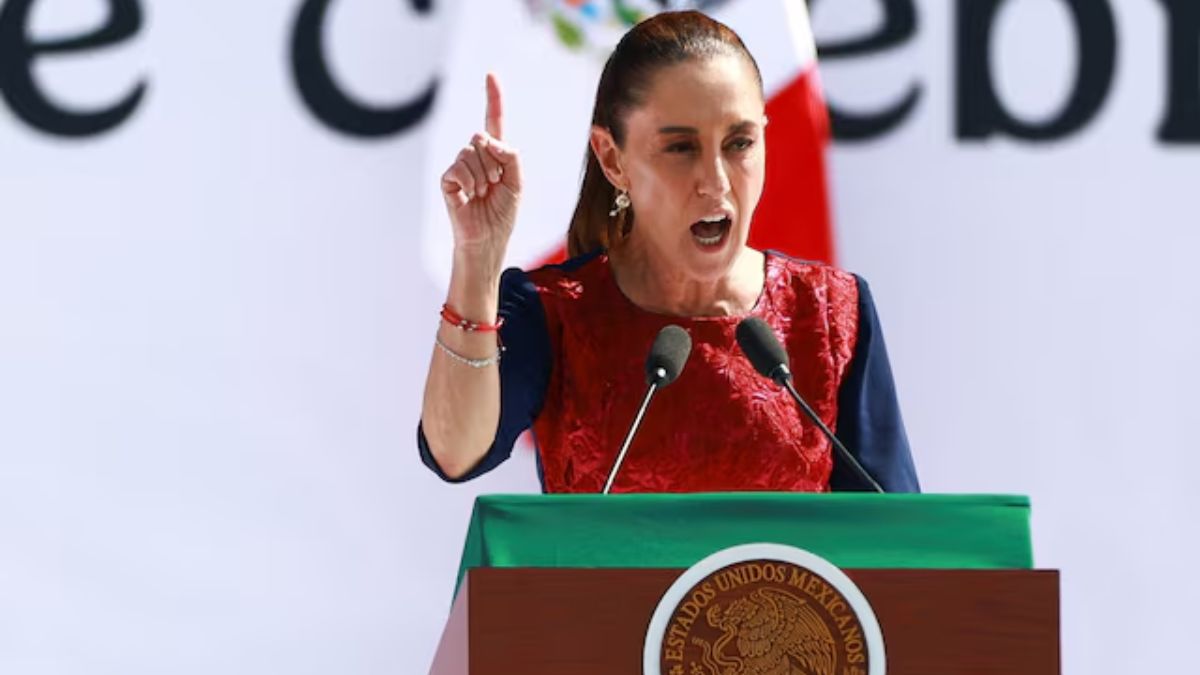
 "Mexico's President Claudia Sheinbaum speaks during an event in Zocalo Square to commemorate 7 years since her party, Morena, came to power, in Mexico City, Mexico December 6, 2025. REUTERS")
Mexican President Claudia Sheinbaum said on Wednesday that about 152,600 migrants have been sent to Mexico since US President Donald Trump took office in January, including non-Mexicans.
The influx is forcing Mexico into a rapid response. Since early 2025, Mexican authorities have begun erecting reception centers and temporary shelters, particularly in northern border cities like Ciudad Juárez, designed to house deportees arriving in waves.
For Mexico, the growing numbers are more than statistical. They pose real logistical, social and humanitarian challenges, especially given that thousands of returnees are not even Mexican citizens but migrants from elsewhere shipped to Mexico when their home countries refused to accept them.
In February 2025 alone, Mexico took in nearly 11,000 deportees, around 2,500 of whom were non-Mexicans. Over the course of the year, further waves of deportations swelled the overall total, reaching the 152,600 mark in December.
This surge is part of a broader push by the US under Trump to crack down on unauthorised immigration. Deportations, third-country removals and termination of certain asylum-processing routes have all been ramped up, fuelling pressure on border and transit-route nations.
To handle the influx, the Mexican government and state authorities had began last January to build tent shelters in border states under a plan known as “Mexico embraces you.”
These centers provide temporary housing, meals, medical aid and assistance obtaining identity documents. Transport services to migrants’ home states are also being organised.
Still, many worry the system may be overwhelmed. The scale is described by local NGOs and migrant-support groups as “unprecedented,” especially given the irregular arrival patterns and the inclusion of non-Mexican migrants whose return to their home countries remains uncertain.
Quick Reads
View AllThe broader implications
For Mexico, the large numbers of deportees sometimes including non-Mexicans raise questions about capacity, humanitarian responsibility and regional cooperation. Some analysts warn that if returnees are not adequately supported, this could destabilise border areas and strain public services.
For the U.S., the use of third-country deportations and aggressive removal policies may temporarily reduce unauthorised migration flows but risks pushing the problem onto neighbours, rather than addressing root causes. Mexico’s experience highlights a key consequence of Trump-era immigration enforcement: immigration pressure hasn’t disappeared — it has shifted.