

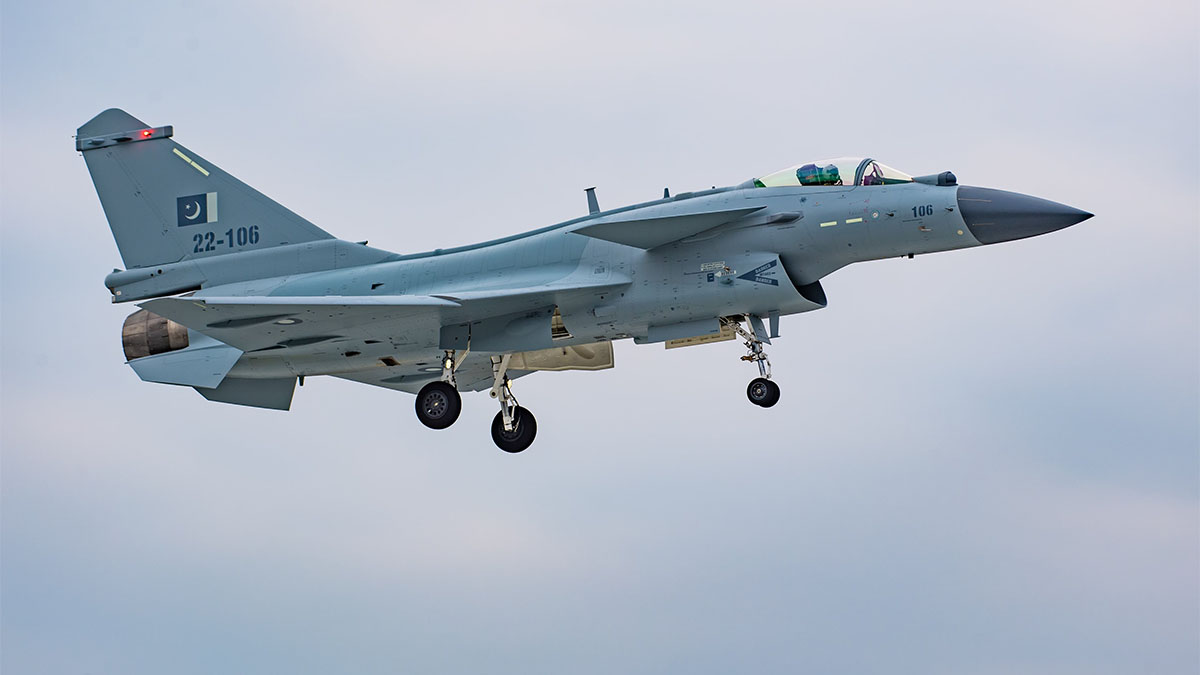
 "Is China raising Bangladesh as second proxy after Pakistan on India’s border?")
With Bangladesh considering upgrades to its ageing fighter jets, including the potential acquisition of China’s J-10C Vigorous Dragon, the security scenario in South Asia is poised for change. Currently led by a government less aligned with India, Bangladesh is rapidly moving closer to China—a trend reminiscent of Pakistan on India’s western front. While Bangladesh looks to enhance its defence capabilities the pace of its alignment with Beijing is striking as it does not has an adversarial relationship with any of its immediate neighbours. However, it fits well in China’s scheme of things of encircling India with military allies.
Bangladesh’s push for modernisation
The Bangladesh Air Force (BAF) operates a fleet of ageing aircraft, including the F-7MG and MiG-29 fighters, which are in urgent need of replacement. Air Chief Marshal Hasan Mahmood Khan’s recent visit to China underscores Dhaka’s ambition to modernise its fleet with multirole combat aircraft and attack helicopters.
According to a South China Morning Post report, Khan attended China’s Zhuhai Air Show and met with officials from the China National Aero-Technology Import and Export Corporation, signalling Bangladesh’s intent to strengthen defence ties with Beijing. Reports indicate that Dhaka is considering acquiring 16 J-10CE fighters, the export variant of the 4.5-generation J-10C, as part of its initial fleet upgrade.
China’s role as a key defence partner
China is Bangladesh’s second-largest arms supplier after Pakistan, having provided trainer aircraft, tanks, vessels and missiles over the years. Past deliveries include 16 F-7MG fighters between 2006 and 2013. The potential acquisition of J-10CE fighters would significantly enhance the BAF’s operational capabilities.
Impact Shorts
More ShortsThe J-10C, often compared to the American F-16, features the advanced WS-10B engine and multirole combat versatility. However, Song Zhongping, a military analyst and former People’s Liberation Army instructor, suggested to the Hong Kong-based newspaper that the cost-effective FC-1 multirole fighter might be a more pragmatic choice, given Bangladesh’s security needs and budget constraints.
Geopolitical ramifications for India
While the deal remains in the planning stage and may take years to materialise, Bangladesh’s potential purchase of J-10C fighters underscores its deepening military cooperation with China. This development could strain relations with India, which closely monitors China’s growing influence in South Asia.
Should Dhaka proceed with the J-10C acquisition, it would become the second South Asian country, after Pakistan, to operate advanced Chinese fighter jets. This move could heighten regional tensions, particularly given India’s sensitivities to China’s strategic manoeuvers along its borders and in the maritime neighbourhood.
Pakistan’s fifth-generation leap: The FC-31 stealth fighter
While Bangladesh eyes the J-10C, Pakistan has taken a significant step forward by announcing plans to procure China’s FC-31 stealth fighter jets in January this year. This fifth-generation aircraft, developed by the Aviation Industry Corporation of China, offers advanced stealth capabilities, situational awareness and a versatile weaponry suite, making it comparable to the US-made F-35.
Pakistan’s acquisition of the FC-31 would mark a generational leap in its air combat capabilities, granting it a strategic edge over India. The Pakistan Air Force (PAF) has seamlessly integrated Chinese platforms like the J-10C, JF-17 and HQ-series missile systems, which positions it to fully exploit the FC-31’s potential.
India’s preparedness
India now faces a dual challenge as both Bangladesh and Pakistan strengthen their air forces with advanced Chinese fighter jets. While Bangladesh’s modernisation may be less of a direct threat compared to Pakistan’s, India is likely monitoring the development carefully.
As of today, the Indian Air Force (IAF) boasts advanced platforms like the Rafale, Sukhoi Su-30MKI and Tejas Mk-1A, equipped with state-of-the-art avionics, weaponry and electronic warfare systems. India’s integrated air defence system (IADS) combines advanced systems like the S-400 Triumf, Akash surface-to-air missiles and a multi-layered radar network creating a robust shield against aerial threats. The S-400 system, with a detection range exceeding 600 km and the ability to engage targets at varying altitudes, ensures effective protection even against advanced stealth fighters.
India’s growing focus on domestic defence production, driven by initiatives such as Atmanirbhar Bharat, is significantly strengthening the IAF’s self-reliance. Projects like the Tejas Mk-2, AMCA and unmanned combat aerial vehicles are expected to further enhance its capabilities, cementing its technological and strategic edge. However, the emergence of advanced Chinese platforms in its neighbours’ arsenals underscores India’s growing concerns about its national security as it pushes to expedite procurement and indigenisation plans.
Broader implications for South Asia
The changing air power dynamics in South Asia highlight the region’s shifting geopolitics. China’s increasing presence, driven by arms sales and defence partnerships, challenges India’s traditional position as a key security provider.
For Pakistan, acquiring the FC-31 is a significant step that could alter the regional power balance, especially if India fails to match its stealth capabilities. For Bangladesh, the potential purchase of the J-10C or similar advanced jets will play a crucial role in shaping its defence strategy and regional position.
Bangladesh’s interest in the J-10C reflects its aim to modernise its air force and boost its strategic independence. However, economic and geopolitical factors make this decision complex.
For India, China’s growing influence in the region calls for a reassessment of its defence strategy. As Bangladesh and Pakistan deepen ties with Beijing, India may soon be reassessing its military modernisation plan.


 "Russian drones over Poland: Trump’s tepid reaction a wake-up call for Nato?")
 "As Russia pushes east, Ukraine faces mounting pressure to defend its heartland")
 "Why Mossad was not on board with Israel’s strike on Hamas in Qatar")
 "Turkey: Erdogan's police arrest opposition mayor Hasan Mutlu, dozens officials in corruption probe")
 "Russian drones over Poland: Trump’s tepid reaction a wake-up call for Nato?")
 "As Russia pushes east, Ukraine faces mounting pressure to defend its heartland")
 "Why Mossad was not on board with Israel’s strike on Hamas in Qatar")
 "Turkey: Erdogan's police arrest opposition mayor Hasan Mutlu, dozens officials in corruption probe")



