

 "‘India Out’ across South Asia: Has Hasina’s exit made neighbourhood more hostile for New Delhi?")
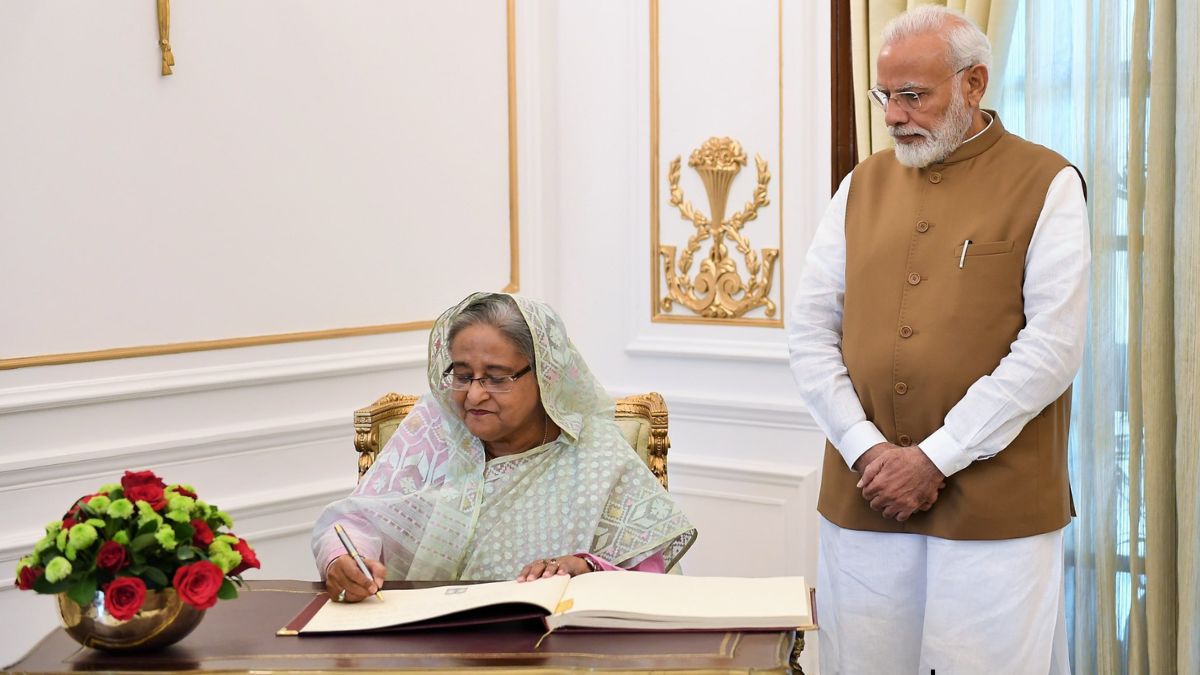
Till last week, Sheikh Hasina was synonymous with Bangladesh and the country had the friendliest regime for India in the subcontinent.
Now, Hasina is out of power and radical mobs are running amok in Bangladesh. The pro-Pakistan and pro-China Bangladesh Nationalist Party (BNP) and Islamist Jamaat-e-Islami have emerged as the main players .
The great turnaround in Bangladesh, say many, is part of the trend in South Asia where leaders friendly to India are being replaced by not-so-friendly regimes. The new leaders are much friendlier to China and Pakistan and that has been seen as a sign of India’s falling clout in the region. The rise of Mohamed Muizzu in the Maldives and KP Sharma Oli in Nepal are cited as examples as part of the trend.
The change of guard in Bangladesh, Maldives, and Nepal have come at a time when Afghanistan continues to be ruled by the Taliban and Myanmar remains embroiled in a civil war. Bhutan appears to be the only oases in the unfriendly desert but there have been winds of change there as well. But is this really that simple?
‘India Out’ across South Asia — is it new?
India is the largest country in South Asia in terms of size, economy, and hard power — and that comes with a cost.
For everything that goes wrong anywhere in the region, fingers are pointed at New Delhi and leaders friendly to India are labelled as Indian stooges. It happened with Hasina, who had long been dubbed by her critics as a prop for New Delhi, and it has previously happened with Ibrahim Solih in the Maldives.
Labelling India as a hegemon that has eyes on their nation’s sovereignty becomes critical to stoking nationalism in their country. The leaders have used the playbook across the region from Nepal to the Maldives and it is not new. Nepal was the first to pioneer this ‘anti-India nationalism’ which successive monarchs and later the prime ministers used to bolster their domestic standing.
Impact Shorts
More ShortsBefore Muizzu or Khaleda Zia’s BNP, King Mahendra of Nepal played the ‘China Card’ in as early as 1960. How Mahendra antagonised India for internal politics explains why anti-India brand of politics has remained popular in the region.
In 1960, after ousting Prime Minister BP Koirala, Mahendra turned to China to balance India that was sympathetic to the Koirala-led democrats of the Nepali Congress. He not only moved Nepal closer to China but also to Pakistan and even visited the country — a well-known Indian adversary. The opposition to India was part of the broader strategy of stoking anti-India sentiments to weave the ‘one nation, one language, one dress’ brand of nationalism.
In his book ‘Battle of the New Republic: A Contemporary History of Nepal’, Prashant Jha notes that Mahendra subtly told India that he could align with China which could leave India’s whole approach of having a buffer state between the two Asian giants in tatters. He further highlighted that Mahendra made the most of the brewing India-China enmity at the time — which continues to this day and has only got worse over time.
“As relations between Nepal’s neighbours to the north and south deteriorated, he played what has come to be known as the ‘China card’, subtly threatening the Indian establishment with the prospect of Nepal developing closer ties with Beijing, both politically and in terms of greater infrastructural connectivity. This would have left India vulnerable on another front. The policy of using the Himalayas as India’s security frontier —as articulated by Nehru— would be in tatters, and Nepal would no longer remain a buffer state under the Indian arc of influence,” wrote Jha in the book.
Since then, Nepali leaders have repeatedly followed the Mahendra’s playbook. King Birendra followed suit and later, when it became a republic, numerous prime ministers did the same — KP Sharma Oli being the latest in the long line of leaders who relied on anti-India sentiments to stoke nationalism for domestic political compulsions. Other leaders in South Asia, whether Muizzu or Zia, have followed the same playbook.
Just like Mahendra utilised the India-China tensions to bolster his position in 1960, now the likes of Muizzu have done the same — if only at a greater scale as the geopolitical stakes have risen.
In the case of Bangladesh, the case of religious fanaticism of Jamaat and inherent pro-Pakistan bent of the BNP have worked to create a new brand of nationalism that brings Islam and anti-India sentiment together. This goes against the original Bangladeshi nationalism of Awami League rooted in Bangla culture and anti-Pakistan movement. But, like Awami League itself, that brand of cultural and ethnic nationalism is now perhaps done and dusted.
Is South Asia really witnessing anti-India wave?
While it is a fact that South Asian nations have witnessed change of guards in a way that have brought leaders not-so-friendly to power, the processes that led to these changes are too diverse to suggest an outright and systematic setback.
In Afghanistan, the takeover of the nation by the Taliban was a result of two decades of war and failure of the Afghan government and its international partners. The deep divisions in the society and the prevalence of Islamic fundamentalism endemic to Afghanistan drove the regime change and India was nowhere in the picture — even if the change of guard was a setback in a sense that India lost a friendly government and the nation became a haven for extremism.
Even though parallels have been drawn between Sri Lanka and Bangladesh in terms of mass movements and expulsion of long-time rulers, the conditions driving the movements in the two countries were starkly different, says Dhananjay Tripathi, who teaches Indian subcontinent’s politics at the South Asia University (SAU), Delhi.
“The Bangladeshi and Sri Lankan movements against their leaders were completely different. In Sri Lanka, the movement was primarily rooted in economic crises as food, fuel, medicines, and other basic necessities were short as a result of the government’s policies. The country was going through a recession and was stuck in a debt trap. The tourism sector had also collapsed because of the Covid-19 pandemic. In Bangladesh, on the other hand, the crisis was sociopolitical in nature. There was great anger against Hasina,” says Tripathi, an Associate Professor at the Department of International Relations at SAU.
In Myanmar, the ongoing civil war is a deeply internal issue where India is not a factor. India has strategic interests there and has to deal with the fallout but, unlike Nepal, Bangladesh, or the Maldives, neither side waged war on the other by invoking India.
In the cases of the Maldives and Nepal, where Muizzu and Oli have come to power on the back of anti-India movements, there are signs that they have already moderated their stance. While Oli had declared to deploy the military against India in border dispute in 2020 and had gone on to claim that Hindu deity Ram was born in Ram and had turned to China full-throttle, he has been cordial in the current term.
There are signs that Muizzu has also moderated his anti-India position to an extent as the fact remains that you cannot run a government in South Asia with overt animosity in India, says Tripathi.
“India is the principal South Asian power in terms of geography, economy, and military. You cannot run a government in the region by sidelining India. India is too important and central for trade and security. There are also diasporas on both sides so you cannot disturb that as well beyond occasional ripples in bilateral ties. Even if you come to power by bashing India, you have to figure out a way to cooperate with India even if out of sheer compulsions. We are already seeing signs of that in cases of the Maldives and Nepal,” says Tripathi.
The case of Bhutan is a bit different. While there is neither a widespread anti-India sentiment among the public nor among the political leaders, there is a China angle there. For years, China has been encroaching on the remote hilly regions of Bhutan and the two countries are eager to strike a deal to settle the disputed boundaries but Bhutan does not wish to do it lest it angers India — the closest economic partner of Bhutan and its security guarantor.
In lieu of a boundary settlement, Bhutan wants investments and an economic revival as the Covid-19 pandemic has battered the country’s finances. The people are increasingly going abroad to settle and work and the domestic economy is suffering. In such a time, the prospects of a deal with China bringing investments in lieu of ceded territory is something that may be appealing to the leadership.
Ever since its formation through the Partition of India, Pakistan has been an adversary to its parent nation. It has launched multiple incursions into India, with at least four turning into wars — in 1947, 1965, 1971, and 1999. Pakistan has long been considered as a nation permanently hostile to India. Besides direct military attacks, it has engaged in an ongoing proxy war through export of terror from its land to India. Even in Bangladesh’s current turmoil, Pakistan’s disruptive role is being suspected. It has been an ambition of Pakistan to keep India unsettled on security front.
Pakistan has got an ‘iron brother’ in China to further its India policy. China, on its part, has long considered India an adversary. Even during the years of ‘Hindi-Chini Bhai-Bhai’, it launched a unilateral invasion of India despite having signed a five-point non-aggression treaty — the Panchsheel. In the era of economic and technological cooperation that deepens globalisation, China has used its production capacity to dump goods in India and needle the country at regular intervals at borders and the Line of Actual Control (LAC).
China launched an ambitious Belt and Road Initiative (BRI) programme through Pakistan-Occupied Kashmir (POK), the territory that is legally claimed by India. In recent years, military skirmishes have taken serious turn, including the Galwan incident in which 20 Indian soldiers and an undeclared number of Chinese personnel lost their lives. China has also tried to create obstacles for India at platforms such as the World Trade Organisation (WTO) or BRICS.
China and Pakistan are believed to be fostering anti-India sentiments across South Asia. Events in Nepal, the Maldives, Sri Lanka, and now Bangladesh have been testimonies to such efforts. Even in Bhutan, China forced a military deadlock over Doklam, the plateau that belongs to Bhutan, which has a security pact India for its defence.
How should India deal with these changes?
While India has been dealing with changing landscapes in the neighbourhood for decades, broadly securing its interests, the approach has come under criticism in recent years. It has been criticised for being reactive as well as partisan — which requires an urgent course-correction now.
In Afghanistan, India did not engage with the Taliban even as everyone was engaging with it. In Nepal, India was accused of having a partisan approach in the early years of the Narendra Modi government, which was corrected shortly but some say considerable damage was still done. In Bangladesh, not just Hasina but India also failed to read the situation.
The solution lies in having a proactive and multi-pronged approach, says Tripathi, the scholar of South Asia at SAU.
“India needs to engage with parties across the aisle proactively. In Afghanistan, when even the United States was engaging with the Taliban, India stayed out of the picture. In Bangladesh too, India had little outreach to anyone other than Sheikh Hasina. This should not be the case. India needs to be flexible in its dealings. Since 2021, India has had to deal with the Taliban and now India will be dealing with the BNP in Bangladesh. Instead of a renewed engagement after regime changes, India should have sustained, proactive engagements with all players,” says Tripathi.
As for China, Tripathi says China is not going anywhere.
“China will stay in the region and will make efforts to get more entrenched. The countries will also turn to China to widen their options and counter-balance India. That’s the reality Indian foreign policy has to manage,” says Tripathi.


 "Russian drones over Poland: Trump’s tepid reaction a wake-up call for Nato?")
 "As Russia pushes east, Ukraine faces mounting pressure to defend its heartland")
 "Why Mossad was not on board with Israel’s strike on Hamas in Qatar")
 "Turkey: Erdogan's police arrest opposition mayor Hasan Mutlu, dozens officials in corruption probe")
 "Russian drones over Poland: Trump’s tepid reaction a wake-up call for Nato?")
 "As Russia pushes east, Ukraine faces mounting pressure to defend its heartland")
 "Why Mossad was not on board with Israel’s strike on Hamas in Qatar")
 "Turkey: Erdogan's police arrest opposition mayor Hasan Mutlu, dozens officials in corruption probe")



