

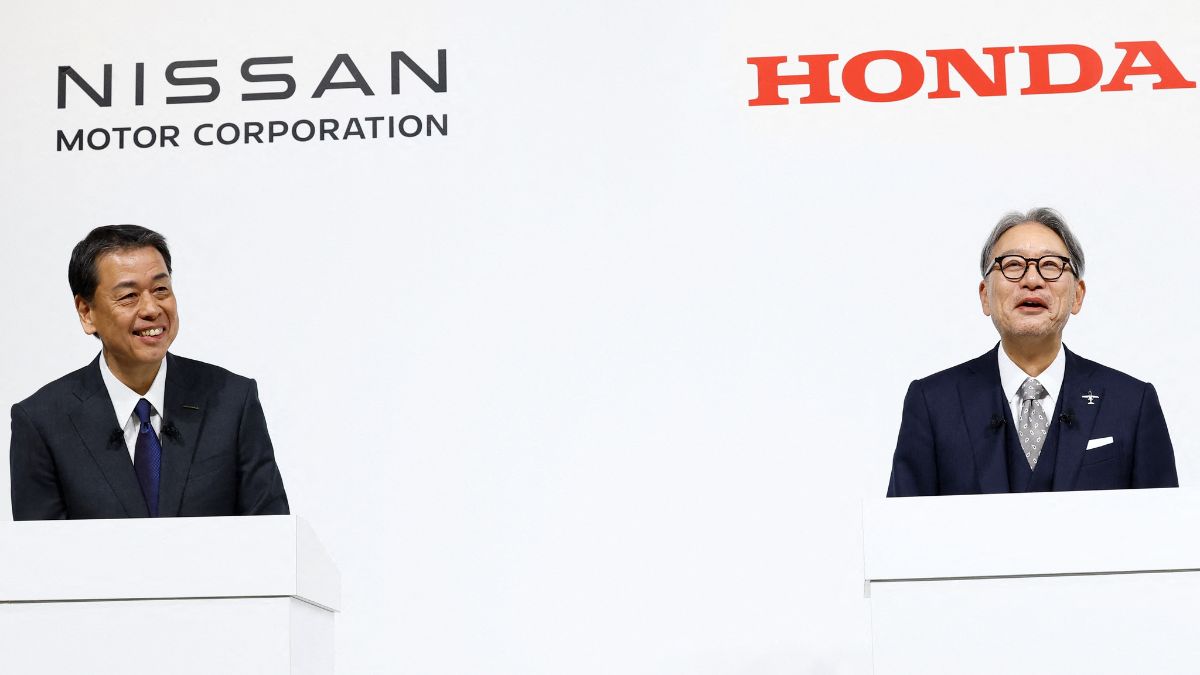
 "Honda & Nissan officially start merger talks to form world's 3rd largest automobile company")
Japanese automakers Honda and Nissan on Monday (December 23) announced they have officially started talks for a merger.
The merger of Honda and Nissan would form the world’s third-largest automobile company after Toyota and Volkswagen.
In a press conference on Monday, Honda CEO Toshihiro Mibe said the two companies needed greater scale to compete amid new technological developments in electric vehicles (EVs) and intelligent mobility and integrating the two companies would give them an “edge that will not be possible under the current collaboration framework”, according to a translation carried by CNBC.
Honda and Nissan aim to conclude merger talks by the end of 2025, following which they would set up holding company by August 2026, as per Reuters.
The two said in a statement carried by the news agency that they aim for combined sales of 30 trillion yen ($191 billion) and operating profit of more than 3 trillion yen through the potential merger.
The Mitsubishi Group, which is Nissan’s strategic partner, has been given the option to join the merger talks as well and has to submit a response by the end of January 2025, according to CNBC.
The announcement of merger talks come at a time when both the automobile industry has been going through a churn in the wake of an evolving industrial landscape. As newcomers, such as Elon Musk’s Tesla and China’s BYD and MG, have shaken up the automobile market, particularly in the industry’s pivot to EVs, legacy automakers have found it hard to compete — particularly as China has been using the might of state subsidies to boost exports and chipping away at foreign automakers’ market shares in their native markets.
Impact Shorts
More ShortsOf the two companies exploring the merger, Nissan has particularly been troubled in recent years. Former Nissan Chairman Carlos Ghosn plunged the company into crisis when he fled to Lebanon by jumping bail in Japan. He remains a fugitive in Japan where he stands accused of financial wrongdoing.
Just last month, Nissan announced it would lay off 9,000 staffers and cut 20 per cent of global production capacity on account of falling sales in key markets of China and the United States. Similarly, Honda also reported worse-than-expected revenue on account of falling sales in China.


 "Russian drones over Poland: Trump’s tepid reaction a wake-up call for Nato?")
 "As Russia pushes east, Ukraine faces mounting pressure to defend its heartland")
 "Why Mossad was not on board with Israel’s strike on Hamas in Qatar")
 "Turkey: Erdogan's police arrest opposition mayor Hasan Mutlu, dozens officials in corruption probe")
 "Russian drones over Poland: Trump’s tepid reaction a wake-up call for Nato?")
 "As Russia pushes east, Ukraine faces mounting pressure to defend its heartland")
 "Why Mossad was not on board with Israel’s strike on Hamas in Qatar")
 "Turkey: Erdogan's police arrest opposition mayor Hasan Mutlu, dozens officials in corruption probe")



